Where to Get Your iPhone 11 Battery Replaced (and How Much It Costs)

iphone 11 battery replacement cost near me: 2 Smart Options

Why Your iPhone 11 Battery Matters (And What to Do When It Fails)

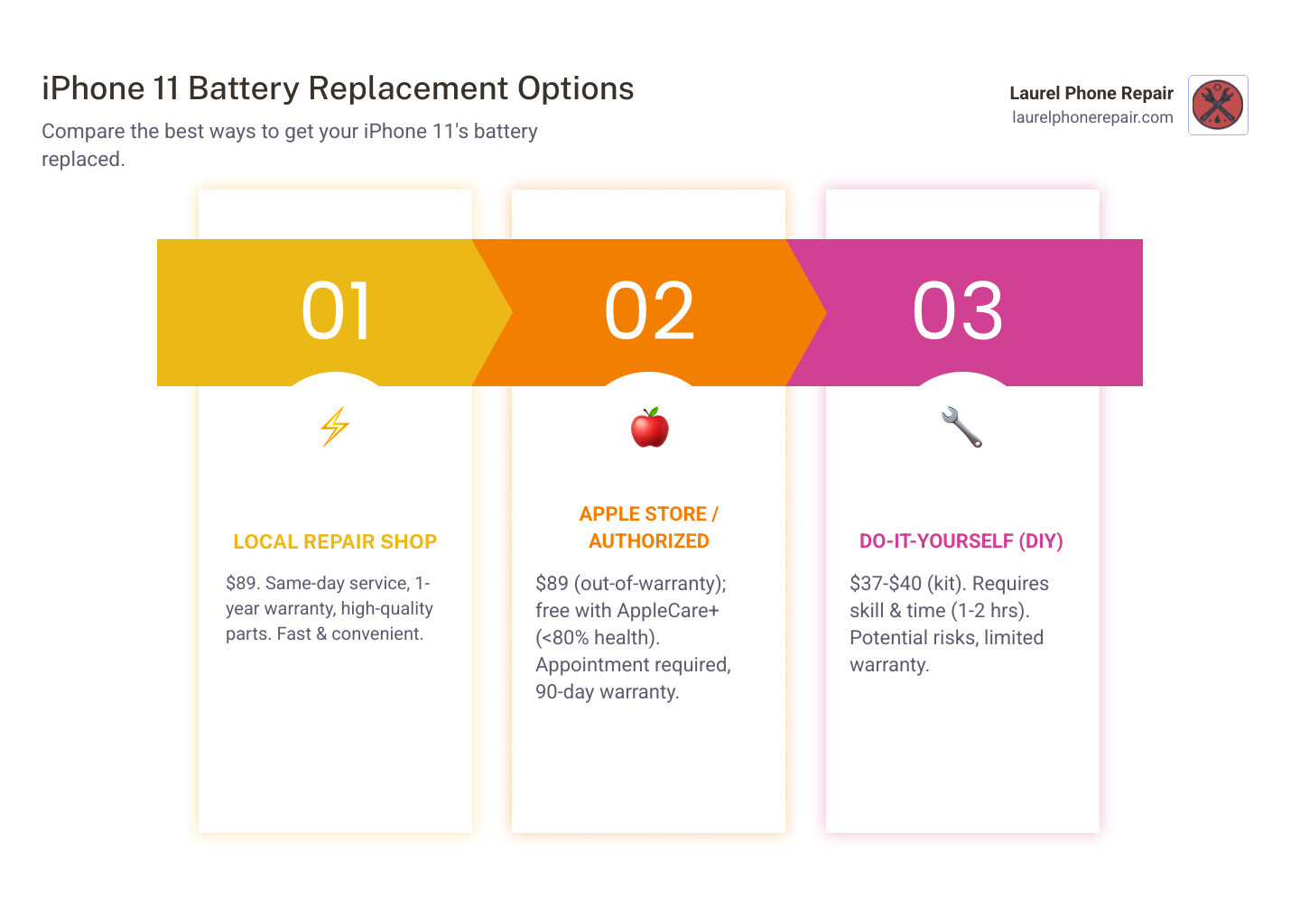
iPhone 11 battery replacement cost near me can vary, but you can generally expect to pay between $37-$40 for a do-it-yourself kit and around $89 for a professional service. Here’s a quick breakdown of your options:

  • Manufacturer or Authorized Service Centers: Typically around $89 for an out-of-warranty replacement. This is often free if you have an extended warranty plan and the battery’s health is below 80%.
  • Local Repair Shop (like Laurel Phone Repair): Competitive pricing, often with the added benefits of same-day service and a robust local warranty.
  • DIY Replacement: The most affordable option at $37-$40 for parts and tools, but it requires 1-2 hours of your time and carries some risk.

Your iPhone 11 was a flagship device, built with a powerful processor and a fantastic camera system that still holds up today. But its battery, like all rechargeable batteries, has a finite lifespan. After about 18-24 months of regular use, most iPhone batteries degrade to roughly 80% of their original capacity. When that happens, you’ll notice your phone slowing down, shutting off unexpectedly, or barely making it through the day without needing a charge. The good news? Replacing your battery is a smart, economical choice that is far cheaper than buying a new phone—and it can give your trusty iPhone 11 several more years of reliable, top-tier performance.

I’m Ralph Harris, and I’ve completed over 500 Apple repair certifications in my 20+ years working with electronics. I’ve seen countless customers searching for iPhone 11 battery replacement cost near me who simply want fast, affordable service without the hassle of shipping their device away or risking a DIY disaster.

Infographic comparing iPhone 11 battery replacement options: Professional repair at local shop shows $89 cost, same-day service, 1-year warranty, and genuine parts; Apple Store shows $89 cost, appointment required, 90-day warranty, and genuine parts; DIY replacement shows $37-40 cost, 1-2 hours time, limited warranty, and requires technical skill with risk of damage - iphone 11 battery replacement cost near me infographic pillar-3-steps

Is It Time for a New Battery? 5 Telltale Signs

We’ve all been there: that moment when your trusty iPhone 11 starts acting less like a reliable companion and more like a moody teenager. Often, the culprit isn’t a major malfunction, but simply a tired battery. iPhone batteries, like all rechargeable batteries, degrade over time and with use. They’re typically rated to hold 80% of their original capacity for up to 500 charge cycles, which usually translates to about 18-24 months for most users. A charge cycle is completed each time you use 100% of your battery’s capacity, whether in one go or over several days. If your iPhone 11 is showing any of these signs, it might be time for a battery refresh:

  1. iPhone Performance Slowdowns: Have you noticed your apps launching slower, scrolling becoming less smooth, or games stuttering? This isn’t your imagination. A degraded battery can’t provide peak power as reliably, so to prevent unexpected shutdowns, Apple’s iOS includes a performance management feature. This feature throttles the iPhone’s processor, deliberately slowing it down to match the battery’s diminished capability. It’s like trying to run a marathon on an empty stomach—your iPhone just can’t give its best performance. A new battery restores its ability to draw full power, making your phone feel snappy and new again.

  2. Unexpected Shutdowns: One of the most frustrating symptoms of a failing battery is when your iPhone unexpectedly shuts down, even when the battery indicator shows a significant charge (say, 20% or 30%). This often happens during power-intensive tasks like gaming, recording video, or even just opening the camera app, especially in cold temperatures. The aging battery can no longer supply the sudden burst of voltage required, causing the device to protect its internal components by shutting down abruptly.

  3. Not Holding a Charge: If you find yourself constantly reaching for your charger, or if your phone’s battery percentage seems to drop dramatically even with light use, your battery’s capacity has likely diminished significantly. What used to last all day now barely gets you through lunch. This is a clear indicator that the battery’s ability to store energy has severely decreased. You might leave the house with 100% charge, only to see it plummet to 50% after an hour of casual browsing. This constant “battery anxiety” is a sure sign a replacement is needed.

  4. Battery Health Below 80%: Your iPhone actually tells you how its battery is doing! You can check your battery’s “Maximum Capacity” by going to Settings > Battery > Battery Health & Charging. This percentage represents its current capacity relative to when it was new. If this number drops below 80%, Apple considers the battery degraded and recommends replacement. At this point, you’ll likely see a “Service” message. This 80% mark is also the threshold for free battery replacement if you have an active AppleCare+ plan. You can Check your coverage status to see if you’re eligible.

  5. Physical Swelling of the Phone: This is a critical and potentially dangerous sign that requires immediate attention. If you notice your iPhone’s screen bulging, separating from the frame, or if there’s a soft spot or visible distortion on the back, it could be due to a swollen lithium-ion battery. This happens when the battery’s internal cells degrade and release gas. Swollen batteries are a serious safety hazard and should be addressed immediately by a professional. Do not continue to charge or use the phone, and absolutely do not try to repair a swollen battery yourself, as puncturing it can lead to a fire or explosion.

If your iPhone 11 is exhibiting one or more of these symptoms, don’t despair! A battery replacement can breathe new life into your device, restoring its performance and extending its usability for years to come.

Your iPhone 11 Battery Replacement Options

When your iPhone 11 battery calls it quits, you essentially have two main paths to consider for replacement: professional service or a do-it-yourself (DIY) approach. Each has its own set of pros and cons related to cost, convenience, and the parts used.

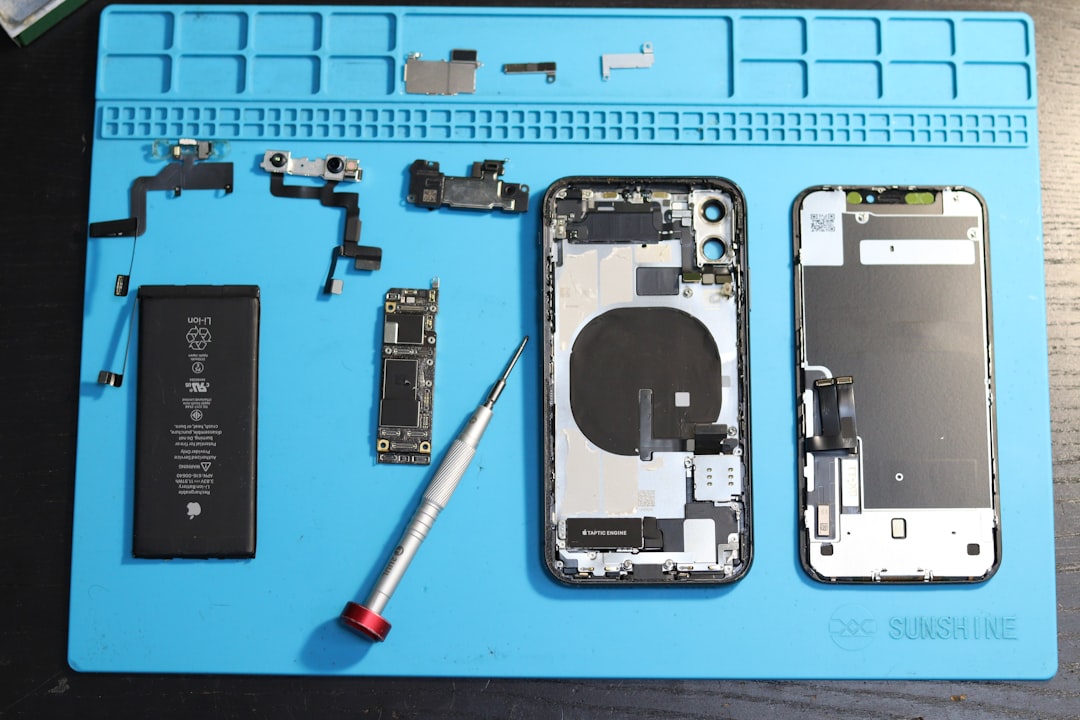
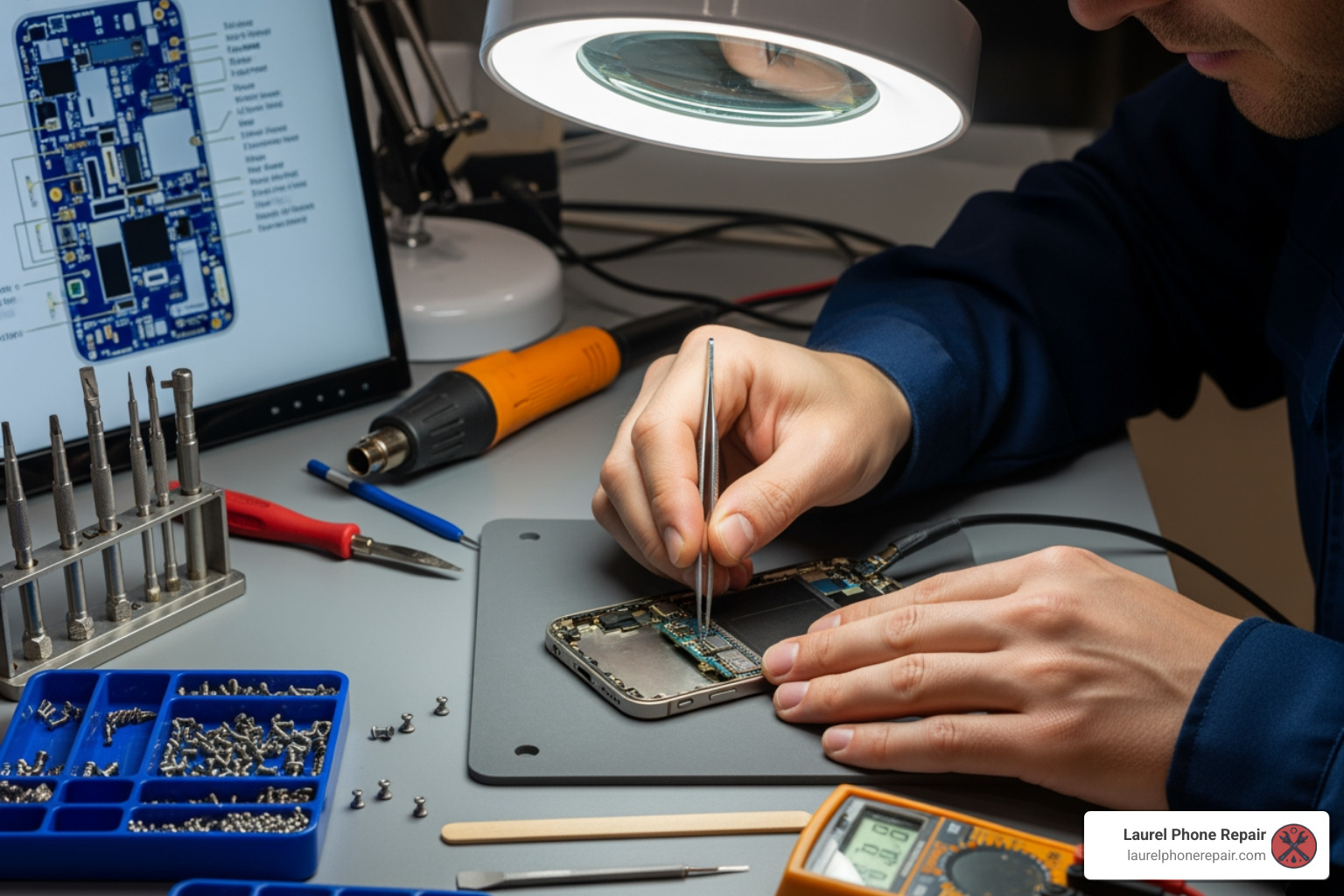
technician working on phone - iphone 11 battery replacement cost near me

Option 1: Professional Service at Laurel Phone Repair

For many, the most straightforward and stress-free option is to bring their iPhone 11 to a professional repair shop like ours. Here at Laurel Phone Repair, with locations in Laurel, Hattiesburg, Jackson, and Jones County, Mississippi, we specialize in making this process as smooth as possible.

  • In-store Service: We offer convenient walk-in service or the option to schedule an appointment online. This means you can drop off your phone at one of our local stores and pick it up when it’s ready, without the hassle of shipping it away.
  • Genuine or High-Quality Parts: We understand the importance of quality. We offer transparent part options, ensuring you get a reliable replacement battery. Our experts use high-quality parts that meet rigorous standards, ensuring your iPhone performs as it should.
  • Warranty Coverage: Your peace of mind is important to us. That’s why we stand behind our repairs with a strong warranty. This means if anything goes wrong with the new battery within the warranty period, we’ve got you covered.
  • Fast Turnaround: We know you can’t be without your phone for long! Most iPhone 11 battery replacements at our shop are completed quickly, often as soon as the same day. Our experienced technicians work efficiently to get your device back in your hands promptly.

Getting an estimate for your iPhone 11 battery replacement is easy. You can visit one of our stores in Laurel, Hattiesburg, Jackson, or Jones County, Mississippi, or simply Get an estimate through our website. We pride ourselves on transparent pricing and excellent customer service.

Option 2: Do-It-Yourself (DIY) Replacement

For the adventurous and tech-savvy among us, replacing your iPhone 11 battery yourself is a viable option. You can purchase DIY kits online that include the battery and all the necessary tools.

DIY iPhone 11 battery replacement kit - iphone 11 battery replacement cost near me

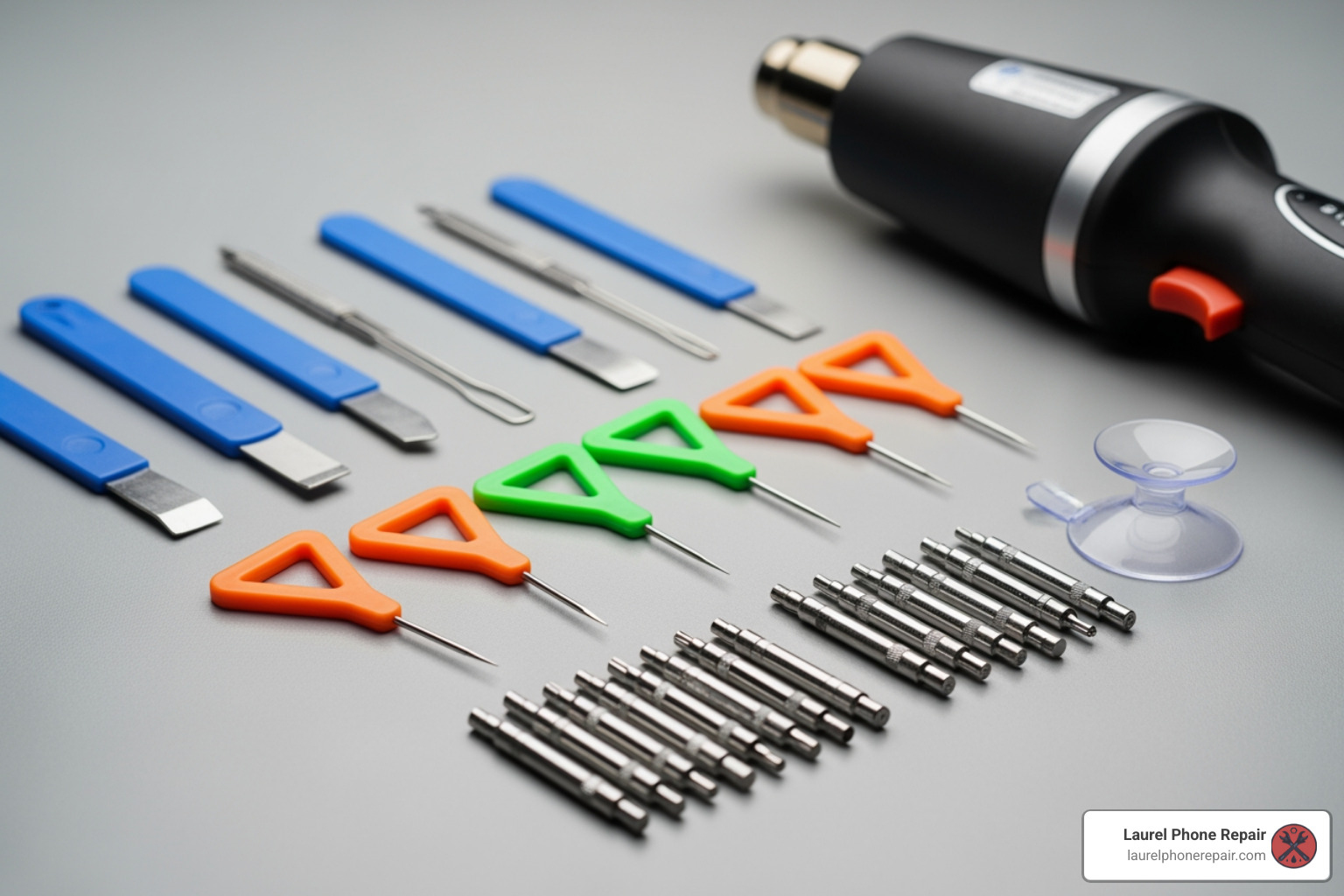
  • DIY Kits: These kits typically come with a new battery, specialized screwdrivers (like pentalobe), opening picks, a suction cup, and adhesive strips. For an iPhone 11, a complete kit can be found online for around $37-$40, which is a significant saving compared to most professional services.
  • Cost Savings: Doing it yourself can indeed save you money on the upfront cost. A DIY replacement can save you around $40-$50 compared to having it professionally serviced.
  • Technical Skill Required: While many online guides offer step-by-step instructions, the process is often rated as “Moderate” to “Difficult.” It involves handling very delicate components, keeping track of dozens of tiny, different-sized screws, and carefully prying open a device sealed with strong adhesives. Patience and a steady hand are an absolute must.
  • Risks Involved: This isn’t for the faint of heart. Lithium-ion batteries can be dangerous if mishandled; accidentally puncturing one with a tool can lead to a chemical fire or explosion. Furthermore, opening the iPhone compromises its factory water-resistant seals, and they must be replaced perfectly to restore any level of protection. There’s also a very high risk of damaging other components, such as the fragile display cables or the intricate Face ID sensor array. A single slip can turn a simple battery swap into a much more expensive screen or logic board repair, negating any initial savings.
  • Voiding Warranty: Performing a DIY repair typically voids any remaining manufacturer’s warranty your iPhone might have. If something goes wrong during or after your DIY attempt, the original manufacturer may refuse to service your device, even for unrelated issues.

Choosing between professional service and DIY depends on your comfort level with electronics, your budget, and how much you value convenience, peace of mind, and warranty protection.

iPhone 11 Battery Replacement Cost Near Me: A Full Breakdown

Let’s explore the numbers and considerations for iPhone 11 battery replacement cost near me. When comparing options, it’s not just about the initial price tag, but also the time involved, the quality of the parts, the warranty you receive, and the potential risks. A cheap DIY kit can quickly become expensive if a mistake leads to a more serious repair.

Here is a side-by-side comparison to help you decide:

Feature Professional Service (Laurel Phone Repair) DIY Replacement
Estimated Cost ~$89 ~$37-$40 (for parts & tools)
Repair Time As little as one hour, often same-day service 1-2 hours (for an experienced person)
Warranty Comprehensive warranty on parts and labor Limited warranty on the part only (if any)
Key Pros Fast, reliable, guaranteed work, no risk to you, water resistance can be reapplied Lower initial cost, satisfaction of doing it yourself
Key Cons Higher upfront cost than DIY High risk of damaging phone, no labor warranty, loss of water resistance, can be time-consuming and stressful

How much does a professional replacement at Laurel Phone Repair cost?

At Laurel Phone Repair, we believe in transparent and competitive pricing. A professional battery replacement for an iPhone 11 typically costs around $89. This price includes the high-quality replacement battery, professional installation by an experienced technician, and our comprehensive warranty that covers both the part and the labor. There are no hidden fees. What you’re quoted is what you pay for a successful, worry-free repair that will have your phone performing like new. For the most current pricing, you can always View our pricing on our website.

What are the costs for a DIY iPhone 11 battery replacement?

The primary appeal of a DIY replacement is the lower initial cost. A DIY kit, which includes the battery and the necessary tools, generally costs between $37 and $40. If you already own the specialized tools (like pentalobe screwdrivers and pry tools), you might be able to find the battery alone for slightly less. However, it’s crucial to factor in the “hidden costs.” This includes the value of your own time (1-2 hours or more for a first-timer) and the significant financial risk if you make a mistake. Damaging the screen, a delicate cable, or the Face ID sensors during the repair can lead to costs that far exceed the price of a professional replacement.

Fast & Reliable Servis Laptop Near Me: Get Your Device Back in Action

Servis Laptop Near Me: Fast & Reliable Fix 2025

Why Finding the Right Local Laptop Repair Service Matters

Servis laptop near me searches spike when your device suddenly won’t start, displays a cracked screen, or refuses to charge—and you need help fast. Here’s what you need to know:

Quick Answer: How to Find Quality Laptop Repair Near You

  1. Search for certified technicians with A+ or manufacturer certifications
  2. Check reviews on Google and other platforms for reputation
  3. Ask about warranties (most reputable shops offer 1-year guarantees)
  4. Request free diagnostics before committing to repairs
  5. Compare turnaround times (many common repairs done same-day)
  6. Verify they use quality parts (OEM or high-grade aftermarket)

The global laptop repair market reached $35.5 billion in 2022 and continues growing—proof that repair is often smarter than replacement. Whether you’re dealing with a cracked screen, dead battery, or mysterious startup failure, understanding your options saves both time and money.

70% of consumers prefer repairing electronics over replacing them, and for good reason. Most laptop issues cost between $50-$300 to fix, far less than buying new equipment. But choosing the wrong repair shop can mean poor parts, voided warranties, or even data loss.

Common signs your laptop needs professional attention include persistent overheating, unusual grinding noises, blue screens of death, and physical damage like cracked displays or liquid spills. While some software issues can be handled at home, hardware problems require experienced technicians with proper tools and training.

I’m Ralph Harris, and with over 20 years in electronics repair and more than 500 Apple certifications, I’ve diagnosed and fixed thousands of laptop issues ranging from simple battery swaps to complex motherboard repairs—expertise I bring to every servis laptop near me search that leads customers to quality local repair options.

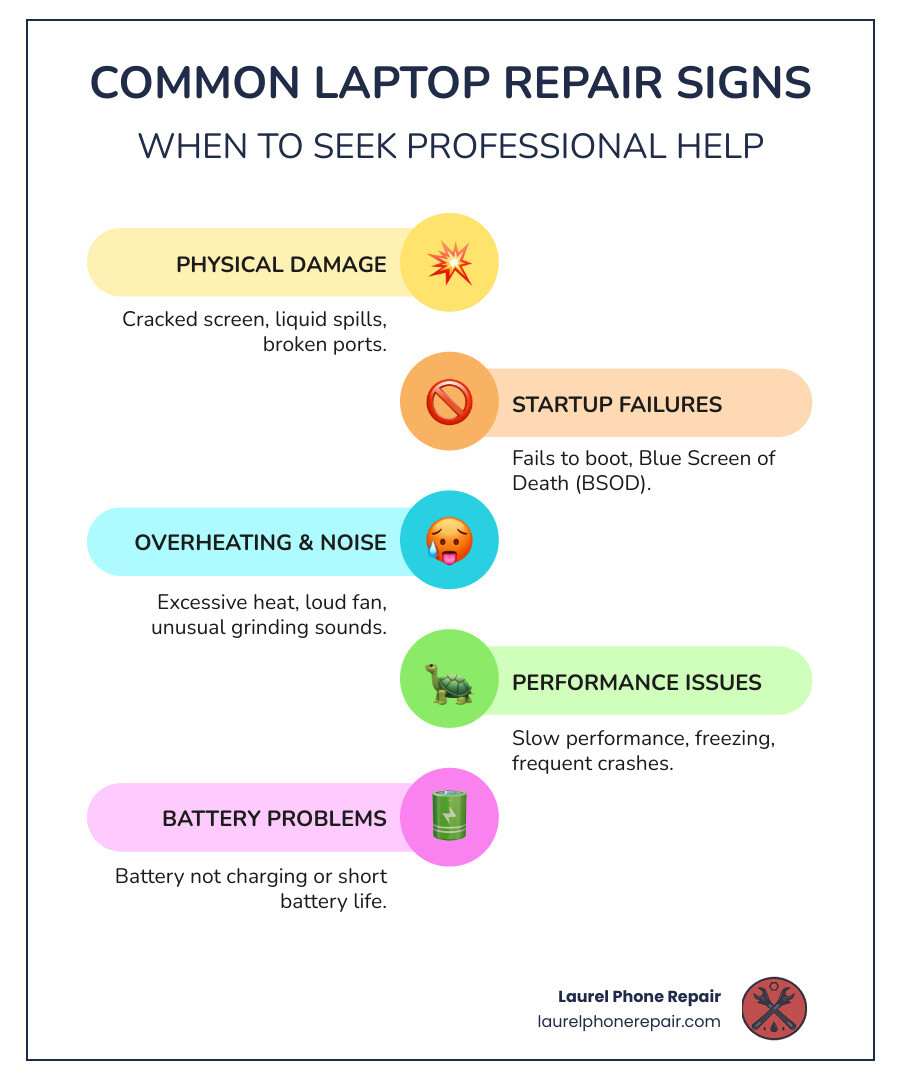
infographic explaining the common signs a laptop needs professional repair: physical damage like cracks or spills, startup failures and blue screens, overheating with loud fan noise, freezing and crashing, battery issues, and slow unresponsive performance - servis laptop near me infographic infographic-line-5-steps-colors

Signs Your Laptop Needs Professional Repair

We’ve all been there: staring at a laptop that just won’t cooperate. But how do you know if it’s a minor hiccup or something that genuinely needs professional attention? Recognizing the signs is the first step to getting your device back in action.

Here are some of the common laptop problems that often require professional repair:

  • Physical Damage: This is probably the most obvious. A cracked screen makes your laptop virtually unusable, and often requires a full replacement. We’ve seen it all, from accidental drops to pets knocking devices off tables.
  • Liquid Spills: The dreaded coffee-soaked keyboard! Liquid damage can be insidious, causing corrosion and short circuits that might not manifest immediately but can lead to severe issues later. If you’ve had a spill, it’s best to get it checked out.
  • Startup Failures: Your laptop refuses to boot up, or it gets stuck on the loading screen. This could indicate issues with your operating system, hard drive, or even the motherboard.
  • Blue Screen of Death (BSOD): A classic Windows error, the blue screen with white text indicates a critical system error that your laptop can’t recover from on its own. It’s often a sign of driver issues, failing hardware, or serious software conflicts.
  • Overheating: Is your laptop getting unusually hot, even during light use? This can lead to component damage and system instability.
  • Loud Fan Noises: If your laptop’s fan sounds like a jet engine, it might be struggling to cool the system, often due to dust buildup or a failing fan component.
  • Slow Performance: Your laptop used to be a speed demon, but now it crawls. This could be due to a full hard drive, too many background programs, a virus, or even failing hardware like RAM or the hard drive.
  • Freezing and Crashing: Your applications stop responding, or the entire system locks up and requires a hard reboot. This can be incredibly frustrating, especially if you’re in the middle of important work.
  • Battery Not Charging / Short Battery Life: Your laptop only works when plugged in, or the battery drains in an hour. This usually points to a failing battery, a faulty charging port, or an issue with the power adapter.

The most common laptop repairs we see include screen replacement, battery replacement, and hard drive repair. These are often straightforward for experienced technicians but can be tricky (and risky) to attempt at home.

When to Skip DIY and See a Pro

While we appreciate a good DIY spirit, some laptop issues are simply beyond the scope of a casual fix. Attempting to repair these yourself can often lead to further damage, making the professional repair more costly, or even rendering your device irreparable.

You should definitely seek professional help if you encounter:

  • Unusual Noises: Grinding, clicking, or repetitive beeping sounds are often indicators of a failing hard drive or other critical hardware components. These are not issues you can fix with a software tweak or a quick restart.
  • Persistent Overheating: If cleaning the vents doesn’t help and your laptop still feels like it’s ready to ignite, there might be a deeper cooling system failure or a component drawing too much power.
  • Failure to Power On: When your laptop is completely unresponsive to the power button, it could be a dead motherboard, a power supply issue, or a critical component failure. This requires specialized diagnostic tools.
  • Major Physical Damage: Beyond a simple cracked screen, if the chassis is bent, ports are damaged, or multiple components are visibly broken, professional disassembly and part replacement are essential.
  • Unresponsive Operating System: If your OS is corrupted to the point where safe mode or system restore doesn’t work, a clean reinstallation might be needed, which can be complex if not done correctly, especially regarding data backup.
  • Data Access Issues: If you can’t access your files, or your hard drive isn’t recognized, data recovery requires specialized tools and expertise. Messing with it yourself can permanently destroy your data.

Software vs. Hardware Problems

Understanding the difference between software and hardware issues can help you describe the problem to us more accurately, leading to a faster diagnosis.

  • Software Issues: These relate to the programs, operating system, and data on your laptop. Common software problems include:

    • Virus and Malware: Unwanted programs that can slow down your system, steal data, or cause crashes.
    • OS Corruption: Your operating system files become damaged, leading to startup problems or instability.
    • Driver Conflicts: Incorrect or outdated drivers can cause hardware components (like graphics cards or Wi-Fi adapters) to malfunction.
    • Slow performance due to too many installed apps or a cluttered hard drive.
  • Hardware Issues: These involve the physical components of your laptop. If a part is broken or failing, it’s a hardware problem. Examples include:

    • Failing Hard Drive/SSD: Data storage unit starts to malfunction, leading to data loss or slow performance.
    • RAM Failure: Issues with your computer’s memory can cause crashes, freezing, and startup problems.
    • Motherboard Problems: The main circuit board of your laptop, if it fails, the entire system can become inoperable.
    • Broken screens, faulty batteries, damaged charging ports, non-functional keyboards, or trackpads.

No matter if it’s a software glitch or a hardware breakdown, our expert technicians are equipped to handle it. For a comprehensive check-up, explore our Device Diagnostics services.

How to Find the Best “Servis Laptop Near Me”

When your laptop is on the fritz, finding a reliable servis laptop near me is paramount. You want a service that’s not just close, but trustworthy, affordable, and quick. Here’s our guide to making the right choice, especially for those of us in Laurel, Hattiesburg, Jackson, and Jones County, Mississippi.

Key Factors for Choosing a “servis laptop near me”

Choosing the right repair service isn’t just about the price tag; it’s about peace of mind and getting a lasting solution. Here’s what we recommend you consider:

  • Reputation and Reviews: Start with online searches for “laptop repair Laurel MS,” “computer repair Hattiesburg MS,” or “laptop service Jackson MS.” Pay close attention to Google reviews and testimonials. What are past customers saying about their experience? Do they mention professionalism, speed, and effective repairs?
  • Technician Experience and Certifications: Look for shops that employ certified technicians. Certifications like A+ indicate a foundational understanding of computer hardware and software. Our technicians at Laurel Phone Repair, for example, are not only A+ certified but also OEM certified, ensuring they’re up-to-date with the latest technology and repair techniques.
  • Warranty on Parts and Labor: A reputable repair service stands behind its work. We offer a 1-year limited warranty on our repairs. This means if the same issue recurs within the warranty period due to our repair, we’ll fix it at no additional cost. Always ask about their warranty policy—it’s your safety net.
  • Transparent Pricing: You shouldn’t have to guess what your repair will cost. A good shop will offer clear estimates after a diagnostic. We provide upfront pricing, so you know what to expect before any work begins. The average cost of laptop repair can range from $50 to $300, depending on the issue and parts needed, and we strive to keep our services affordable.
  • Quality of Parts (OEM vs. Aftermarket): This is a crucial distinction. OEM (Original Equipment Manufacturer) parts are made by the original manufacturer of your laptop. Aftermarket parts are produced by third parties. While aftermarket parts can be more affordable, their quality can vary. We offer transparent part options, allowing you to choose between OEM and high-quality aftermarket parts based on your budget and preferences, ensuring durability and performance.
  • Inquiring about Free Diagnostics: A thorough diagnosis is the first step to any repair. Many reputable shops, including ours, offer free diagnostics to pinpoint the exact problem before proceeding with any repairs. This ensures you only pay for what truly needs fixing.
  • Comparing Turnaround Times: How quickly can they get your laptop back to you? Many repair shops, including ours, offer same-day service for common issues like screen or battery replacements. For more complex problems, expect a few days. Always get an estimated timeline.

For more information about our comprehensive services, visit our services page.

Choosing the Right Local Repair Shop

When you’re looking for a servis laptop near me, you’re not just looking for a repair; you’re looking for a partner to keep your digital life running smoothly. Here’s a table summarizing the key factors to consider:

| Feature | Description Note: Laurel Phone Repair is a trusted local provider offering high-quality parts, cost-effective solutions, and personalized service.

Our commitment to quality repair is unwavering. We know that choosing a local repair shop in Laurel, Hattiesburg, Jackson, or Jones County, Mississippi, is about finding a team that genuinely cares about your device and your data. We pride ourselves on transparent communication, expert knowledge, and delivering excellent results.

The Laptop Repair Process: From Diagnosis to Done

You’ve identified a problem and found a reliable servis laptop near me – congratulations! Now, what happens when you bring your laptop to us? We believe in a clear and structured repair process to minimize your stress and get you back to work or play as quickly as possible.

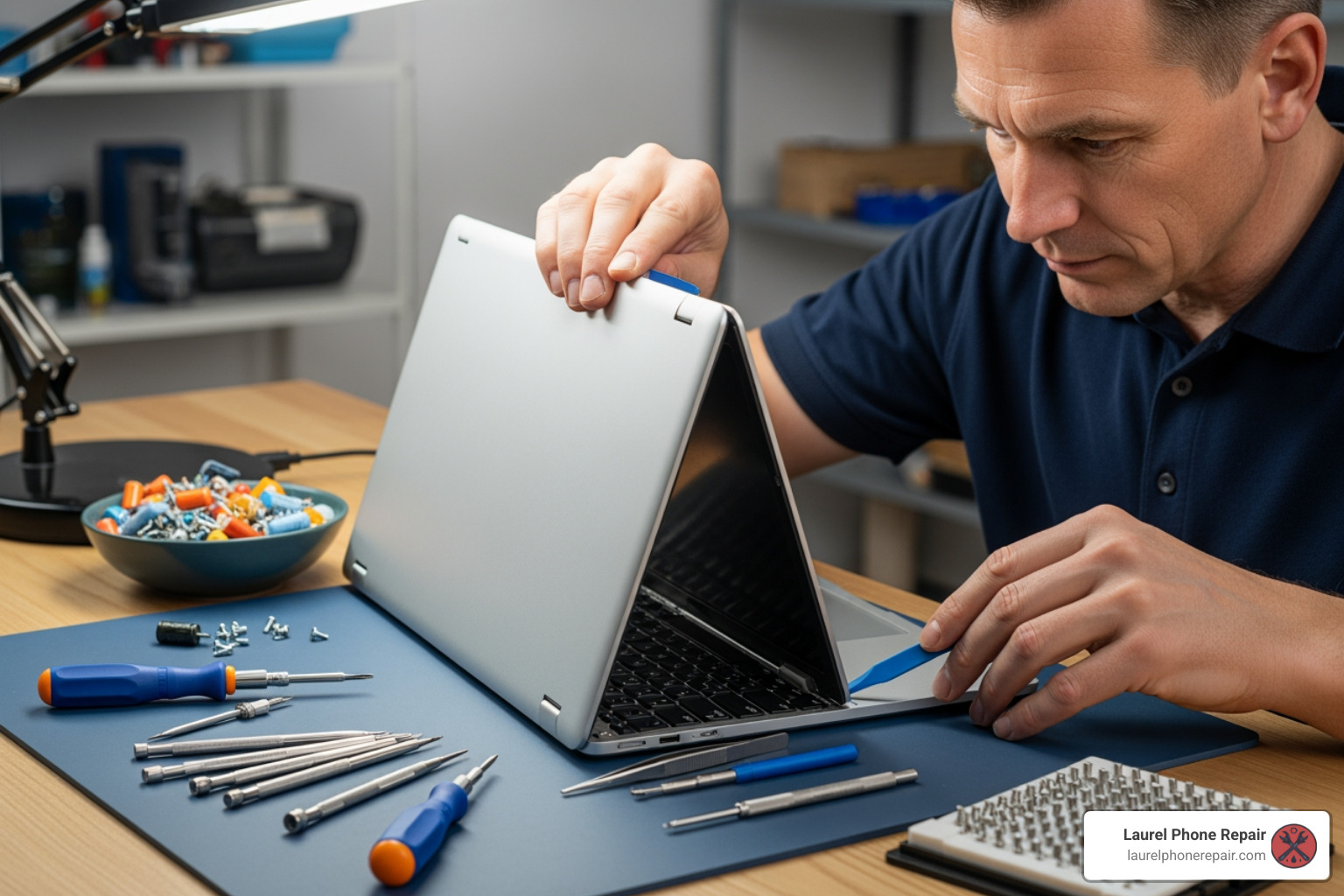
technician disassembling a laptop - servis laptop near me

Understanding Repair Costs and Timelines

One of the first questions we hear is, “How much will this cost?” and “How long will it take?” These are perfectly valid questions, and we strive for complete transparency.

  • Initial Diagnosis: When you bring your laptop to us, our expert technicians will perform a thorough diagnostic. This is a crucial step to accurately identify the root cause of the problem, whether it’s a software glitch or a hardware failure. This initial assessment is often free and helps us provide you with an accurate repair plan.
  • Cost Estimate: Once the diagnosis is complete, we’ll provide you with a detailed cost estimate. This estimate will include the price of any necessary parts and the labor involved. As mentioned, the average cost of laptop repair can range from $50 to $300, but this can vary depending on the specific issue. Factors influencing the price include:
    • Part Cost: Replacing a screen or a motherboard will naturally be more expensive than replacing a charging port.
    • Labor Complexity: Some repairs require extensive disassembly and delicate handling, which can take more time and specialized skill.
    • For a general idea of our pricing, you can visit our Pricing page.
  • Repair Timeline: We understand that you rely on your laptop, so we aim for the fastest possible turnaround. Many repair shops, including ours, offer same-day service for common issues like screen replacements, battery replacements, or quick software fixes. For more complex problems, or if we need to order a specific part, the repair might take a few days. We’ll always give you an estimated completion time.
  • In-Store vs. Mail-in Services: While we focus on local, in-store repairs for immediate service in Laurel, Hattiesburg, Jackson, and Jones County, Mississippi, it’s worth noting that some manufacturers like Dell offer mail-in repair services. These services can take anywhere from 5-7 business days for express service to 12-15 business days for standard service. For us, the benefit of an in-store repair is direct communication, faster turnaround, and personalized service right here in your community.
  • Communication During Repair: We believe in keeping you informed. If any unexpected issues arise or if there’s a delay, we’ll reach out to discuss the options with you.
  • Final Testing: After the repair is complete, we rigorously test your laptop to ensure everything is working perfectly. We want to make sure your device is fully functional before it leaves our shop.

Your Pre-Repair Checklist: What to do before you go for a servis laptop near me

Bringing your laptop in for repair can feel a bit like sending your child off to camp – you want to make sure it’s prepared! Taking a few simple steps before you visit us can protect your data and streamline the repair process.

  1. Backup All Important Data: This is the most crucial step! While we take every precaution, there’s always a small risk of data loss during a repair, especially if the issue is with your hard drive. Copy all essential documents, photos, and files to an external hard drive or cloud storage. This way, even in the worst-case scenario, your precious memories and work are safe.
  2. Remove Confidential Information: If you have highly sensitive personal or business data on your laptop that you can’t back up or feel uncomfortable leaving on the device, consider removing it temporarily if possible. This adds an extra layer of security.
  3. Disable Passwords or Provide Login Details: For us to properly diagnose and test your laptop, we often need to access the operating system. You can either temporarily disable your login password or provide it to us securely. We understand privacy concerns and handle your information with the utmost discretion.
  4. Remove Accessories (Dongles, SD Cards, CDs): Take out any external accessories like USB drives, SD cards, dongles, or CDs/DVDs from the optical drive. These are easily forgotten and can get lost or damaged during transport or repair.
  5. Write Down a Description of the Problem: Even if you’ve already explained it on the phone, a written summary of the issue, when it started, and anything you’ve already tried to fix it can be incredibly helpful for our technicians. Include any specific error messages you’ve seen.

Once you’ve completed these steps, you’re ready to schedule your repair! You can easily do so through our Schedule Repair page.

Frequently Asked Questions about Laptop Repair

We get a lot of questions about laptop repair, and we’re always happy to answer them. Here are some of the most common inquiries we receive when customers are looking for a servis laptop near me.

What kind of warranty should I expect on a laptop repair?

When choosing a repair service, a warranty is a critical indicator of their confidence in their work. We offer a 1-year limited warranty on our repairs. This typically covers:

  • Parts: The specific new part (OEM or high-quality aftermarket) that we installed, ensuring it functions correctly.
  • Labor: The work performed by our technicians to install the part and resolve the issue.

It’s important to understand what a warranty usually doesn’t cover. Generally, warranties exclude:

  • Accidental Damage: New drops, liquid spills, or other physical damage that occurs after the repair.
  • Software Issues: While we can fix software problems, ongoing software conflicts or new virus infections are typically not covered by a hardware repair warranty.
  • New, Unrelated Issues: If your screen was replaced, and a month later your hard drive fails, the hard drive issue would not be covered under the screen replacement warranty.

Always ask for a written guarantee of the warranty terms. This protects both you and the repair shop and ensures clarity on what to expect.

Will my personal data be safe during the repair?

The safety of your personal data is a top concern for us, and it should be for you too. Here’s how we approach data safety and what you can do:

  • Data Privacy Policies: Reputable repair shops, including ours, have strict data privacy policies. Our technicians are trained to respect your privacy and only access what is necessary for the repair.
  • Data Backup Importance: As we stressed in our pre-repair checklist, backing up your data is paramount. While many repairs don’t directly affect your data (like a screen replacement), some, such as hard drive replacements or operating system reinstallations, can lead to data loss if not handled carefully. Having your own backup is the ultimate safeguard.
  • Possibility of OS Reinstallation: In cases of severe software corruption or hard drive failure, an operating system reinstallation might be necessary. This process typically wipes the drive. If you have a backup, we can help restore your files after the OS is reinstalled.
  • Removing Sensitive Files Beforehand: If you have extremely sensitive information, consider moving it off your laptop or encrypting it before bringing it in.
  • Asking the Shop About Their Data Handling Procedures: Don’t hesitate to ask us or any repair service about their procedures for handling customer data. A transparent answer should reassure you.

What information should I have ready when I contact a repair service?

The more information you can provide upfront, the faster and more accurately we can diagnose your laptop’s problem. When you contact us or visit one of our locations in Laurel, Hattiesburg, Jackson, or Jones County, Mississippi, please have the following ready:

  • Laptop Brand and Model: This helps us identify your specific device and any common issues associated with it. For example, “Dell Inspiron 15” or “HP Pavilion x360.” The model number is usually on a sticker on the bottom of the laptop.
  • Description of the Issue: Be as detailed as possible. “My laptop won’t turn on” is good, but “My laptop won’t turn on, and it makes a clicking sound when I press the power button” is even better.
  • Any Error Messages: If you’ve seen any specific error codes or messages (like a “STOP” error on a blue screen), write them down verbatim. These are incredibly valuable diagnostic clues.
  • What You’ve Already Tried to Fix It: Tell us if you’ve tried restarting, running antivirus scans, or any other troubleshooting steps. This prevents us from repeating steps and helps us narrow down the problem.
  • Warranty Status of the Device: Knowing if your laptop is still under its manufacturer’s warranty can sometimes impact repair options or costs, especially if you’re considering an authorized repair center for specific brands like Dell, HP, or Apple. We can often perform repairs that don’t void your manufacturer’s warranty, even if we’re not an authorized center for that specific brand.

laptop repair technician - servis laptop near me

Get Your Laptop Repaired Today

When your laptop acts up, it can bring your world to a halt. From work and school to entertainment and staying connected, a functioning laptop is essential. Trying to steer tech repair can be daunting, but with the right information and a trusted local expert, getting your device back in top shape is simpler than you think.

We’ve covered the common signs that indicate your laptop needs professional attention, the crucial factors to consider when searching for a reliable servis laptop near me, and what to expect during the repair process. Choosing to repair often makes more financial sense than replacing, with the average repair cost significantly lower than a new purchase.

At Laurel Phone Repair, we pride ourselves on being that trustworthy local service for Laurel, Hattiesburg, Jackson, and Jones County, Mississippi. Our experienced and certified technicians are ready to provide transparent diagnostics, quality repairs with excellent parts, and a solid warranty to ensure your peace of mind. We understand the urgency, and we’re committed to fast, reliable solutions that get you back to what matters most.

Don’t let a malfunctioning laptop disrupt your life any longer.
Get your computer repaired with us today!

The Great Ebike Battery Dilemma: When to Replace, When to Repack

Ebike battery replacement: 5 Crucial Signs Guide

Why Your E-Bike Battery is the Heart of Your Ride

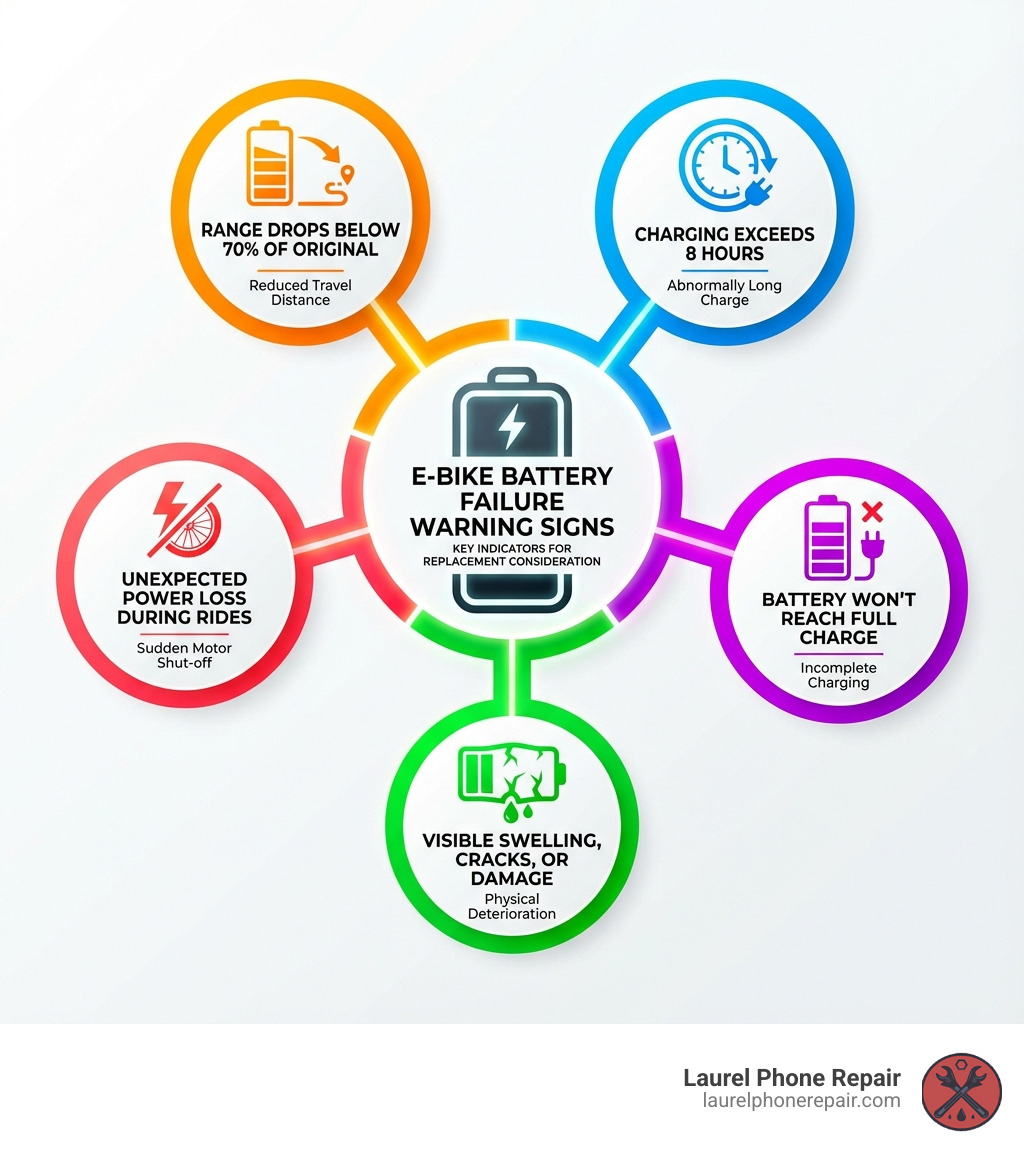
Ebike battery replacement becomes necessary when your electric bike’s power source can no longer hold a charge or deliver the performance you need. Most e-bike batteries last 3-5 years or 500-1,000 charge cycles before requiring replacement. Key signs include:

  • Reduced range – Your bike doesn’t travel as far on a full charge
  • Slow charging – The battery takes much longer to reach full capacity
  • Power cuts – The motor unexpectedly shuts off during rides
  • Physical damage – Visible swelling, cracks, or leaks in the battery case
  • Won’t hold charge – The battery drains rapidly even when not in use

No power for the motor means no range—on an e-bike, nothing works without the battery. Your electric bicycle battery is the heart of your ride, defining its power, range, and reliability. Over time, all lithium-ion batteries lose capacity through normal use, typically around ten percent each year. Eventually, you’ll face an important decision: should you replace your battery entirely, or explore repacking options?

Understanding when and how to replace your e-bike battery can save you hundreds of dollars while keeping your ride running smoothly. The market offers numerous options, from original manufacturer batteries to third-party alternatives, but choosing the wrong one can create safety risks or void your warranty. Temperature extremes, improper charging habits, and using incompatible chargers can all shorten battery life or create hazardous conditions.

I’m Ralph Harris, and with over 20 years of experience in electronics repair, I’ve diagnosed and replaced countless batteries across various devices, including the growing field of ebike battery replacement for customers seeking to extend their ride’s lifespan. This guide will help you identify failing batteries, understand your replacement options, and make the safest choice for your e-bike.

infographic showing five key warning signs of ebike battery failure: decreased range below 70 percent of original, charging time exceeds 8 hours, unexpected power loss during rides, battery won't reach full charge, and visible physical damage like swelling or cracks - Ebike battery replacement infographic

Is It Time for a Change? Recognizing a Failing Battery

You’re out enjoying the scenic paths around Laurel, Hattiesburg, or Jackson, Mississippi, when suddenly your e-bike feels sluggish, or worse, completely cuts out. These aren’t just minor inconveniences; they’re often the tell-tale signs that your e-bike battery is waving a white flag. Recognizing these signals early can prevent you from being stranded and help you make an informed decision about ebike battery replacement.

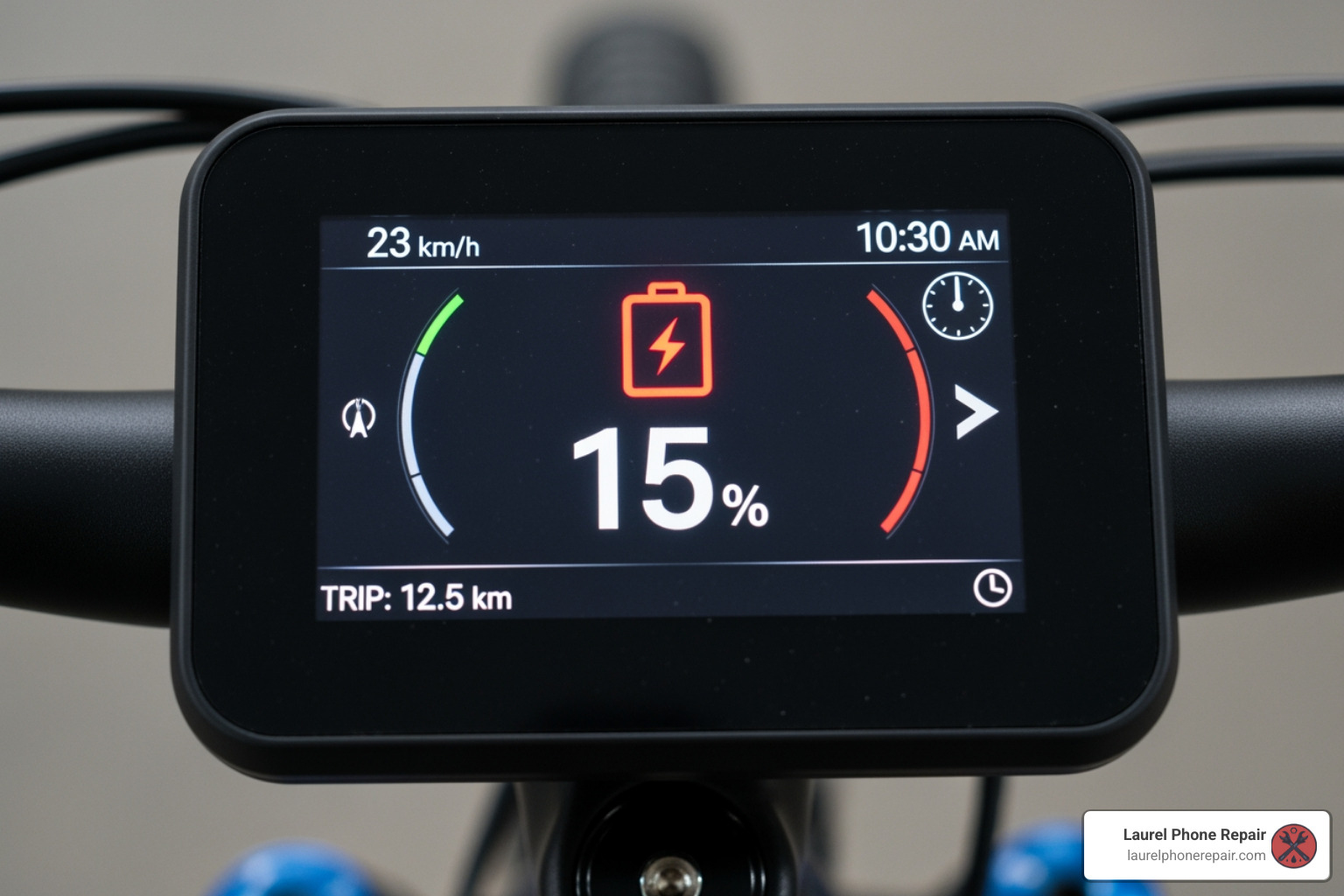
ebike display showing low battery warning - Ebike battery replacement

Here’s what to look for:

  • Reduced Range: This is one of the most common indicators. If your bike used to take you 40 miles on a charge, but now it’s only managing 20 or 25, your battery has likely lost a significant portion of its capacity. A rider might not notice a small capacity loss at first, but it becomes apparent with regular use.
  • Slower Acceleration and Less Power: A healthy battery provides consistent power to your motor, giving you that satisfying boost. If your e-bike struggles on inclines that were once easy, or acceleration feels noticeably weaker, the battery might not be delivering power efficiently. For instance, while a 48V battery generally delivers more power and better hill-climbing than a 36V, a degrading 48V battery will still show a marked decline in performance.
  • Power Cutting Out Unexpectedly: Imagine cruising down a street in Jones County, and your e-bike suddenly dies. This is a critical sign. If your battery runs out very quickly, allowing only a few kilometers of range, replacement should be considered. Weak batteries can die mid-ride and may even damage the bike’s motor or control unit due to inconsistent power delivery.
  • Failure to Hold a Full Charge: You charge your battery overnight, only to find it’s already lost a bar or two by morning, or it drains rapidly even when not in use. This indicates a significant internal issue.
  • Long Charging Times: While a new battery might take a few hours to fully charge, an aging one might take excessively long, or never quite reach 100%.
  • Physical Damage: This is perhaps the most serious warning sign. Any visible swelling, cracks, or leaks in the battery case are red flags. Swelling indicates internal cell damage, which can be a significant fire hazard. If you notice any physical damage, stop using the battery immediately. If a battery is leaking, we urge you to call us immediately for guidance.

How Battery Age Affects Your Ride

Just like any rechargeable device, your e-bike battery doesn’t last forever. The total lifespan of a quality lithium-ion e-bike battery is typically 500 to 1,000 charge cycles, translating to 3-5 years of use. Manufacturers of e-bikes and e-bike drives often recommend replacing the battery after four to five years, or after 500 to 1,000 charge cycles, whichever comes first.

The primary culprit behind reduced performance is capacity loss. E-bike batteries lose approximately ten percent of their capacity each year due to charging and general use. This gradual decline means that over time, your battery simply can’t store as much energy as it once could.

This capacity loss directly impacts your e-bike’s performance:

  • Reduced Range: As discussed, less stored energy means shorter rides.
  • Diminished Power Output: A battery with lower capacity struggles to provide the consistent, high-power bursts needed for acceleration or tackling hills. This can lead to your e-bike feeling less responsive and making those Mississippi hills a real workout.
  • Inconsistent Performance: You might experience erratic power delivery, with the motor feeling strong one moment and weak the next.

Your e-bike battery is the heart of your ride, defining its power, range, and reliability. Replacing an e-bike battery restores smooth, powerful performance and reduces the stress of constantly watching your battery gauge.

Decoding Your E-Bike’s Power Source

Before diving into ebike battery replacement, it’s crucial to understand the different types of batteries out there. E-bike manufacturers have gotten creative with battery placement, influencing both aesthetics and function.

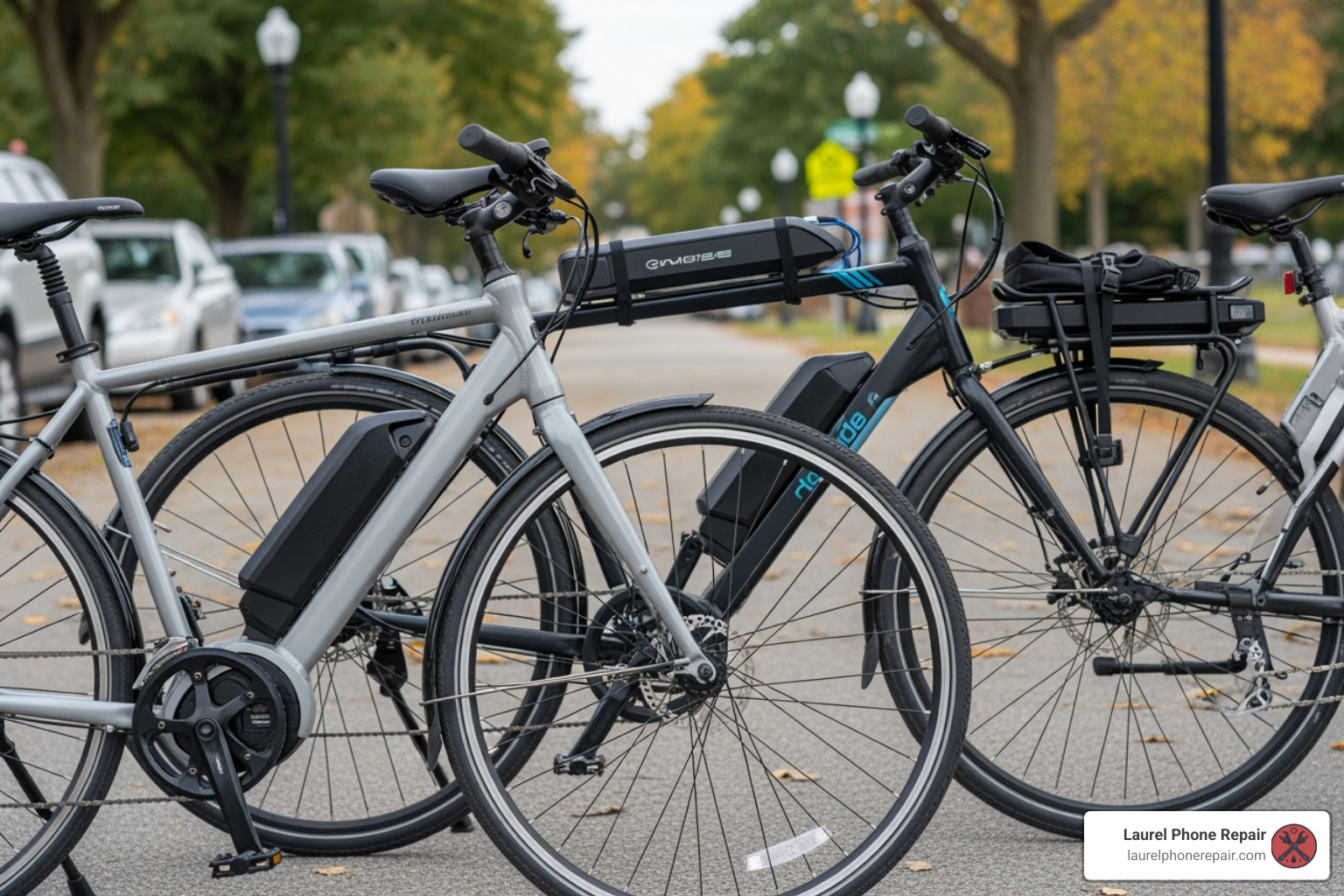
three main types of e-bike batteries: integrated, external, and rack-mounted - Ebike battery replacement

The three primary physical form factors you’ll encounter are:

  • Integrated Batteries: These batteries are designed to be seamlessly hidden within the e-bike’s frame, often in the downtube. They offer a sleek, clean look, making the e-bike resemble a traditional bicycle. While aesthetically pleasing, their replacement can be more complex, often requiring specialized tools and expertise. For fully integrated batteries, we always recommend letting a specialist handle the replacement due to the intricate wiring and frame integration.
  • External Downtube Batteries: This is a very common design where the battery attaches to the downtube of the frame, but it’s clearly visible and easily removable. These are generally simpler to remove and install, making DIY replacement more feasible for some riders.
  • Rack-Mounted Batteries: These batteries are typically found on the rear rack of the e-bike. They are often easy to access and remove, making them a practical choice for commuters who might want to charge their battery separately or carry a spare.

The physical form factor significantly impacts the bike’s handling, aesthetics, and convenience. For example, a heavy rack-mounted battery can shift the bike’s center of gravity, while an integrated battery keeps the weight low and central for better balance.

Understanding Key Specifications

When it comes to ebike battery replacement, numbers matter. Understanding the key specifications—Voltage, Amp-hours, and Watt-hours—is vital for choosing a compatible and effective replacement.

  • Voltage (V): This dictates the power output of your e-bike. Common voltages are 36V and 48V, though some go higher. A 48V battery delivers more power more efficiently than a 36V battery, resulting in faster acceleration and better hill-climbing. A 48V system can provide the same amount of power to the motor while drawing less electrical current (amps) than a 36V system, which improves overall efficiency. When replacing your battery, it’s crucial to match the original voltage of your e-bike’s motor system.
  • Amp-hours (Ah): This measures the battery’s capacity, essentially how much “fuel” it can hold. A higher Amp-hour rating means a larger fuel tank and, consequently, a longer range. Generally, if the voltage and physical connectors match, using a battery with a higher Ah rating is a great way to increase your range.
  • Watt-hours (Wh): This is arguably the most important metric for judging an e-bike’s total range. Watt-hours are calculated by multiplying Volts (V) by Amp-hours (Ah). For instance, a 48V 10Ah battery has 480Wh. A 672Wh battery might offer a range of 27 miles under heavy use or up to 45 miles in ideal conditions. Your real-world results will vary, but a higher Wh rating always provides a greater potential range.

Every e-bike battery also contains a sophisticated Battery Management System (BMS). This is the “brain” of the battery, a critical component that monitors and controls its performance and safety. The BMS protects the battery from overcharging, over-discharging, overheating, and short-circuiting. It also balances the charge across individual cells, maximizing their lifespan. Sometimes, a BMS entering a protective “sleep mode” can mimic a dead battery, which is why a professional diagnosis is often the first step in addressing battery issues.

Your Guide to Ebike Battery Replacement

So, you’ve determined your e-bike battery needs replacing. The next step is navigating the process to ensure you get the right fit and avoid potential headaches.

The journey to a successful ebike battery replacement starts with careful selection and ends with proper installation.

Choosing the Right Ebike Battery Replacement

Finding the correct replacement battery for your specific e-bike model is paramount. It’s not just about voltage and capacity; physical fit and connector compatibility are equally important.

  1. Match Specifications:

    • Voltage (V): Always match the original voltage of your e-bike system. Using an incorrect voltage can damage your motor and controller.
    • Amp-hours (Ah): You can often upgrade to a higher Ah battery (for more range) if it physically fits and is compatible with your motor’s power draw.
    • Watt-hours (Wh): Consider this for total range potential. Wh = V x Ah.
  2. Physical Fit and Connectors:

    • Mounting: Ensure the new battery’s mounting mechanism (e.g., downtube, rack, integrated) matches your bike’s frame.
    • Dimensions: Even if the type is correct, check the battery’s length, width, and height to ensure it fits without obstruction.
    • Connectors: The battery’s power output connector and charging port must be identical to your e-bike’s system and charger.

The average cost of an e-bike battery replacement can be a significant investment, often ranging from several hundred to over a thousand dollars, depending on the model, brand, and specifications. This is why making an informed decision is so important.

When considering options, you’ll generally encounter two categories:

Feature Original Manufacturer (OEM) Batteries Third-Party Batteries
Pros – Guaranteed compatibility – Often more affordable
– Assured quality and performance – Wider availability, especially for older models
– Maintains e-bike warranty (if applicable) – Potential for custom capacities/configurations
Cons – Generally more expensive – Variable quality and reliability
– Availability can be limited for older models – May void e-bike warranty
– Less flexibility in capacity upgrades – Risk of safety issues (fire hazards, poor BMS) if from an unknown source
– Compatibility issues (physical fit, connectors, BMS communication)
Recommendation Always the first choice if available and within budget. It ensures optimal performance and safety. Proceed with extreme caution. Prioritize reputable third-party brands known for quality and safety certifications. Using a non-original replacement pack potentially introduces all sorts of uncontrolled risks and may void the e-bike warranty.

Safety Certifications: Regardless of whether you choose OEM or a third-party option, always look for crucial safety certifications. For instance, UL Certified, Hazmat Safety Certified (UN38.3), and batteries that have passed third-party technical lab safety tests are indicators of quality. UL 2849 for e-bikes and UL 2271 for e-bike battery packs are critical safety certifications to look for. These certifications ensure the battery has undergone rigorous testing for electrical, mechanical, and fire safety. You can learn more about these standards here: E-Bikes Certification and Testing to UL 2849 – UL Solutions.

DIY vs. Professional Ebike Battery Replacement

The temptation to save a few dollars by attempting a DIY ebike battery replacement can be strong. However, we strongly advise against it for most integrated or complex battery systems, and even for simpler external batteries if you’re not experienced.

DIY Risks:

  • Fire Hazard: Lithium-ion batteries store significant energy. Improper handling, short-circuiting cells, or using incorrect tools can lead to overheating, thermal runaway, and dangerous fires or explosions. True cell replacement for e-bike batteries is a highly specialized and dangerous task not recommended for home users.
  • Electrical Shock: High voltage can deliver a nasty shock.
  • Voiding Warranty: Most e-bike manufacturers will void your warranty if you attempt unauthorized repairs or use non-approved parts.
  • Damage to Your E-bike: Incorrect installation can damage the battery, the e-bike’s electronics, or the motor. For instance, with non-removable frame integrated batteries, DIY replacement can get tricky in a hurry.

When to Seek Professional Help:
For the safety of yourself and your e-bike, we recommend professional assistance in the following scenarios:

  • Integrated Batteries: These are complex to access and replace.
  • Uncertainty: If you’re unsure about compatibility, installation, or diagnosing the issue.
  • Complex Issues: If the problem seems to stem from the BMS or motor controller rather than just a dead battery. Specialist technicians have analysis tools to diagnose battery issues accurately. A professional diagnosis is the first step for battery issues, as a BMS entering protective sleep mode can mimic a dead battery.

Our experienced technicians at Laurel Phone Repair specialize in battery diagnosis and replacement. We offer transparent part options and are committed to high customer satisfaction with warranties on our work. You can find more information about our services here: More info about professional battery repair.

Smart Habits: Maximizing Your Battery’s Lifespan

Once you have a new or healthy battery, adopting smart habits can significantly extend its lifespan and maintain optimal performance on your rides through Mississippi.

  • Charging Best Practices:
    • Charge Regularly, Avoid Extremes: Charge your battery after each ride and as soon as possible when it’s low. Avoid letting it drain completely. Lithium-ion batteries have no “memory effect,” so partial charges are fine.
    • Partial Charging is Key: For the longest lifespan, try to keep your battery’s charge between 20% and 80% when possible.
    • Avoid Overnight Charging (Unless Smart Charger): While many modern chargers have cut-off features, it’s best to avoid leaving your battery plugged in overnight unless you have a smart charger that automatically stops charging when full.
  • The 40-80% Storage Rule: For long-term storage (more than a few weeks), it is recommended to keep the battery charged between 40% and 80% (or 40%-70%). Store it in a cool, dry place.
  • Using the Correct Charger: Always use the official charger that came with your battery or a manufacturer-approved replacement. Using aftermarket chargers not tested for your specific battery can damage it, create a safety hazard, or even void your warranty. Using a charger that comes from the original manufacturer helps it sync well with the battery and avoid overloading.
  • Temperature Effects on Performance: Temperature is a battery’s best friend and worst enemy.
    • Ideal Charging Temperature: The recommended charging range for e-bike batteries is between 41°F to 77°F (5°C to 25°C). Charging outside this range, especially in very hot conditions (above 100°F or 38°C), can stress the battery and shorten its life.
    • Ideal Riding Temperature: The recommended use (riding) temperature range for e-bike batteries is 5°F to 105°F (-15°C to 40°C). Extreme cold can reduce range and power, while extreme heat can cause permanent damage. Storing a battery above 131°F (55°C) can cause permanent range decline or critical failure.
    • Storage Temperature: Recommended long-term storage range is 40°F to 77°F (5°C to 25°C). Avoid storing in freezing temperatures or excessively hot environments.

For more in-depth knowledge on prolonging battery life, we recommend resources like: How to Prolong Lithium-based Batteries – Battery University.

The Final Step: Safe Disposal and Future Tech

Your e-bike battery, like all electronics, eventually reaches the end of its useful life. Proper disposal is not just good practice; it’s an environmental responsibility.

What to Do With Old Batteries:
Never throw your old e-bike battery in the regular trash. These batteries contain valuable materials and hazardous chemicals that require specialized recycling. Ideally, take your old e-bike battery back to the dealer you bought it from, who will send it on for recycling.

In the US, the industry is actively setting up recycling schemes. Call2Recycle, for example, coordinates a network of battery drop-off locations, often at independent bike shops. This makes it easier for you to responsibly dispose of your old battery. You can find a recycling location near you through their website: Find a recycling location with Call2Recycle.

Latest Advancements:
The world of e-bike batteries is constantly evolving. Looking ahead, we anticipate exciting advancements that will further improve performance, safety, and sustainability:

  • Solid-State Batteries: These next-generation batteries promise higher energy density, faster charging, and improved safety compared to current lithium-ion technology.
  • Faster Charging: Innovations are continually pushing the boundaries of how quickly batteries can be recharged, reducing downtime between rides.
  • AI-Managed BMS: Artificial intelligence integrated into Battery Management Systems will offer even more precise control over battery health, optimizing performance, predicting issues, and extending lifespan.
  • More Eco-Friendly Recycling: Efforts are underway to develop more efficient and environmentally sound methods for recycling battery components, reducing waste and recovering valuable materials.

Frequently Asked Questions about E-Bike Batteries

How long does a typical e-bike battery last?

A quality lithium-ion battery typically lasts 3-5 years, or between 500 and 1,000 full charge cycles, before its capacity significantly diminishes. This lifespan is influenced by factors like charging habits, storage conditions, and riding temperatures. Manufacturers often recommend replacement after four to five years or after 500 to 1,000 charge cycles.

Can I upgrade to a battery with a higher capacity (Ah)?

Generally, yes. As long as the voltage of the new battery is the same as the original (e.g., replacing a 48V battery with another 48V battery), using one with a higher Amp-hour (Ah) rating is a great way to increase your range. A higher Ah simply means the “fuel tank” is bigger. Just ensure the new battery will physically fit on your bike’s mount and that its maximum continuous discharge current can support your motor. Always double-check physical dimensions and connector types before purchasing.

Are e-bike batteries from different brands interchangeable?

Usually, no. E-bike batteries are specifically designed to work with particular motor systems, controllers, and physical mounts. While some manufacturers might have cross-compatible batteries within their own product lines (e.g., certain Bosch PowerPack models), generally, you should only replace a battery with one that comes from the same manufacturer and is of exactly the same specifications. Using an incompatible battery can be dangerous, may damage your e-bike’s electrical system, and will likely void your warranty. Using a non-original replacement pack potentially introduces all sorts of uncontrolled risks.

Conclusion: Power Up Your Ride with Confidence

Navigating ebike battery replacement might seem daunting, but with the right knowledge, it’s an opportunity to revitalize your ride. We’ve explored the tell-tale signs of a failing battery, the critical specifications to consider, and the nuanced choices between OEM and third-party options. We’ve also emphasized the paramount importance of safety, urging caution against risky DIY repairs and advocating for professional assistance when needed.

Smart charging habits and proper storage are your battery’s best friends, significantly extending its life. And when the time finally comes, responsible recycling ensures your old battery doesn’t harm our environment.

By making informed decisions, you’re not just replacing a part; you’re investing in countless more miles of joyful, confident riding. For expert diagnosis, professional ebike battery replacement services, or any battery-related concerns for your e-bike, trust the experienced technicians at Laurel Phone Repair. We’re here to keep the heart of your ride beating strong.

Get a quote for your battery repair today

How Much Does a New Battery Really Cost?

Battery Replacement Cost: Save Big 2025! Ultimate Guide

Why Understanding Battery Replacement Costs Matters

Battery replacement cost varies significantly depending on what you’re replacing. Here’s what you need to know right away:

Quick Cost Overview:

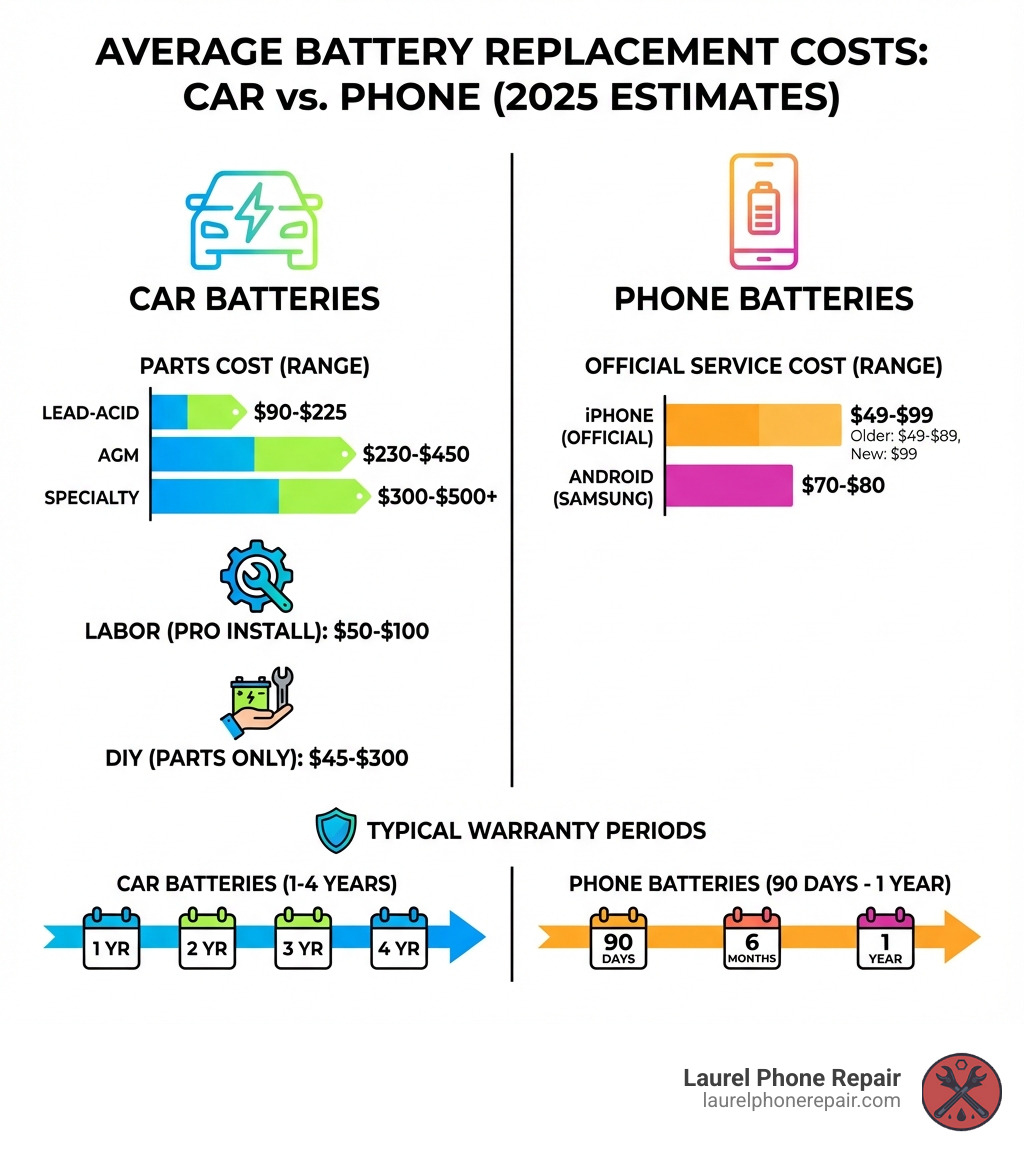
  • Car Batteries: $100 – $400+ (parts only)
  • Car Battery Labor: $50 – $100 (if professionally installed)
  • iPhone Batteries: $49 – $99 (official Apple service)
  • Android Phone Batteries: $70 – $80+ (varies by model)
  • DIY Car Battery: $45 – $300 (parts only, self-install)

Whether you’re dealing with a dead car battery on a cold morning or a phone that dies by lunchtime, a failing battery brings your day to a halt. The good news? Replacing a battery is almost always cheaper than buying new—and it’s often simpler than you think.

The challenge is understanding what you should actually pay. Prices swing wildly based on battery type, your vehicle or device model, where you get service, and whether you’re getting genuine parts or aftermarket alternatives. A standard car battery might cost $100, while a premium AGM battery for a luxury SUV could hit $400. Similarly, an official iPhone battery replacement runs $99, but third-party shops may charge less—or more, depending on part quality.

Making smart decisions starts with knowing the real costs. Are you paying for genuine parts or aftermarket? Does the quote include labor and disposal fees? Is there a warranty? Understanding these factors helps you avoid overpaying and ensures your device or vehicle gets back to peak performance without breaking the bank.

I’m Ralph Harris, and with over 20 years in electronics repair and thousands of battery replacements under my belt, I’ve seen how battery replacement cost confusion leads people to make expensive mistakes. My goal is to break down exactly what you should expect to pay—and why—so you can make the right choice for your situation.

infographic comparing average battery replacement costs - battery replacement cost infographic

Infographic showing: Car batteries range from $100-$400 depending on type (Lead-Acid $90-$225, AGM $230-$450, Specialty $300-$500+). Phone batteries range from $49-$99 for official service (iPhone 14/15: $99, older models: $49-$89; Samsung Galaxy models: around $70-$80). Labor adds $50-$100 for car batteries. Warranty periods vary from 1-4 years for car batteries, 90 days to 1 year for phones.

Decoding Car Battery Replacement Costs

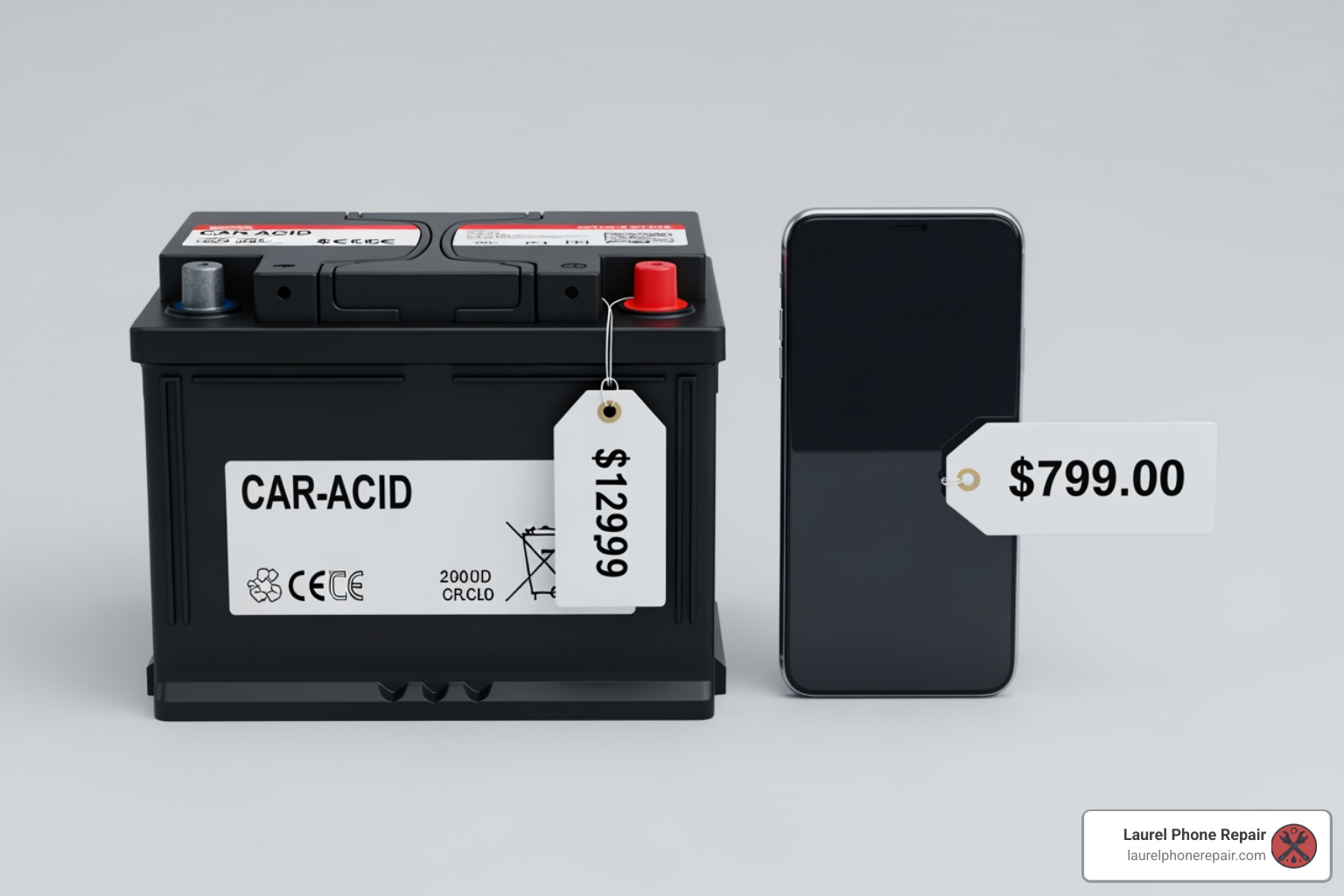
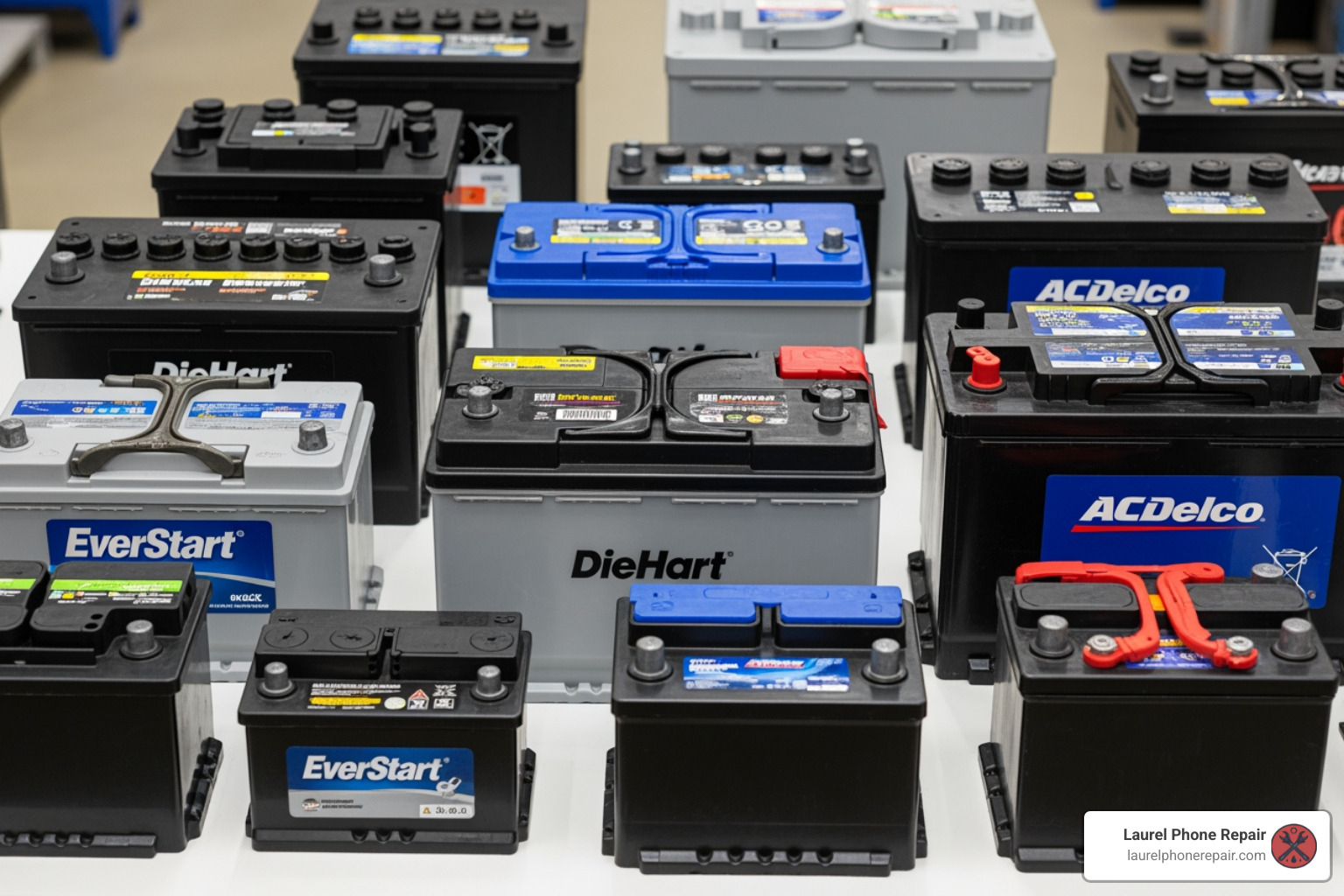
different types of car batteries - battery replacement cost

When your car battery calls it quits, the first question on your mind is likely, “How much is this going to set me back?” The battery replacement cost for your vehicle can range significantly, typically falling between $100 and $400 for the battery itself. However, this is just a starting point. Labor costs, battery type, and even where you live in Mississippi can influence the final bill.

For a standard passenger vehicle, you might expect to pay anywhere from $100 to over $300 for the battery. But if your car demands a premium or specialty battery, that price can climb to $400 or more. Labor for professional installation usually adds another $39 to $100 to the total. This is why getting a reliable quote from local shops in Laurel, Hattiesburg, Jackson, or Jones County is crucial. Many auto service centers in our area offer battery services that can provide you with an accurate estimate.

Factors Influencing Car Battery Replacement Cost

Several key elements come into play when calculating your car’s battery replacement cost:

  • Vehicle Make and Model: This is a big one. A compact car might only need a smaller, less expensive battery. However, a luxury SUV, a truck, or a diesel engine often requires a larger, more powerful battery with specific features, significantly increasing the cost. For instance, a battery for a large truck in Jackson might cost more than for a sedan in Laurel.
  • Engine Size and Electrical Demands: Larger engines require more power to start, meaning a more robust battery. Modern vehicles, especially those with start-stop technology, high-end audio systems, or numerous power-hungry electronics, place greater demands on the battery, often necessitating advanced battery types.
  • Battery Specifications:
    • Cold Cranking Amps (CCA): This rating indicates how much power a battery can deliver to start an engine in cold temperatures. Batteries with higher CCA ratings are more expensive but are vital for reliable starts, especially during colder Mississippi winters.
    • Reserve Capacity (RC): This measures how long your battery can power essential accessories if your alternator fails. A higher RC means more time to get to safety, and typically, a higher price tag.
  • Climate Impact: Believe it or not, the Mississippi heat can be tougher on car batteries than the cold. While cold weather highlights battery weakness, extreme heat accelerates battery degradation. Car batteries in warmer climates, like ours, might only last 3 to 4 years, compared to 5 years or more in cooler regions. This means you might need to replace your battery more frequently, impacting your long-term battery replacement cost.

Battery Types, Brands, and Warranties

The type of battery your vehicle needs is a primary driver of its battery replacement cost.

Battery Type Cost Range Lifespan (Approx.) Performance
Lead-Acid (Flooded) $90 – $225 3-5 years Most common, suitable for basic vehicles.
AGM (Absorbent Glass Mat) $230 – $450+ 4-6 years Better suited for vehicles with start-stop technology, high electrical demands, or luxury features. Handles deep discharges better.
Specialty/Premium $300 – $500+ 5+ years Designed for specific applications (e.g., performance vehicles, hybrids, some newer 12-volt systems use lithium-ion). Offers improved features like vibration resistance or spill-proof designs.
  • Lead-Acid (Flooded): These are the traditional car batteries, filled with liquid electrolyte. They are the most affordable option, typically ranging from $90 to $225. While reliable for most standard vehicles, they are less durable than their AGM counterparts, especially under heavy electrical loads.
  • AGM (Absorbent Glass Mat): Gaining popularity, AGM batteries encapsulate the electrolyte in fiberglass mats. This design makes them more resistant to vibration, spill-proof, and capable of handling deeper discharges, making them ideal for modern vehicles with advanced electronics or start-stop systems. Their cost usually falls between $230 and $450.
  • Brand Reputation: Just like with any product, trusted battery brands often come with a higher price tag. However, many drivers are willing to pay for the peace of mind that comes with proven quality and reliability. We always recommend reputable brands that have strong industry reviews.
  • Warranty Impact: A battery’s warranty significantly affects its overall value and initial battery replacement cost. Batteries with longer warranties, especially those with an extended free-replacement period (e.g., 24-48 months), tend to cost more upfront. However, this investment can save you money if the battery fails prematurely. Always compare warranties, noting the difference between free replacement and prorated coverage, where reimbursement decreases over time.

Understanding Smartphone & Device Battery Replacement Cost

technician replacing smartphone battery - battery replacement cost

Is your phone barely making it to lunchtime? You’re not alone. A common frustration, a dying phone battery often leads people to consider a new device. But here’s a secret: replacing the battery is often a much smarter choice. It’s not just about saving money; it’s about extending your device’s lifespan and making a more environmentally conscious decision. Many devices, like those we repair in Laurel, Hattiesburg, Jackson, and Jones County, Mississippi, work like new after a fresh battery.

The signs of a failing smartphone battery are usually pretty clear:

  • Your phone dies unexpectedly, even when showing 20% or 30% charge.
  • The battery drains rapidly, even with minimal use.
  • Your phone feels sluggish, as older batteries can lead to performance throttling.
  • The battery health percentage (found in your phone’s settings) is below 80%.

If you’re experiencing any of these issues, we offer free diagnostic checks at our locations. This allows our experienced technicians to assess your device and determine if a battery replacement is the right solution.

Typical Smartphone Battery Replacement Cost

The battery replacement cost for a smartphone can vary, but it’s almost always a fraction of the price of a new phone.

  • Official Apple Service: For iPhones, Apple provides battery service directly. The out-of-warranty price for newer models (like iPhone 14 or 15) is typically $99. For earlier models, the cost can range from $49 to $89. You can use Apple’s “Get an estimate” tool on their support page to check the specific cost for your model. If you have AppleCare, your battery might be replaced at no additional cost if its capacity falls below 80% of its original capacity.
  • Third-Party Providers: Many reputable third-party repair services, like us, offer competitive pricing for iPhone and Android battery replacements. While specific costs vary by model, you can often find prices in the $49 – $99 range for common smartphone models. For example, battery replacements for popular Android models, like the Samsung Galaxy series, can cost around $70 to $80. We strive to provide transparent pricing and high customer satisfaction with our battery services.

Additional fees might apply if other issues are found during inspection, or for shipping if you send your device in. Our local services avoid these shipping fees and provide clear estimates upfront.

OEM vs. Aftermarket Parts and Other Devices

When it comes to smartphone and device battery replacements, you’ll often encounter discussions about part quality.

  • Genuine (OEM) Parts: These are parts made by or for the original equipment manufacturer (e.g., Apple, Samsung). When available, they offer the assurance of being designed and tested to the manufacturer’s exact safety and performance standards. Apple emphasizes the use of genuine Apple batteries for their service.
  • High-Quality Aftermarket Batteries: These are third-party manufactured parts that aim to match the quality and performance of OEM parts. They can be a more affordable option while still providing excellent performance. At Laurel Phone Repair, we offer transparent part options, discussing the pros and cons of each choice so you can make an informed decision based on your budget and preferences. Our experienced technicians ensure that any part we use meets our high standards for quality and performance.
  • Impact on Performance and Safety: Using low-quality aftermarket batteries can lead to performance issues, reduced lifespan, or even safety risks. That’s why choosing a reputable repair provider who sources high-quality parts is paramount. We prioritize your safety and device longevity above all else.
  • Tablets and Computers: The battery replacement cost isn’t limited to just cars and smartphones. Tablets and computers also have batteries that degrade over time. Costs for these devices can vary widely based on the model, complexity of the replacement (some laptop batteries are internal and require significant disassembly), and part availability. Our expertise extends to these devices too, offering quick and affordable repairs for tablets and computers.

To get a precise estimate for your device, you can always View our repair pricing on our website or simply drop by one of our locations in Laurel, Hattiesburg, Jackson, or Jones County.

How to Find a Fair Price and Avoid Hidden Fees

Navigating battery replacement costs can feel like a maze, but with a few smart strategies, you can find a fair price and avoid unexpected charges. Whether it’s for your car or your phone, being an informed consumer pays off.

  1. Get Multiple Quotes: This is perhaps the most critical step. Don’t settle for the first estimate you receive. Call or visit a few local shops in Laurel, Hattiesburg, Jackson, or Jones County, Mississippi. For car batteries, consider auto parts stores, independent mechanics, and even dealerships. For phones, check official service centers and reputable third-party repair shops like ours. Compare not just the price, but also what’s included.
  2. Check Online Reviews: A quick search can tell you a lot about a repair shop’s reputation for fair pricing, quality work, and customer service. Look for consistent positive feedback regarding their transparency and reliability.
  3. Understand the Warranty: Always ask about the warranty on both the new battery and the labor. For car batteries, warranties can range from 1 to 4 years, often with a free replacement period followed by a prorated period. For phone batteries, Apple offers a 90-day guarantee on their service, while many third-party shops, including ours, provide a 1-year limited warranty. A strong warranty indicates a shop’s confidence in their parts and workmanship.
  4. Parts and Labor Guarantees: Ensure the quote clearly separates parts and labor costs. Ask if the parts are genuine (OEM) or high-quality aftermarket, and how that affects the price and warranty. We pride ourselves on transparent part options and high customer satisfaction with our warranties.

Questions to Ask a Repair Shop Before Service:

  • What is the total battery replacement cost, including parts and labor?
  • What type of battery will be used (e.g., standard lead-acid, AGM, OEM, aftermarket)?
  • What is the warranty period for the new battery and the installation?
  • Are there any diagnostic fees, and are they waived if I proceed with the repair?
  • Are there any additional fees (e.g., core charges for car batteries, disposal fees, shop supplies)?
  • How long will the repair take?

Potential Hidden Fees:

  • Core Charges (Car Batteries): When you buy a new car battery, you might be charged a “core fee.” This fee is refunded when you return your old battery for recycling. It’s designed to encourage proper disposal of hazardous materials. Make sure you’re aware of this and bring your old battery back!
  • Disposal Fees: Some shops may charge a small fee for disposing of your old battery, whether it’s a car or phone battery.
  • Shop Supplies: A minor charge for miscellaneous items like cleaning solutions, rags, or terminal protectors might be added. These should be clearly itemized.

By asking the right questions and comparing options, you can ensure you’re getting a fair and accurate price for your battery replacement cost without any unpleasant surprises.

Frequently Asked Questions about Battery Replacement

How long should a car or phone battery last?

This is one of the most common questions we hear, and the answer depends heavily on the type of battery and how it’s treated.

  • Car Battery Lifespan: On average, a car battery should last between 3 to 5 years. However, this can vary significantly.
    • Climate Impact: Here in Mississippi, our hot climate can be particularly harsh on car batteries. Extreme temperatures accelerate the chemical reactions inside the battery, leading to faster degradation. While cold weather can make a weak battery fail, heat does more damage over time. You might find your car battery lasting closer to 3 or 4 years in our region.
    • Usage Habits: Frequent short trips where the alternator doesn’t have enough time to fully recharge the battery can shorten its life. Leaving lights on or doors ajar can also drain a battery completely, which can be detrimental to its long-term health.
  • Phone Battery Lifespan: Smartphone batteries, typically lithium-ion, are designed to retain about 80% of their original capacity after 500 charge cycles, which usually translates to about 2 to 3 years of typical use.
    • Charge Cycles: A charge cycle is one full discharge and recharge. Regularly charging your phone from 0% to 100% counts as one cycle. If you often charge it from 50% to 100%, that’s half a cycle.
    • Usage Habits: Heavy usage, prolonged exposure to extreme temperatures (like leaving your phone in a hot car), and constantly letting your battery drain to zero can all accelerate its decline.

Is it better to replace the battery or buy a new device?

This is a critical decision, especially for smartphones, and it almost always leans towards replacement for both your wallet and the planet.

  • Cost-Benefit Analysis:
    • Repair is Cheaper: The battery replacement cost for a phone (typically $49-$99) is a fraction of the cost of a new device (often $500-$1,000+). For cars, a new battery ($100-$400) is far less than a new car. It’s a simple, low-cost way to extend the life of your existing investment.
    • Device Age and Support: If your phone or car is relatively new and otherwise in good condition, a battery replacement can give it a new lease on life for another year or two (for phones) or several years (for cars). This allows you to delay a much larger purchase.
  • Environmental Impact: Replacing a battery rather than the entire device is a sustainable choice. It reduces electronic waste and conserves the resources required to manufacture new devices. As Consumer Reports rightly points out, “Replacing the battery is a simple, low-cost way to extend the life of your phone.” We believe in the power of repair to keep devices out of landfills.

Can I replace a battery myself?

The answer here depends largely on the type of battery and your comfort level with DIY repairs.

  • Car Battery DIY: For many older car models, replacing the battery yourself is a straightforward task.
    • What’s Involved: You’ll need basic tools like a wrench, battery terminal cleaner, and potentially a battery puller. The general steps include disconnecting the negative terminal first, then the positive, removing the old battery, cleaning the tray and terminals, installing the new battery, and connecting the positive terminal first, then the negative.
    • Risks: There’s a risk of electrical shock, damaging vehicle electronics (especially in newer cars with complex systems), or improper installation. Some car batteries are located in hard-to-reach places (e.g., under seats, in the trunk), requiring specialized knowledge or tools. If you’re not confident, it’s always best to leave it to the professionals.
  • Phone Battery DIY: While there are countless online guides and kits for DIY phone battery replacement, we strongly advise against it for most users.
    • High Risk of Damage: Smartphone components are tiny and fragile. Without specialized tools, proper training, and a steady hand, you risk damaging the screen, flex cables, or other internal components, turning a simple battery replacement into a costly full-device repair.
    • Specialized Tools Needed: Opening a modern smartphone often requires specific heat guns, suction cups, tiny screwdrivers, and spudgers.
    • Safety Concerns: Lithium-ion batteries can be dangerous if punctured or improperly handled, leading to swelling, overheating, or even fire.
    • Professional Service Recommended: For these reasons, we highly recommend professional phone battery replacement. Our experienced technicians in Laurel, Hattiesburg, Jackson, and Jones County have the tools, expertise, and genuine or high-quality aftermarket parts to perform the replacement safely and efficiently, often with a warranty.

Conclusion: Making the Right Choice for Your Wallet and Device

Understanding the true battery replacement cost is about more than just the price tag; it’s about making informed decisions that benefit your wallet, your device, and even the environment. We’ve seen that costs vary widely based on the type of battery (car vs. phone), the specific model, the quality of parts, and whether you opt for professional installation or attempt a DIY repair.

Key takeaways to remember:

  • Car battery replacement cost typically ranges from $100-$400 for the battery, plus $39-$100 for labor.
  • Smartphone battery replacement cost usually falls between $49-$99 for official or reputable third-party services.
  • Factors like battery type (lead-acid vs. AGM), brand, specifications (CCA, RC), and warranty significantly influence the price.
  • For phones and other devices, choosing to replace the battery is almost always more cost-effective and environmentally friendly than buying new.
  • While DIY car battery replacement is possible for some, phone battery replacement is best left to experienced professionals due to complexity and safety risks.
  • Always compare quotes, understand warranties, and ask about any potential hidden fees.

At Laurel Phone Repair, we believe in transparent pricing and quality repairs. Our experienced technicians are dedicated to providing fast, affordable battery services for your phones, tablets, and computers, using transparent part options (OEM vs. aftermarket) and backing our work with strong warranties. We’re here to help you get the most out of your devices, ensuring high customer satisfaction every step of the way.

For expert phone, tablet, or computer battery service, Laurel Phone Repair offers transparent pricing and quality repairs. Get your device back to full power and extend its life without breaking the bank. Don’t let a dying battery slow you down.

Get a fast, affordable battery repair today!

Where to Fix Your Keys: The Ultimate List of Computer Keyboard Repair Shops Nearby

Computer keyboard repair shop near me: Best 2025 Fix

Why a Broken Keyboard Doesn’t Have to Mean Downtime

A computer keyboard repair shop near me is your best bet when keys stop responding, coffee spills ruin your day, or your laptop’s built-in keyboard malfunctions. Most keyboard issues—from sticky keys to connectivity problems—are fixable, often within the same day. Here’s what you need to know:

Quick Answer: Finding Keyboard Repair Near You

  • Best option: Walk into a local repair shop like Laurel Phone Repair for free diagnostics
  • Typical turnaround: Same-day to 24 hours for most repairs
  • Cost: Often more affordable than replacement, especially for laptops and high-end mechanical keyboards
  • What they fix: Liquid damage, unresponsive keys, connectivity issues, individual key replacements
  • Warranty: Most reputable shops offer 1-year limited warranties

When your keyboard fails, it can bring your work, gaming, or daily tasks to a grinding halt. Whether you’ve spilled a drink on your laptop, have keys that won’t respond, or are dealing with a completely dead keyboard, the good news is that many of these problems are repairable. You don’t always need to buy a new device or keyboard.

The key is finding a trustworthy repair shop nearby that can diagnose the problem quickly and fix it right.

Most repair shops handle everything from external mechanical keyboards to built-in laptop keyboards. They can tackle sticky keys, liquid spills, broken switches, and connectivity issues with USB or Bluetooth keyboards. Many shops offer same-day service for common problems, and most provide free diagnostics so you know exactly what you’re dealing with before committing to a repair.

I’m Ralph Harris, and with over 20 years in electronics repair and more than 500 Apple repair certifications, I’ve helped countless customers find the right computer keyboard repair shop near me to get their devices back in working order. Whether you’re in Laurel, Hattiesburg, Jackson, or Jones County, Mississippi, the right local repair shop can save you time and money.

infographic showing the most common causes of keyboard failure including liquid spills, stuck keys, connectivity issues, physical damage to individual keys, dust and debris buildup, and wear from heavy use, with percentage breakdowns and typical repair times for each issue - computer keyboard repair shop near me infographic

First Steps: Can Your Keyboard Be Fixed?

When your keyboard starts acting up, the first question that usually pops into mind is, “Is this thing even fixable?” We’re here to tell you that in most cases, the answer is a resounding yes! From a single stubborn key to a completely unresponsive board, many common keyboard ailments don’t spell the end for your trusty input device.

various keyboard types (mechanical, laptop, wireless) - computer keyboard repair shop near me

Common Repairable Issues

Let’s explore some of the most frequent problems we see and how a professional computer keyboard repair shop near me can bring your keys back to life:

  • Sticky or Unresponsive Keys: This is often caused by dust, crumbs, pet hair, or that unfortunate coffee spill. Even a tiny bit of debris can prevent a key from registering a press or cause it to stick. Our technicians can carefully clean beneath the keycaps or address any underlying switch issues to restore smooth functionality.
  • Liquid Damage: The dreaded spill! Whether it’s water, soda, or that morning cup of joe, liquid can wreak havoc on a keyboard’s internal circuitry. Depending on the extent and type of liquid, we can often clean the corrosion, repair damaged traces on the circuit board, or replace affected components. Don’t throw out a liquid-damaged keyboard until you’ve had it professionally assessed; many are salvageable!
  • Broken Individual Keys: Did a keycap pop off and refuse to go back on? Is a switch completely dead? We can often replace individual keycaps, repair or replace damaged switches (especially common in mechanical keyboards), or fix the underlying mechanism that makes the key work.
  • Connectivity Problems (USB, Bluetooth): If your keyboard isn’t connecting to your computer, it could be a simple driver issue, a damaged USB cable, a faulty Bluetooth module, or even a ripped-off USB port. We can diagnose these connection woes, whether it’s soldering a new port onto a PCB or troubleshooting wireless pairing issues.

Types of Keyboards Serviced

At Laurel Phone Repair, our experienced technicians are equipped to handle a wide array of keyboard types. We understand that whether you’re a gamer, a professional, or a casual user, your keyboard is essential.

  • Laptop Keyboards: These are often the trickiest because they’re integrated into the laptop’s chassis. A single broken key can sometimes necessitate replacing the entire keyboard assembly. Our experts are skilled in disassembling laptops carefully to replace these built-in keyboards, ensuring your laptop feels good as new.
  • External Mechanical Keyboards: Beloved by enthusiasts for their tactile feedback and durability, mechanical keyboards can still suffer from individual switch failures, PCB issues, or connectivity problems. We can diagnose and repair these intricate components, often replacing specific switches or repairing circuit board damage.
  • Wireless Keyboards: From Bluetooth to 2.4GHz wireless models, these keyboards can face unique challenges related to battery issues, signal interference, or receiver malfunctions. We can troubleshoot these connectivity woes and ensure your wireless freedom is restored.

No matter the type of PC keyboard you have, if it’s broken, our trusted experts at Laurel Phone Repair can provide reliable repairs—fast. We’re committed to getting your device working perfectly again. Visit our Computer Repair page to learn more about how we can help.

The Repair Process: From Diagnosis to Done

Understanding what happens when you bring your ailing keyboard to a repair shop can ease your mind and help you feel more confident in the process. We pride ourselves on a transparent and efficient repair journey, ensuring you’re informed every step of the way.

technician examining a keyboard - computer keyboard repair shop near me

The Diagnostic Process

The first and most crucial step in any repair is a thorough diagnosis. Just like a doctor needs to understand your symptoms, we need to understand what’s ailing your keyboard.

When you bring your keyboard (or laptop with an integrated keyboard) to us, we’ll ask you to provide some key information:

  • Keyboard Make and Model: This helps us understand the specific components and design of your device.
  • Detailed Description of the Issue: Explain exactly what’s happening. Is it a single key? The whole board? Did something spill? The more details, the better we can pinpoint the problem.

At Laurel Phone Repair, we offer free diagnostics. This means our skilled technicians will carefully inspect your keyboard to identify the root cause of the malfunction without any upfront cost to you. This includes checking for physical damage, testing individual keys, examining internal circuitry, and assessing connectivity.

You can learn more about this initial assessment on our Device Diagnostics page.

Upfront Price Estimates and Low Price Guarantee

Once the diagnosis is complete, we’ll provide you with a comprehensive and upfront price estimate for the repair. We believe in complete transparency, so you’ll know the cost before any work begins. This estimate will detail the parts needed, labor charges, and any other associated fees.

We’re confident in our competitive pricing. While we don’t offer a specific dollar-amount price beat, we strive to keep our services affordable without sacrificing quality. Our goal is to provide exceptional value, making repair a more attractive option than replacement. We ensure our transparent pricing reflects our commitment to quality parts and expert service.

Turnaround Times

We know you rely on your keyboard, and downtime is frustrating. That’s why we prioritize speed and efficiency in our repairs.

  • Same-Day Service: For many common issues, like a single sticky key, minor cleaning, or simple part replacements, our experts can complete repairs as soon as the same day.
  • 24-Hour Repairs: Most diagnoses and common repairs that don’t require specialized parts are often completed within 24 hours of check-in. Our team works diligently to get your device back in your hands quickly.
  • Part-Ordering Delays: Sometimes, a repair requires a specific, less common part that we don’t have immediately in stock. In these instances, the repair might take an additional 1-2 days after the diagnostic, or potentially longer if the part needs to be special ordered from a manufacturer. We’ll always keep you informed about any potential delays due to parts availability.

Repair Warranties

We stand behind the quality of our work. That’s why every keyboard repair we perform comes with a 1-year limited warranty. This warranty covers the parts and labor associated with your repair, giving you peace of mind that your fixed keyboard will continue to perform as expected. If an issue related to the original repair arises within this period, simply bring it back, and we’ll make it right.

How to Find the Best Computer Keyboard Repair Shop Near Me

When your keyboard is on the fritz, finding a reliable computer keyboard repair shop near me is paramount. You want a service that’s not only close by but also trustworthy, efficient, and affordable. Here’s how to steer your options and what to look for, especially if you’re in the Laurel, Hattiesburg, Jackson, or Jones County, Mississippi areas.

Online Search Strategies

Your first step should always be a targeted online search. Using phrases like “computer keyboard repair shop near me” or “laptop keyboard repair Laurel MS” will give you a list of local businesses.

  • Using Map Searches: Google Maps is an invaluable tool. It will show you repair shops in your immediate vicinity, along with their operating hours, contact information, and, crucially, customer reviews. This visual approach helps you quickly identify the closest and most convenient options.
  • Reading Customer Reviews: Don’t skip this step! Reviews offer real-world insights into a shop’s service quality, turnaround times, and customer satisfaction. Look for patterns in feedback: are people consistently praising their speed, professionalism, or fair pricing? Conversely, be wary of shops with numerous negative reviews about unresolved issues or poor communication.
  • Checking for Certifications: While not always explicitly listed for keyboard repairs, a shop that highlights certifications for major brands (like Apple, Samsung, or Google) often indicates a higher standard of technical expertise and access to quality parts. This suggests a commitment to professional training and adherence to industry best practices.
  • Evaluating Local Options: Specifically for our communities in Laurel, Hattiesburg, Jackson, and Jones County, Mississippi, we encourage you to look for businesses with a strong local presence and a reputation for serving the community well. A local business often means more personalized service and a vested interest in customer satisfaction.

What to Look for in a Quality Repair Service

Once you have a list of potential repair shops, it’s time to evaluate them based on key criteria that define a truly quality service.

  • Experienced Technicians: This is non-negotiable. You want someone who has seen it all, from liquid spills to intricate circuit board repairs. Our technicians at Laurel Phone Repair are not only experienced but also undergo meticulous training programs to stay ahead of evolving technology. They are proven professionals, equipped with the tools and knowledge to tackle a wide range of keyboard issues.
  • Transparent Pricing: No one likes hidden fees. A reputable shop will offer free diagnostics and provide a clear, upfront estimate before any work begins. This ensures you know exactly what you’re paying for. Our Pricing structure is designed to be as straightforward as possible, reflecting our commitment to honesty and fairness.
  • Use of Quality Parts: The longevity of your repair often depends on the quality of the replacement parts. A good shop will use high-quality components, and ideally, offer transparent part options, such as OEM (Original Equipment Manufacturer) or high-grade aftermarket parts, explaining the differences and benefits.
  • Strong Warranty Policies: A shop that stands behind its work offers a warranty. As mentioned, we provide a 1-year limited warranty on our keyboard repairs, giving you confidence in the durability and effectiveness of our service. This shows our commitment to ensuring your satisfaction long after you leave our shop.
  • Excellent Customer Service: A friendly, communicative staff can make all the difference. Look for shops that prioritize customer service, offering clear explanations, regular updates, and a willingness to answer all your questions. We focus on helpful communication and a professional approach to make your repair experience as smooth as possible.

Exploring Different Repair Models

How you get your keyboard repaired can vary based on the shop’s model and your personal convenience.

  • Walk-In Stores: Many repair shops operate on a walk-in basis, allowing you to drop off your device without an appointment. This is often the quickest way to get a diagnostic and start the repair process. We welcome walk-ins at our locations in Laurel, Hattiesburg, Jackson, and Jones County.
  • Schedule a Repair Online: For those who prefer planning ahead, many shops offer online scheduling. This can save you time and ensure a technician is ready for your specific issue. You can easily schedule a repair online with Laurel Phone Repair at your convenience.
  • In-Store Diagnostics and Repairs: The most common model involves bringing your keyboard directly to the shop. Here, technicians perform the diagnostics and all repair work on-site, providing a controlled environment for intricate repairs.

Questions to ask a potential computer keyboard repair shop near me

Before committing to a repair, asking a few key questions can help you gauge the shop’s expertise and policies:

  • Do you offer free estimates? This is a crucial indicator of transparency. A reputable shop should be willing to diagnose the problem and provide a cost breakdown without an initial charge.
  • What is your warranty? Understand the length and scope of their warranty. Does it cover parts and labor? For how long? Our 1-year limited warranty offers peace of mind.
  • How long will the repair take? Get a realistic timeframe. While many simple repairs are done quickly, complex issues or part orders can extend the duration. We aim for same-day or 24-hour turnaround for most common repairs.
  • Do you have experience with my keyboard brand/type? While most shops can handle general repairs, specific brands or niche keyboard types (like custom mechanical boards) might require specialized knowledge. Our experienced technicians are familiar with a broad range of keyboard brands and types.

Frequently Asked Questions About Keyboard Repair

We often hear similar questions from customers seeking a computer keyboard repair shop near me. Let’s address some of the most common concerns to help you make an informed decision about your keyboard repair.

Is it cheaper to repair or replace a computer keyboard?

This is a common dilemma, and the answer often depends on several factors:

  • Cost-Benefit Analysis: For external keyboards, especially basic membrane models, replacement might sometimes be cheaper or nearly equivalent to repair costs. However, for higher-end external mechanical keyboards, where a new unit can cost upwards of $100-$300+, repairing a few switches or a PCB issue is almost always more cost-effective.
  • Laptop Keyboard vs. External: Laptop keyboards are integrated, meaning their replacement often involves significant labor to disassemble and reassemble the laptop. A new laptop keyboard assembly can range from $50 to $150+, plus labor. In these cases, repair is almost always the more affordable solution compared to buying a new laptop.
  • High-End Mechanical Keyboards: If you own a premium mechanical keyboard with specific switches or custom features, repair is definitely the way to go. Replacing a few faulty switches or a damaged USB port is far more economical than buying a brand-new, expensive enthusiast keyboard.
  • Environmental Impact: Beyond cost, consider the environmental impact. Repairing your current keyboard reduces electronic waste and extends the life of your device, which is a more sustainable choice.

Getting a free diagnostic and upfront estimate from a trusted computer keyboard repair shop near me like Laurel Phone Repair will give you the precise cost comparison for your specific situation. Don’t risk ruining your favorite electronics by attempting repairs yourself when professional, affordable help is available.

What is the average turnaround time for a computer keyboard repair shop near me?

The speed of repair can vary, but reputable shops prioritize getting your device back to you quickly. Here’s a general breakdown:

  • Varies by Issue: Simple fixes, like cleaning sticky keys or replacing a single keycap, are much faster than complex issues involving liquid damage, circuit board repair, or a full laptop keyboard replacement.
  • Simple Fixes Within Hours: For straightforward problems, some services can indeed be completed within just a few hours. This is especially true for external keyboards with readily available parts.
  • Same-Day Service is Common: For the majority of common keyboard malfunctions, our experts at Laurel Phone Repair aim for same-day service. Many repairs are completed and ready for pickup by the end of the day.
  • Diagnostics Take 2-3 Days in Some Cases: While we strive for quick diagnostics, some complex issues might require more in-depth testing. In such cases, diagnostics (finding the issue) might take 2-3 days, with the repair typically taking an additional 1-2 days after the diagnostic is approved. Most diagnoses and common repairs are still completed within 24 hours of check-in.
  • Part Orders Add Time: If your repair requires a specialized part that isn’t immediately in stock, there might be a delay while we wait for the part to arrive. In rare cases, for very specific or obscure components, this could extend the repair time. We always keep you informed about such situations.

We understand the urgency and will keep you updated on the status of your repair every step of the way.

Do repair shops fix both mechanical and membrane keyboards?

Yes, absolutely! Most professional repair shops, including Laurel Phone Repair, are equipped to service a wide range of keyboard types, including both mechanical and membrane keyboards, whether they are external or integrated into a laptop.

  • Membrane Keyboards: These are common in many standard external keyboards and most laptops. Repairs often involve cleaning beneath the keys, addressing liquid damage to the underlying membrane layers, or replacing the entire keyboard assembly in a laptop. Our technicians are adept at these precise operations.
  • Mechanical Keyboards: Known for their individual switches under each keycap, mechanical keyboards offer a different repair challenge. We can diagnose and replace individual faulty switches, repair damaged PCB (Printed Circuit Board) traces, or address issues with stabilizers and keycaps. Our expertise extends to all brands and types of keyboards, ensuring that even your high-performance gaming or custom mechanical keyboard can be restored.
  • Laptop Keyboard Replacements: As discussed, built-in laptop keyboards are a common repair. We have the tools and experience to carefully replace these assemblies, ensuring your laptop functions perfectly.

For more detailed information about our comprehensive computer repair services, including how we handle various keyboard types, please visit our Computer Repair page. We’re here to help you with any keyboard issue, big or small.

Conclusion: Get Your Keys Clacking Again

A malfunctioning keyboard doesn’t have to lead to frustration or the expense of a new device. As we’ve explored, many common keyboard issues—from sticky keys and liquid damage to connectivity problems and broken individual switches—are highly repairable. Repairing your keyboard is not only often more affordable than replacement, especially for integrated laptop keyboards or high-end mechanical models, but it also contributes positively to reducing electronic waste.

Choosing a reputable computer keyboard repair shop near me is key to a successful repair. Look for shops that offer transparent pricing, free diagnostics, and a solid warranty on their work. Experienced technicians who communicate clearly and use quality parts are essential for a lasting fix.

At Laurel Phone Repair, we’re proud to be your trusted local experts for computer keyboard repair in Laurel, Hattiesburg, Jackson, and Jones County, Mississippi. Our commitment to experienced technicians, transparent part options, high customer satisfaction, and a 1-year limited warranty means you can confidently bring us your keyboard issues. We’re here to help you get your keys clacking smoothly again, quickly and affordably.

Don’t let a broken keyboard slow you down. Schedule your computer repair today and let us bring your device back to life!

Honor 8X Repair Costs: Navigating Screen Replacement Prices and Options

Honor 8X Screen Replacement Price 2025: Smart Choices

Why Understanding Honor 8X Screen Replacement Costs Matters

The honor 8x screen replacement price varies significantly depending on where you get the part and who does the repair. Here’s a quick overview:

Quick Price Overview:

  • DIY Parts Only: $4.00 – $55.76 (depending on quality)
  • Professional Repair (Estimated): $50 – $120 (parts + labor)
  • Key Price Factors: Part quality (OEM vs. aftermarket), shipping, and installation method

If you’ve cracked your Honor 8X screen, you’re facing a tough decision. Should you fix it yourself? Is the cheapest part online worth it? What’s the real difference between a $5 and a $50 screen?

The mobile repair market is booming, which means more options but also more confusion about pricing and quality. The truth is simple: understanding what drives the honor 8x screen replacement price helps you make a smart choice that balances cost, quality, and convenience. Knowing the difference between OEM and aftermarket screens, factoring in hidden costs, and deciding between DIY and professional installation all impact your final bill.

With over 20 years in electronics repair, I’m Ralph Harris. I’ve helped countless people steer repair decisions. This guide breaks down everything you need to know to make an informed choice.

Infographic showing Honor 8X screen replacement price breakdown: DIY parts range from $4-$56, professional installation adds $15-$65 in labor, key factors include part quality tier (OEM vs aftermarket vs high-copy), shipping and import fees can add $25-$40, and total professional repair typically costs $50-$120 - honor 8x screen replacement price infographic

Understanding the Average Honor 8X Screen Replacement Price

When your Honor 8X screen shatters, the first question is, “How much will this cost?” The average honor 8x screen replacement price is a range influenced by part quality and whether you choose a DIY or professional repair.

The growing global mobile repair market means more parts are available, but also wider price variations. Independent repair shops like ours handle over 45% of screen replacements, offering a trusted, affordable alternative to manufacturer services.

For the Honor 8X, parts are readily available. Wholesale B2B prices for screens can be as low as $4.00-$5.00 for bulk orders, which sets the baseline cost for the component. For individual buyers, prices are higher. Online retailers like eTech Parts or ETScreen.com might sell a screen for $35-$50. On marketplaces like eBay, you might find a replacement screen assembly for around $40-$55. These prices are typically for the part only, sometimes with a basic tool kit.

Professional installation includes a labor charge on top of the part cost, covering the technician’s expertise, time, and a warranty. Based on market rates, a professional Honor 8X screen replacement in our shops in Laurel, Hattiesburg, Jackson, or Jones County, Mississippi, typically falls within the $50 to $120 range. This includes a quality screen and expert installation.

Here’s a quick comparison:

Repair Option DIY Part Cost Range (USD) Estimated Professional Repair Cost (USD)
Honor 8X Screen Replacement $4.00 – $55.76 $50 – $120

This table shows that while DIY seems cheaper, a professional repair provides peace of mind, expertise, and a warranty.

Different Quality Tiers and How They Affect Price

Not all replacement screens are equal, and understanding quality tiers is key to navigating the honor 8x screen replacement price.

  1. OEM (Original Equipment Manufacturer) Quality: These screens meet the original manufacturer’s specifications for brightness, color, and touch response. While true OEM parts are rare outside of authorized centers, high-quality aftermarket screens can be nearly identical. They are the most expensive but offer the best user experience.
  2. High-Quality Aftermarket: Produced by third-party manufacturers, these screens aim to replicate the OEM experience at a lower cost. They offer a great balance of price and performance and are used by many reputable repair shops, including ours.
  3. Standard Aftermarket (or “Copy”): These are the most budget-friendly options but may use lower-grade components. You might notice differences in color, brightness, or touch sensitivity. They function, but the user experience may be compromised.

The price difference between these tiers can be substantial. A professional service will typically use high-quality aftermarket or OEM-grade parts and will be transparent about your options.

The Cost of DIY Repair Kits

For the technically inclined, a DIY repair kit can seem like a way to save money on the honor 8x screen replacement price. These kits bundle the screen with basic tools.

A typical kit includes:

  • LCD/Digitizer Assembly: The complete screen unit.
  • Basic Tool Kit: Plastic pry tools, small screwdrivers, a suction cup, and adhesive strips.

The price for these kits is usually $40-$60, depending on the screen’s quality. While the upfront cost is lower than a professional repair, there’s a risk of damaging other components in your phone, which could lead to more expensive repairs. We recommend caution with DIY repairs unless you are experienced.

Key Factors That Influence Your Final Repair Cost

technician's hands working on a phone screen - honor 8x screen replacement price

The true honor 8x screen replacement price isn’t just the cost of the screen. Several factors influence the final bill, including part quality, installation method, and potential hidden fees.

OEM vs. Aftermarket: A Critical Choice for your Honor 8x screen replacement price

Your choice between OEM-quality and aftermarket parts is one of the biggest factors affecting the honor 8x screen replacement price.

  • Original Equipment Manufacturer (OEM) Quality: These parts match the original screen’s specifications for color, brightness, and touch response. Choosing an OEM-quality screen ensures your phone will look and feel like new.

  • Aftermarket Affordability: Made by third-party manufacturers, these screens come in various quality grades. High-quality aftermarket screens offer a great balance of cost and performance, while lower-quality screens are the cheapest but may compromise on display vibrancy and durability.

At Laurel Phone Repair, we offer transparent part options. We’ll discuss the different quality tiers for your Honor 8X, explaining the pros and cons so you can choose based on your budget and needs. Learn more about our process and parts at More info about our Repair process.

Professional Installation vs. DIY: Weighing the Pros and Cons

Who installs the screen significantly influences the final honor 8x screen replacement price and the repair’s success.

Professional Installation:

  • Expertise & Warranty: You pay for a technician’s skill and receive a warranty on both the part and labor. This protects you if something goes wrong.
  • Reduced Risk: Experienced technicians know how to handle delicate components, minimizing the risk of further damage.
  • Convenience: A professional repair is quick and hassle-free. Drop off your phone, and we handle the rest.

DIY (Do-It-Yourself) Repair:

  • No Labor Costs: You only pay for the part and tools, which is the main financial appeal.
  • High Risk of Damage: A wrong move can damage the motherboard, battery, or other components, leading to a more expensive problem or a dead phone.
  • No Labor Warranty: If you break something, you’re responsible for the cost.
  • Time Commitment: A DIY repair can take several hours of research and careful work.

While DIY can be rewarding, the risk of costly errors makes professional installation a safer choice for most people. You can explore More info about our Services to see how we can help.

Hidden Costs: Shipping, Tools, and Import Fees

When calculating the honor 8x screen replacement price for a DIY project, don’t forget the hidden costs.

  • Shipping Costs: The price listed online rarely includes shipping, which can add a significant amount, especially for international orders. An international shipment could add $30 or more to your total.
  • Import Duties: If you order from another country, you may have to pay import fees or customs duties to the shipping carrier before delivery. These fees are unpredictable and add an unexpected surcharge.
  • Tools and Adhesive: If your part doesn’t come with a tool kit, you’ll need to buy screwdrivers, pry tools, and special adhesive to seal the new screen, adding to the overall cost.

When comparing prices, remember to add these potential costs to the DIY option. The price gap between DIY and a professional service often narrows once you factor everything in.

Where to Find Reliable Honor 8X Screen Replacements

computer screen showing an online store for phone parts - honor 8x screen replacement price

Finding a reliable Honor 8X screen replacement is crucial. You can search online suppliers or visit local repair shops, but it’s important to know what to look for.

Online Parts Suppliers and Marketplaces

The internet offers a vast selection of phone parts, with competitive pricing for your Honor 8X screen.

  • Wholesale and Retail: B2B suppliers offer the lowest per-unit prices (as low as $4-$5) for bulk orders. For individuals, online retailers like eTech Parts and ETScreen.com sell screens for around $35-$50, while marketplaces like eBay also have numerous listings.
  • Vetting Sellers: When buying online, always check the seller’s feedback and reviews. Look for high positive feedback scores and read comments about product quality and shipping.
  • Tips for Buying Online:
    • Read descriptions carefully to ensure it’s the correct model (Honor 8X JSN-L21, etc.) and a full assembly.
    • Look for quality indicators like contrast ratios or detailed specifications.
    • Check the seller’s warranty and return policy.
    • Factor in all costs, including shipping and potential import fees.

Online shopping offers great prices, but it requires careful research to avoid low-quality parts.

The Value of Independent Repair Shops

For many, an independent repair shop is the most reliable and stress-free option for an honor 8x screen replacement price. Local businesses like our shops in Laurel, Hattiesburg, Jackson, and Jones County, Mississippi, offer a complete solution.

  • Expert Installation: Our experienced technicians have the proper tools and training to install screens with precision, minimizing risk.
  • Post-Repair Support & Warranty: We provide ongoing support and a warranty covering both the part and our labor. This gives you peace of mind that your investment is protected.
  • Convenience: A local repair is fast and convenient. You can often get your phone back the same day, avoiding the hassle of ordering parts and attempting a complex repair yourself.
  • Transparent Options: We believe in transparency and will discuss the different screen quality tiers available for your Honor 8X, helping you find a balance between cost and performance.

Independent shops account for over 45% of screen replacements globally, highlighting their value and reliability. The cost of professional service includes expertise, warranty, and convenience, making it a worthwhile investment. To see our commitment to quality, Check our Pricing.

Frequently Asked Questions about Honor 8X Screen Repair

We often get asked similar questions about Honor 8X screen replacements. Here are the most common ones with our expert answers.

What should I look for in a warranty when comparing the honor 8x screen replacement price?

When comparing the honor 8x screen replacement price, a good warranty is a key indicator of quality. It should cover manufacturing defects like touch issues or dead pixels for at least one year.

It’s important to clarify what the warranty covers:

  • Part-only warranty: Common with online purchases, this covers a defective part but not any damage that occurs during a DIY installation.
  • Part and labor warranty: Offered by professional repair services like ours, this is the most comprehensive option. It covers both the replacement part and the installation, protecting you from defects and repair-related issues.

A strong warranty reflects the quality of the parts and the service, adding significant value to your repair.

How does the total repair cost compare to buying a new phone?

This is a practical question, especially for an older model like the Honor 8X. A professional screen replacement, typically costing between $50 and $120, is almost always a fraction of the cost of a new smartphone.

Beyond the financial savings, repairing your Honor 8X is an environmentally friendly option. Extending the life of your device reduces electronic waste and the demand for new manufacturing. If your Honor 8X is otherwise in good working condition, a screen replacement is a smart, sustainable investment.

Are there different screen qualities available?

Yes, absolutely. This is a crucial factor that influences both the honor 8x screen replacement price and your phone’s performance after repair. The main tiers are:

  • OEM (Original Equipment Manufacturer) Quality: Matches the original screen’s specifications for the best performance.
  • High-Quality Aftermarket: Offers a great balance of quality and cost, closely mimicking OEM performance.
  • Standard Aftermarket (or “Copy”): The most budget-friendly option, but may have noticeable compromises in display quality and touch response.

At Laurel Phone Repair, we are transparent about these options and help you choose the best screen for your needs and budget.

Conclusion

Navigating the honor 8x screen replacement price is easier when you understand the key factors. We’ve covered the cost of parts (from $4 wholesale to over $55 retail) and professional repairs (typically $50-$120). We’ve also detailed the differences between OEM and aftermarket screens, the pros and cons of DIY vs. professional installation, and hidden costs like shipping and import fees that can affect your final bill.

Choosing to repair your Honor 8X is not just a cost-effective decision compared to buying a new phone; it’s also a sustainable choice that reduces electronic waste.

For a transparent, reliable, and expertly handled repair, a professional service is your best bet. At Laurel Phone Repair, our experienced technicians use quality parts and provide warranties on both parts and labor. We’re ready to give your Honor 8X a new lease on life. Get your free screen repair estimate today!

Chevy Volt Battery Replacement: What You Need to Know Before You Start

Chevy Volt Battery Replacement: Crucial Tips 2025

What You Need to Know About Replacing Your Chevy Volt’s Battery

Chevy Volt battery replacement is a significant decision that most owners will face at some point during their vehicle’s lifetime. Whether you’re experiencing reduced electric range, dashboard warning lights, or sluggish performance, understanding your options can save you thousands of dollars and help you make the right choice for your situation.

Quick Answer: Key Facts About Chevy Volt Battery Replacement

  • Average Lifespan: 8-10 years or 100,000-150,000 miles
  • New Battery Cost: $6,000-$9,000 (varies by model year)
  • Remanufactured Battery Cost: $4,500-$8,000
  • Used Battery Cost: $1,500-$3,000
  • Labor Cost: $1,000-$2,000 (professional installation)
  • Warranty Coverage: 8 years/100,000 miles (standard); 10 years/150,000 miles (PZEV states)
  • Replacement Time: 1 day (professional) or 4-5+ hours (DIY)
  • Main Warning Signs: Reduced electric range, dashboard alerts, frequent engine startups

The good news? Chevy Volt batteries are known for their durability and typically only need replacement after severe damage or normal end-of-life degradation. Many owners report their batteries lasting well beyond 100,000 miles with proper care.

I’m Ralph Harris, and with over 20 years of experience in electronics repair and technical diagnostics, I’ve guided countless customers through complex battery replacement decisions. While Chevy Volt battery replacement involves high-voltage systems beyond typical consumer electronics, the fundamental principles of battery health, cost analysis, and repair options remain the same across all devices.

Infographic showing signs of Chevy Volt battery failure including reduced electric range bar graph from 40 miles to 15 miles, dashboard warning light icon, average lifespan timeline of 8-10 years, and cost breakdown showing new batteries at $9000, remanufactured at $4500-8000, and used at $1500 plus with warranty coverage periods illustrated - chevy volt battery replacement infographic 4_facts_emoji_light-gradient

Understanding Your Chevy Volt’s Battery Health

The Chevrolet Volt is a unique plug-in hybrid electric vehicle, meaning it relies on two distinct battery systems: a large high-voltage (HV) battery that powers the electric motor, and a smaller 12V auxiliary battery that functions much like a traditional car battery, powering the vehicle’s accessories and starting the car’s internal combustion engine (ICE) when needed. When we talk about Chevy Volt battery replacement, we’re typically referring to the larger, more complex high-voltage battery pack. However, it’s worth noting that the 12V battery can also cause starting or electrical issues, and its lifespan is generally shorter, typically 3-5 years, compared to the HV battery.

The HV battery in your Chevy Volt is designed for longevity. Hybrid high-voltage batteries, like the one in your Volt, typically last, on average, about 8 to 10 years or between 100,000 to 150,000 miles. This impressive lifespan is significantly longer than the 3-5 years you might expect from a conventional gas-powered vehicle’s battery. Factors such as driving style, climate, and how well you maintain your vehicle can influence how long your battery performs optimally. For example, a Volt driven primarily in extreme heat or cold, or with very aggressive driving habits, might see its battery degrade faster.

Battery degradation is a natural process where the battery’s capacity to hold a charge diminishes over time and use. This degradation directly impacts your Volt’s performance and electric range.

Chevy Volt dashboard showing a battery-related warning message - chevy volt battery replacement

Signs Your High-Voltage Battery is Failing

Knowing the signs of a failing high-voltage battery can help you address issues promptly. While Chevy Volt batteries are known for standing the test of time, replacement becomes necessary if the battery is severely damaged (e.g., in a collision) or experiences significant degradation. Here are the key indicators that your Volt’s HV battery might need attention:

  • Reduced All-Electric Range (AER): This is often the most noticeable sign. If your Volt used to get 40 miles of electric range, but now you’re consistently seeing much less (e.g., 25 miles or less) on a full charge, it’s a strong indicator of degradation. The car’s computer might still show a higher estimated range, but the actual miles you can drive on electricity will be lower.
  • Sluggish Acceleration: A degraded battery may struggle to deliver the power needed for brisk acceleration, making your Volt feel less responsive than it once was.
  • Dashboard Warning Lights: Your Volt’s sophisticated diagnostic system will often alert you to battery issues. Look out for generic check engine lights, specific “Service High Voltage Charging System” messages, or other electrical warning messages on your dashboard. These warnings should always prompt an immediate service check.
  • Frequent or Uncommanded Engine Startup: The Chevy Volt’s design prioritizes electric driving. If your internal combustion engine (ICE) is starting up more frequently, at lower speeds, or when the battery still shows a decent charge, it could mean the HV battery isn’t performing as expected. This might manifest as “unusual switches between electric and gas-powered driving.”
  • Inability to Hold a Charge: If your Volt struggles to fully charge or rapidly loses its charge even when parked, this points to a significant issue with the battery’s health.

It’s important to differentiate between issues with the high-voltage battery and the 12V auxiliary battery. A weak 12V battery can cause a variety of electrical anomalies, including strange warning messages or the car not starting. We recommend having your 12V battery tested if you experience starting issues or general electrical malfunctions, as these are often simpler and less costly to resolve than HV battery problems.

How Battery Degradation Affects Performance

As your Chevy Volt’s high-voltage battery ages and degrades, its ability to store and deliver energy diminishes. This has several direct impacts on your vehicle’s performance:

  • Gradual Range Loss: The most significant effect is a continuous reduction in your all-electric range. Over time, you’ll find yourself relying on the gasoline engine more often, even for shorter commutes that once were fully electric. Old or degraded batteries cause the hybrid system to work harder, leading to poor mileage and increased gasoline consumption.
  • Reduced Power Output: The battery may not be able to provide the peak power required by the electric motor, leading to a noticeable decrease in acceleration and overall responsiveness. Your Volt might feel “sluggish” or less potent, especially when demanding full power.
  • Strain on Other Vehicle Systems: A struggling battery can put additional stress on other components of your vehicle’s hybrid system. The gasoline engine might run more frequently or at higher loads to compensate for the battery’s shortcomings, potentially leading to increased wear and tear or even costly repairs on other components if ignored.
  • Impact of Climate and Driving Style: The rate of battery degradation can be influenced by external factors. Extreme temperatures, both hot and cold, can accelerate battery aging. Similarly, aggressive driving with frequent hard accelerations and decelerations can put more strain on the battery than smooth, moderate driving. Conversely, a well-maintained Volt, driven with care and in temperate climates, often sees its battery exceed average lifespan estimates.

The Chevy Volt Battery Replacement Process: Options and Costs

Deciding on a Chevy Volt battery replacement is a major decision, primarily due to the specialized nature of hybrid vehicle high-voltage systems and the associated costs. It’s not a job for the faint of heart or the inexperienced. Working with high-voltage systems carries significant dangers, including the risk of severe injury or even death. For this reason, we cannot stress enough the importance of certified technicians who are specifically trained in handling these complex and dangerous components. They understand the necessary safety protocols, such as performing high-voltage disabling procedures and wearing appropriate Personal Protection Equipment (PPE).

When considering a Chevy Volt battery replacement, you generally have three main avenues, each with its own benefits and drawbacks regarding cost, warranty, and required expertise:

Replacement Option Average Cost (Parts + Labor) Warranty Typically Offered Expertise Required Pros Cons
Dealership $7,000 – $12,000+ OEM (8yr/100k mi) Certified, specialized OEM parts, expert technicians, comprehensive diagnostics, often covered by original warranty Highest cost, slower service often, may push for full replacement vs. repair
Aftermarket/Specialist $5,000 – $9,000 1-3 years (unlimited mileage) Trained hybrid/EV technicians Lower cost than dealership, often quicker, mobile installation options, remanufactured batteries available Warranty can vary, quality of parts/service varies by provider
DIY (Used Battery) $1,500 – $3,500+ None to limited (from seller) Advanced electrical/mechanical, specialized tools, high risk Lowest parts cost, sense of accomplishment, educational Extremely high risk, no official warranty, specialized tools/knowledge, potential for serious injury, no support

Where to Get Your Battery Replaced

For a crucial service like Chevy Volt battery replacement, where you choose to have the work done is as important as the decision to replace it.

  • Chevrolet Dealerships: These are the official service centers. They use OEM (Original Equipment Manufacturer) parts and their technicians are specifically trained by GM. If your Volt is still under its 8-year/100,000-mile warranty, the dealership is often your first and only stop, as the replacement may be covered.
  • Certified EV Repair Shops and Independent Hybrid/EV Specialists: Across Mississippi, you can find independent shops that specialize in hybrid and electric vehicles. These establishments often offer more competitive pricing than dealerships, sometimes using remanufactured batteries that meet or exceed OEM standards. We recommend seeking out shops with technicians specifically trained and certified in high-voltage systems.
  • Mobile Installation Services: Some specialized providers offer mobile installation, where technicians come directly to your home or workplace. This option offers unparalleled convenience, saving you the hassle of towing your vehicle or arranging transportation.

While we at Laurel Phone Repair specialize in consumer electronics, we understand the critical need for expert, accessible vehicle repair services in communities like Laurel, Hattiesburg, Jackson, and across Jones County, Mississippi. For specialized services such as Chevy Volt battery replacement, we advise seeking out certified automotive professionals who are equipped to handle these high-voltage systems safely and effectively.

Understanding the Cost of a Chevy Volt Battery Replacement

The cost of a Chevy Volt battery replacement can vary significantly based on several factors, including the model year of your Volt, whether you opt for a new, remanufactured, or used battery, and where you have the service performed.

  • Average New Battery Cost: A new Chevy Volt battery can range from around $6,000 to $9,000 on average. For instance, replacement packs for 2016-2019/2020 Chevy Volts might cost around $7,989 (original price) to $9,999.
  • Remanufactured Battery Costs: These are often a more budget-friendly option, typically ranging from $4,500 to $8,000. Remanufactured batteries are reconditioned to meet specific performance standards and often come with a warranty, such as an 18-month or 36-month warranty. For example, 2011-2015 remanufactured hybrid batteries could be found for around $4,499.
  • Used Battery Costs: If you’re considering a used battery, perhaps from a salvage yard, costs can drop significantly, potentially starting from $1,500 or more. However, the condition and remaining lifespan of used batteries can be highly variable, and they typically come with little to no warranty. One individual reported purchasing a used 2013 pack for $1,500 plus tax.
  • Labor Costs: Beyond the battery itself, you’ll need to factor in labor. Professional installation, including support, typically costs between $1,195 and $2,195. Even just removing and replacing the pack (R&R) can cost over $1,000 at a dealership.
  • Variation by Model Year: The cost can definitely vary by model year. Early models (Gen 1, like 2011-2015) might have different pricing than later models (Gen 2, 2016-2019/2020) due to differences in battery capacity and availability. For example, a 2011-2012 hybrid battery might be around $5,889, while a 2016-2020 battery could be $6,089 (sale prices).

We believe in transparent pricing for all our services, and we encourage you to seek clear, upfront quotes for your Chevy Volt battery replacement to avoid any surprises.

Sourcing a Replacement Battery

Finding the right replacement battery is a critical step in the Chevy Volt battery replacement process. Your options generally fall into three categories:

  • New OEM Parts from Dealers: This is the most straightforward option if you want a brand-new battery directly from Chevrolet. Dealerships will source the correct OEM part for your specific model year. While this is typically the most expensive route, it ensures compatibility and comes with the manufacturer’s warranty.
  • Remanufactured Batteries with Warranties: Several companies specialize in remanufacturing hybrid batteries. These batteries are often rebuilt with new or reconditioned cells and components, then tested to ensure they meet or exceed OEM standards. They are a popular choice as they offer a significant cost saving over new OEM batteries while still providing a warranty (e.g., 18 to 36 months).
  • Used Batteries from Salvage Yards: For those looking for the lowest cost, used batteries can be sourced from salvage yards. Websites like www.car-part.com can help you locate used batteries. When considering this option, it’s crucial to be cautious. Inspect the battery’s physical condition and, if possible, check its voltage readings. Be aware that used batteries may have an unknown history and often come with no warranty or a very limited one. One owner found a 2013 pack for $1,500, but it had a crunched electrical plug, requiring negotiation.

Warranty, DIY, and Aftercare

Once your Chevy Volt battery replacement is complete, or as you consider the options, understanding warranty coverage, the feasibility of a DIY approach, and how to care for your new or existing battery are all vital.

Technician wearing high-voltage safety gloves working on a Chevy Volt battery pack - chevy volt battery replacement

Chevy Volt Battery Warranty Coverage

Chevrolet stands behind its Volt batteries with a robust warranty, reflecting their confidence in the technology.

  • Standard 8-Year/100,000-Mile Warranty: The Chevy Volt comes with Limited Warranty coverage for its high-voltage battery. This coverage typically lasts for eight years or until you’ve driven 100,000 miles in your Volt, whichever comes first. This warranty covers battery replacements and repairs due to defects in materials or workmanship.
  • PZEV State Warranties: While not explicitly mentioned in our specific research for the Volt, some vehicles sold in Partial Zero Emission Vehicle (PZEV) states may have extended battery warranties, sometimes up to 10 years or 150,000 miles. It’s always wise to check your specific vehicle’s documentation or contact a Chevrolet dealership to confirm your coverage, especially if you purchased your Volt in a PZEV state.
  • What’s Covered: Generally, the warranty covers significant degradation that impacts performance, manufacturing defects, or failures of battery components. It’s designed to protect you from premature battery failure.

We always recommend checking your vehicle’s warranty status before pursuing any major repair, as it could save you a substantial amount of money.

DIY Chevy Volt Battery Replacement: Is It Worth It?

A Chevy Volt battery replacement is one of the most complex and dangerous automotive repairs you can undertake. While some dedicated DIY enthusiasts have successfully replaced their Volt batteries at home, we generally advise against it for most owners due to the inherent risks and specialized knowledge required.

  • Complexity and Risks: The Volt’s high-voltage battery operates at hundreds of volts, which can be lethal if handled improperly. There’s a significant risk of electric shock, fire, and damage to the vehicle. The process involves disabling the high-voltage system, disconnecting numerous electrical connectors and coolant lines, and handling a very heavy and cumbersome battery pack. This is why technicians wear specialized Personal Protection Equipment (PPE) and follow strict safety guidelines, as outlined in official documents like the Official GM Service Bulletin for reference for the Chevy Bolt EV battery exchange process (which shares similar high-voltage safety principles).
  • Required Tools: You’ll need more than just a basic wrench set. High-lift jacks (to get the car at least 20-21 inches off the ground), sturdy jack stands, furniture dollies (to maneuver the heavy battery pack, which can weigh several hundred pounds), and specialized diagnostic tools (like a GDS2 setup) are often necessary.
  • Swapping the Battery Energy Control Module (BECM): One of the most intricate parts of a DIY replacement, particularly with used batteries, is swapping the Battery Energy Control Module (BECM) and the four module-level slave controllers from your old battery pack to the “new” used one. This crucial step is what allows you to avoid a trip to the dealer for programming, as the car’s computer will then recognize the “new” pack as its original.
  • Bleeding the Coolant System: The high-voltage battery has its own dedicated liquid cooling system. After replacement, the coolant system must be properly bled to remove air pockets, which can be a time-consuming process involving specific procedures to ensure efficient cooling. The TSB for the Bolt EV emphasizes the “Vac-N-Fill” method for battery coolant replacement due to recurring issues with low coolant levels post-repair, indicating the precision required.
  • No Dealer Programming Needed (if done correctly): The good news for DIYers is that if you successfully swap the BECM and slave controllers, the car should recognize the new pack without needing dealer programming or bleeding the pack’s cooling system. This can save significant costs. However, if this step is not done correctly, you will likely need professional intervention.

Given the extreme safety hazards, specialized tools, and technical expertise required, we strongly recommend entrusting Chevy Volt battery replacement to certified professionals in Laurel, Hattiesburg, Jackson, or Jones County.

Battery Disposal and Maintenance Tips

Proper disposal of an old high-voltage battery is not just about convenience; it’s an environmental and safety imperative.

  • Eco-Friendly Recycling Process: Hybrid batteries contain valuable materials and hazardous chemicals, making proper disposal crucial. Professionals involved in Chevy Volt battery replacement will handle the eco-friendly recycling or refurbishment of your old battery. Many companies, and even GM itself, have programs to return failed batteries for potential refurbishment or to extract usable materials, ensuring they don’t end up in landfills. This also applies to the core deposit you might pay when purchasing a replacement battery; it incentivizes the return of the old unit.
  • Tips to Extend Battery Life: While battery degradation is inevitable, you can take steps to maximize your Volt’s battery lifespan:
    • Avoid Extreme Temperatures: Parking your Volt in extreme heat or cold can accelerate battery aging. Whenever possible, park in shaded areas in summer and consider using the pre-conditioning feature when plugged in during winter.
    • Moderate Driving Style: Aggressive driving (hard acceleration and braking) puts more stress on the battery. A smoother driving style can help prolong its life.
    • Regular Driving: Hybrid batteries need to be “exercised” to prevent decay. If you leave your Volt unused for extended periods, the 12V battery can die, and the HV battery can also suffer. If you must store your car, consider using a battery maintainer for the 12V system.

Frequently Asked Questions about Your Volt’s Battery

How long does a Chevy Volt battery replacement take?

For a professional service center, a Chevy Volt battery replacement typically takes one full day to complete. This includes the removal of the old battery, installation of the new or remanufactured unit, reconnection of all systems, coolant bleeding, and any necessary post-installation checks.

For a DIY enthusiast, the time can vary significantly. An experienced individual who has planned carefully and has all the right tools might be able to complete the physical swap and reassembly in 4-5 hours. However, for a first-timer, especially accounting for potential challenges, troubleshooting, and learning the intricate steps (like module swapping and coolant bleeding), it could easily take much longer, spanning several days.

Do I need to reset my car’s computer after a replacement?

This depends on who performs the Chevy Volt battery replacement and how it’s done:

  • Professional Service: If you have your battery replaced by a certified technician or a specialized shop, they will handle all necessary system resets, programming, and calibration. This includes programming the Battery Energy Control Module (BECM), performing hybrid/EV pack capacity resets, and battery capacity relearns using diagnostic software like GDS2. They ensure the new battery communicates correctly with the vehicle’s other systems.
  • DIY Replacement: If you’re undertaking a DIY replacement using a used battery, you can often avoid a trip to the dealer for programming by carefully swapping the Battery Energy Control Module (BECM) and the four module-level slave controllers from your old battery pack to the replacement one. This makes the “new” battery appear to the car’s computer as the original, bypassing the need for dealer-specific reprogramming. However, other minor resets, like radio station presets, might still be necessary.

What happens to my old Volt battery?

When you get a Chevy Volt battery replacement from a professional service, your old battery doesn’t just get thrown away. It undergoes one of two primary fates:

  • Recycling: The old high-voltage battery is sent to specialized recycling facilities. These facilities safely dismantle the battery, extract valuable materials like lithium, nickel, and cobalt, and dispose of hazardous components responsibly. This eco-friendly approach minimizes environmental impact.
  • Refurbishment: Many manufacturers and aftermarket companies have programs to refurbish old hybrid batteries. These batteries are sent to a facility where they are tested, and any weak or failing cell modules are replaced or reconditioned. The refurbished battery can then be sold as a remanufactured unit, extending its life and reducing waste.

The core charge you typically pay when purchasing a replacement battery is designed to ensure that the old battery is returned to the vendor or manufacturer for proper handling, whether that’s recycling or refurbishment. This means the installer will handle the proper disposal and recycling as part of their service.

Conclusion

The Chevy Volt battery replacement is a significant investment in your vehicle, but one that can restore its performance and extend its life for many more years. Our research and experience show that Volt batteries are remarkably durable, often lasting 8-10 years or 100,000-150,000 miles, far exceeding conventional car batteries. However, like all batteries, they will eventually degrade, leading to reduced electric range, sluggish performance, and dashboard warnings.

When faced with a failing battery, you have several options: from the comprehensive, warrantied service of a dealership to the more cost-effective remanufactured options from specialists, and even the challenging, high-risk path of a DIY replacement. We’ve seen that the costs can vary wildly, from $1,500 for a used pack to over $10,000 for a new, professionally installed battery.

The decision comes down to weighing the costs, the desired warranty, and your comfort level with the complexity and safety risks involved. For a task as critical and potentially dangerous as Chevy Volt battery replacement, entrusting the job to certified professionals who understand high-voltage systems and have the right tools is paramount.

For any questions or to schedule-repair for your electronic devices, our team at Laurel Phone Repair offers expert battery-repair services with professional support. While we specialize in phones, tablets, and computers, we understand the importance of quality repair services for all your battery-powered devices in Laurel, Hattiesburg, Jackson, and throughout Jones County, Mississippi.

Crossing Borders, Fixing Devices: Your Guide to International Warranty Repair

Warranty repair services for international device brands 2-Day

Why International Device Owners Need Specialized Repair Solutions

Warranty repair services for international device brands can be a maze of confusion, delays, and unexpected costs. When your Samsung phone, Sony laptop, or other global brand device breaks down, you’re often left wondering: where do I send it, how long will it take, and who pays for shipping?

Here’s what you need to know:

  • Domestic US repair depots eliminate cross-border shipping delays and fees
  • Typical turnaround time: 2 days with parts in stock (vs. 10-14 days for cross-border)
  • Key services: Component-level repair, dedicated support, data security (ISO 27001)
  • Cost savings: No brokerage fees, fewer duties under trade agreements like the USMCA
  • Supported devices: Mobile phones, tablets, laptops, POS systems, A/V equipment

The challenge with international device brands is that many manufacturers route warranty repairs back to their home countries. This means your device crosses borders—twice. Each crossing adds customs paperwork, brokerage fees, and weeks of waiting. For US consumers and businesses, this creates frustration and downtime.

The solution? Specialized domestic warranty repair depots that partner with international brands to keep repairs within the country. These facilities offer factory-trained technicians, genuine or certified parts, and the same quality standards as the original manufacturer—without the cross-border headaches.

I’m Ralph Harris, and with over 20 years in electronics repair and more than 500 Apple certifications, I’ve seen how warranty repair services for international device brands can make or break customer satisfaction. Whether it’s a cracked screen or a logic board failure, understanding your repair options saves time and money.

infographic showing side-by-side comparison of traditional cross-border RMA process with 10-14 day shipping delays, customs fees, and multiple handoffs versus streamlined Canadian domestic repair with 2-day turnaround, no border crossing, bilingual support, and direct customer communication - warranty repair services for international device brands infographic

The Cross-Border Challenge for International Brands in the US

Imagine you’ve just purchased the latest gadget from an international brand, only for it to malfunction within the warranty period. Your first thought might be to send it back to the manufacturer. But for consumers and brands alike, this isn’t as simple as dropping a package in the mail. The journey a device often takes for warranty repair can involve crossing international borders, leading to a host of logistical nightmares.

Industry experts highlight that shipping warranty units across borders can add 10-14 days, brokerage fees, and import/export duties. This illustrates the core problem: what seems like a straightforward repair often becomes a complex, multi-stage process. These added delays and costs are not just an inconvenience; they directly impact customer satisfaction and the brand’s reputation. The logistical complexity of managing cross-border shipments, customs declarations, and fluctuating tariffs can overwhelm even the most robust supply chains.

Common Problems for Consumers and Brands

When a device needs repair across borders, both consumers and the international brands themselves encounter significant problems. For consumers, the primary issues revolve around shipping logistics and customs paperwork. They may be unsure how to correctly declare items for customs, what forms are needed, or what taxes and duties might apply. This uncertainty often leads to delays, as packages get held up at the border or returned due to incorrect documentation.

Increased costs are another major concern. Beyond the initial shipping fee, brokerage fees for customs clearance and potential duties can quickly inflate the overall expense. This can be particularly frustrating for a warranty repair, where the consumer expects the repair to be “free” of charge.

Perhaps most impactful is the lack of communication and the resulting negative customer experience. When a device disappears into the international shipping void, tracking its progress can be difficult. Consumers are left in the dark, leading to anxiety and dissatisfaction. For international brands, this translates into higher customer service inquiries, negative reviews, and ultimately, a damaged brand image.

Why Sending Devices Abroad for Repair is Inefficient

The traditional model of sending devices abroad for warranty repair is inherently inefficient.

shipping boxes customs labels - warranty repair services for international device brands

Each step of the international shipping process introduces potential points of failure and delay.

  • Added transit time: As noted, cross-border shipping can add an extra 10-14 days to the repair process. This doesn’t even account for the time the device spends in the repair queue once it arrives. For a consumer, being without their essential device for weeks or even months is simply unacceptable in today’s world.
  • Risk of shipping damage: The more a device travels, and the more hands it passes through, the higher the risk of it sustaining further damage during transit. This can exacerbate the original issue or create new ones, leading to further delays and costs. Proper packaging is crucial, but even then, multiple touchpoints increase vulnerability.
  • Tariff implications: The North American Free Trade Agreement (NAFTA), now the USMCA, has eased some trade barriers. However, navigating the specific rules for warranty returns can still be complex. Manufacturers or consumers may incur unexpected duties or taxes, adding to the financial burden. Many manufacturers explicitly state that for international shipments, the “Customer is responsible for customs and/or import duties.” This highlights a common pain point for end-users.
  • Poor end-user satisfaction: Long wait times, hidden costs, and opaque processes inevitably lead to frustrated customers. In an age where immediate gratification is often expected, a prolonged repair process can severely tarnish a brand’s reputation.
  • Complicated return merchandise authorization (RMA) process: Initiating an international RMA often involves navigating complex online forms, providing detailed customs information, and adhering to strict packaging guidelines. This complexity can deter consumers from even attempting a warranty claim, undermining the value of the warranty itself.

The Domestic Advantage: Why Local Warranty Repair Services for International Device Brands Excel

Recognizing these cross-border inefficiencies, a new model has emerged: specialized US-based repair depots. These facilities offer a streamlined, localized approach to warranty repair services for international device brands, changing what was once a headache into a competitive advantage. By establishing repair operations within the United States, international brands can bypass many of the logistical and financial problems associated with cross-border repairs.

This domestic approach means devices stay within US borders for their entire repair journey. This simple change has profound benefits, leading to significantly reduced RMA turnaround times, often plummeting from weeks to mere days. It also means eliminating cross-border fees, such as brokerage charges and duties, which directly benefits both the brand and the end-user. The result is a vastly improved customer experience through localized support and faster service. Moreover, for brands operating across North America, leveraging USMCA benefits by having a domestic depot ensures smooth trade relations and compliance.

Key Benefits of Partnering with a Domestic Repair Depot

Partnering with a domestic repair depot offers compelling advantages for international brands and their US customers.

  • Faster Turnaround Times: Leading domestic depots can cut RMA turnaround to 2 days* by keeping every unit—and every customer—inside the country. This is a stark contrast to the 10-14 days often added by cross-border shipping. For consumers, this means getting their devices back quicker, minimizing disruption to their daily lives.
  • Cost Savings: By eliminating cross-border delays and tariffs under USMCA, brands save on brokerage fees, duties, and the administrative costs associated with international shipping. These savings can be passed on to consumers or reinvested in better service.
  • Improved Customer Satisfaction: Local service means local support. Customers receive a simple domestic return label, making the process effortless. This localized, efficient service fosters goodwill and strengthens brand loyalty.
  • Simplified Logistics: Managing a single domestic repair hub is far simpler than coordinating international shipments with varying customs regulations. This reduces administrative burden and allows brands to focus on their core business.
  • Keeping customers within the US: By offering a domestic repair solution, international brands ensure that American customers receive service within their own country, which resonates positively with consumers and supports local economies.

What to Expect: Services and Capabilities

Specialized domestic repair depots are not just about logistics; they’re about comprehensive, high-quality repair services.

electronics repair workbench - warranty repair services for international device brands

These facilities are equipped to handle a diverse range of devices and often boast extensive experience. Leading depots, for example, often have decades of experience repairing A/V, Computing, POS, and Mobile products for tier-1 OEMs. This breadth of expertise means they can service:

  • A/V equipment: From professional audio mixers and speakers to home theater systems.
  • Computing devices: Laptops, desktops, and other computing peripherals.
  • POS systems: Critical for retail and hospitality, ensuring minimal downtime.
  • Mobile products: Smartphones and tablets from various international brands, like those serviced by Samsung and Google’s authorized partners.

These depots often offer advanced repair capabilities, including component-level repair and BGA rework, meaning they can fix issues at the circuit board level rather than simply replacing entire modules. This not only saves costs but also reduces electronic waste. Their teams consist of factory-trained technicians who are experts in their field, often undergoing continuous training to stay updated with the latest technologies and repair techniques.

These examples illustrate the robust capabilities of domestic depots, and we at Laurel Phone Repair in Mississippi embody a similar commitment to excellence for our local community. We specialize in quick, affordable repairs for phones, tablets, and computers, ensuring that our customers in Laurel, Hattiesburg, Jackson, and Jones County receive expert care. Our experienced technicians offer transparent part options and stand by our high customer satisfaction with warranties. Find more about our comprehensive repair services by visiting More info about our repair services.
The Logistics of Parts and Turnaround Times

Efficient warranty repair services for international device brands hinge on two critical factors: parts sourcing and rapid turnaround. Domestic depots excel in both. For instance, top depots often boast a 2-day repair TAT (Turnaround Time) with parts in stock. This speed is achieved through strategic inventory management and robust supply chains that ensure essential components are readily available. When parts are not immediately available, a typical 40-hour triage process helps quickly diagnose and prioritize repairs, providing clarity on timelines.

Beyond speed, the safe handling and return of devices are paramount. These depots use ISTA-approved packaging, ensuring that repaired units are shipped back securely and arrive in perfect condition. For local logistics, local courier services can provide rapid transportation, further reducing transit times.

At Laurel Phone Repair, we understand the urgency our customers feel when their device needs attention. While our operations are rooted in Mississippi, we apply similar principles of efficient parts sourcing and quick turnaround times to ensure our local community receives prompt and reliable service. We strive to minimize the time you’re without your device, because we know how essential it is to your daily life. For immediate assistance with your device, please don’t hesitate to Get help with your device.

Modern warranty repair services for international device brands are far more sophisticated than simply fixing a broken component. They involve a carefully planned process, often leveraging advanced technology to ensure efficiency, transparency, and high quality. This end-to-end approach transforms what could be a chaotic experience into a smooth, predictable journey for both the brand and the end-user.

A comprehensive depot process often follows 7 key steps: receive & log, triage, quote & approval, repair/refurbish, QC & burn-in, pack & ship, and reporting. This structured workflow ensures every device receives consistent attention. Crucially, these services often provide real-time visibility into the repair status, often through customer portals or integrated systems. This transparency is powered by technologies like API integration and AI-driven workflow software, which automate tasks, optimize repair paths, and provide actionable data. The emphasis is on quality control at every stage, coupled with stringent data security measures and consistent customer communication.

Understanding Warranty Repair Services for International Device Brands

Let’s dig deeper into the typical repair journey for devices handled by these specialized depots.

The process begins the moment a device arrives:

  1. Receive & Log: Each device is carefully logged into the system, often with unique identifiers and photographic documentation of its initial state.
  2. Triage: Experienced technicians perform an initial assessment to identify the problem, determine if it’s a warranty issue, and estimate the repair complexity. This is where a 40-hour triage process can quickly pinpoint the root cause.
  3. Quote & Approval: For non-warranty repairs or issues not covered, a detailed quote is provided for customer approval. Service providers often require a signed estimate approval for non-warranty repairs before work commences, and if not approved within a set time, a service setup and evaluation charge may apply.
  4. Repair/Refurbish: This is where the magic happens. Factory-trained technicians perform the necessary repairs, whether it’s a simple component replacement, complex BGA rework, or a complete refurbishment.
  5. QC & Burn-in: Quality control is paramount. Devices undergo rigorous testing and “burn-in” periods to ensure the repair is stable and the device functions perfectly under various conditions. Top-tier repair labs can boast impressive first-time-yield rates, a testament to their thorough QC.
  6. Pack & Ship: Once cleared, devices are carefully packed using ISTA-approved methods for safe return.
  7. Reporting: Detailed reports on repair activities, failure rates, and turnaround times are generated, providing valuable insights to the international brand.

We at Laurel Phone Repair follow similarly detailed procedures for every repair we undertake in Laurel, Hattiesburg, Jackson, and Jones County, Mississippi. Our commitment to quality and transparency means you’ll always know the status of your device and what steps we’re taking to bring it back to life. To begin your repair process with us, simply visit Start your repair process with us.

Data Security and Privacy: A Top Priority

In an age where personal data is invaluable, ensuring the security and privacy of customer information during device repair is non-negotiable. Warranty repair services for international device brands must adhere to the highest standards to protect sensitive data stored on devices.

Reputable domestic repair depots, for instance, implement ISO 27001-aligned processes for information security management. This internationally recognized standard demonstrates a commitment to managing sensitive company and customer information securely. Furthermore, they follow standards like NIST 800-88 for data sanitization, which dictates how data should be securely erased from storage devices. This includes thorough drive-wipe procedures to eliminate all digital traces of personal information. In cases where data cannot be securely wiped or the storage media is deemed irreparable, physical shredding ensures complete destruction.

While our local services at Laurel Phone Repair in Mississippi don’t handle the same scale of international data, we understand that every customer’s data is precious. We prioritize customer data protection by employing secure handling practices and ensuring that any necessary data erasure is performed carefully, giving you peace of mind when you entrust your device to us.

The Role of Customer Communication and Support

Even the most efficient repair process can fall short if not backed by stellar customer service. For warranty repair services for international device brands, effective communication is key to managing customer expectations and building trust.

Leading depots provide multiple channels for support, ensuring that all customers can communicate comfortably. This extends beyond phone support to include customer portals where users can track their repair status in real-time, reducing the need for constant inquiries. Phone and email support channels are staffed by knowledgeable representatives who can provide updates, answer questions, and resolve issues promptly.

The goal is proactive communication, informing customers at every stage of the repair process, from receipt to shipment. This transparency and accessibility play a vital role in building brand loyalty for the international manufacturers. When customers feel informed and supported, their overall experience with the brand improves significantly, even when facing a device malfunction.

At Laurel Phone Repair, we pride ourselves on our clear communication and dedicated customer service. For our customers in Laurel, Hattiesburg, Jackson, and Jones County, we provide personalized support, keeping you updated on your repair’s progress. We believe good communication is just as important as a good repair!

Navigating the landscape of warranty repair services for international device brands involves a complex interplay of legal frameworks, technical expertise, and financial planning. International brands outsourcing their warranty repairs must consider various factors to ensure compliance, quality, and cost-effectiveness.

This includes understanding outsourcing regulations in different jurisdictions, which can impact data handling, labor laws, and consumer protection. Each international brand operates under its own unique manufacturer warranty policies, which the repair depot must carefully adhere to. Technically, the demand for highly skilled technician training is continuous, as new devices and technologies emerge rapidly. Financially, establishing clear cost structures and service level agreements (SLAs) is crucial for both parties, defining expectations for turnaround times, repair quality, and pricing.

Staying Current with Technology and Techniques

The electronics industry is in a constant state of evolution, with new devices and complex technologies being introduced at a dizzying pace. For warranty repair services for international device brands to remain effective, staying current is not just an advantage—it’s a necessity.

This commitment manifests in several ways:

  • Continuous training: Technicians must regularly update their skills to handle the latest models and repair methodologies. Leading service providers emphasize having “factory-trained technicians.”
  • Latest diagnostic tools: Investing in cutting-edge diagnostic equipment allows for precise and efficient troubleshooting, reducing repair times and increasing accuracy.
  • Diverse brand expertise: Repair depots often service a wide array of international brands, requiring their technicians to possess broad knowledge across different ecosystems and proprietary technologies.
  • Adapting to new devices: As new form factors and internal architectures emerge, repair techniques must evolve. This might involve new soldering methods, specialized tools for delicate components, or updated software for diagnostics.
  • Certifications: Industry certifications and manufacturer-specific training programs ensure that repairs meet the highest standards.

At Laurel Phone Repair, we share this dedication to continuous learning. Our experienced technicians in Mississippi are committed to staying updated with the latest technologies and repair techniques for a diverse range of devices. This ensures that whether you have a brand-new smartphone or a slightly older tablet, we have the expertise to fix it right. Learn more about our commitment to quality by visiting Read about our commitment to quality.

Cost Implications of Warranty Repair Services for International Device Brands

The financial aspect is a major driver for international brands when choosing their warranty repair strategy. While the goal of a warranty repair is to be free for the customer, there are significant costs incurred by the manufacturer, which can be optimized by choosing the right service provider.

Key cost components include:

  • Service setup charges: Initial costs associated with establishing a repair partnership, integrating systems, and setting up inventory.
  • Per-unit repair fees: The direct cost for each repair, which can vary based on complexity, parts used, and labor.
  • Shipping costs: As discussed, cross-border shipping adds substantial freight and brokerage fees. For example, it’s common for customers to be responsible for shipping to the repair facility, while the company covers return shipping for warranty repairs, highlighting how these costs are apportioned.
  • Evaluation charges: For non-warranty items, an evaluation fee may be charged if the customer declines the repair. For example, a service provider might have a minimum charge if the repair is declined.
  • Comparing domestic vs. international costs: The insight that operating a domestic depot “eliminates cross-border delays and tariffs under USMCA” directly points to significant cost savings compared to sending units abroad. These savings are not just in tariffs but also in reduced administrative overhead and faster inventory turnover.

The value proposition of local warranty repair services for international device brands extends beyond just the repair cost. It encompasses the avoided costs of customer dissatisfaction, expedited resolution times, and the improved brand reputation that comes from a seamless service experience. While we operate locally in Mississippi, we are committed to providing transparent and affordable repair solutions, ensuring our customers receive excellent value without the hidden costs often associated with less reputable services.

Frequently Asked Questions about International Device Repair

What is a typical turnaround time for a domestic warranty repair?

With parts in stock, specialized domestic depots aim for a 2-day repair turnaround time (TAT), a significant reduction from the 10-14 days often required for cross-border shipping. This efficiency is a major draw for warranty repair services for international device brands operating in the US, ensuring minimal downtime for customers.

How is my personal data protected during a repair?

Reputable service providers follow strict data security standards, such as ISO 27001-aligned processes and NIST 800-88 for data wiping, ensuring your personal information is secure or completely erased as required. Before sending your device for repair, it’s always a best practice to back up your data and perform a factory reset if possible, or use features like Google Pixel’s Repair Mode for eligible devices. We at Laurel Phone Repair also prioritize your data security with careful handling procedures.

What happens if a device is damaged during shipping?

Responsibility for shipping damage often depends on packaging. Using ISTA-approved packaging and following the service provider’s shipping instructions is crucial. Always clarify insurance options before sending your device. Service providers often explicitly state that shipping damages due to improper packaging are the customer’s responsibility and may recommend contacting the carrier directly for claims.

Conclusion: Bringing World-Class Repair Service Home

The complexities of warranty repair services for international device brands no longer need to be a source of frustration. As we’ve explored, specialized local repair depots offer a powerful solution to the logistical, financial, and customer service challenges posed by cross-border repairs. By fostering efficiency, reducing costs, and prioritizing customer satisfaction, these services create a win-win scenario for international brands and their consumers.

Choosing a domestic repair partner offers international brands a strategic advantage by improving efficiency, reducing costs, and boosting customer satisfaction. For consumers, it means faster, more reliable service without the headaches of cross-border logistics.

This commitment to a better repair experience is exactly what we at Laurel Phone Repair bring to our local community in Laurel, Hattiesburg, Jackson, and Jones County, Mississippi. For expert, transparent, and warrantied repairs on your phones, tablets, and computers, our experienced technicians provide the peace of mind and quality service you deserve. We’re here to ensure your devices are fixed quickly, affordably, and with the utmost care. To understand more about our commitment to quality and the assurance we provide, please Learn more about our warranty.

The Ultimate Guide to Honor 8X Screen Replacement: Disassembly and Teardown

Honor 8X LCD Replacement: The Ultimate Guide 2025

Why Honor 8X LCD Replacement is Essential for Your Device

Honor 8x lcd replacement is a common repair need for this popular 2018 smartphone, which features a large 6.5-inch LTPS IPS LCD display. Whether you’re dealing with a cracked screen, unresponsive touch, backlight issues, or strange colored lines across your display, replacing the LCD assembly can restore your device to full functionality.

Quick Answer: The Honor 8X Screen Replacement Process

  1. Discharge battery below 25% for safety
  2. Heat and remove the back panel using a suction cup and opening picks
  3. Disconnect the battery, fingerprint sensor, and display flex cables
  4. Remove the damaged screen by heating and carefully separating it from the frame
  5. Install the new LCD assembly with fresh adhesive
  6. Test the display before final reassembly
  7. Estimated time: 1-3 hours for DIY, under 1 hour for professionals

The Honor 8X (model numbers JSN-L21 and JSN-L42, also known as Honor View 10 Lite) requires careful disassembly due to its internal layout. You’ll need to remove the battery to access the display cables, which differs from many modern smartphones. Replacement screens typically cost around $36-$40 for quality parts, making DIY repair a cost-effective alternative to buying a new device.

Common symptoms that indicate you need an honor 8x lcd replacement include:

  • Visible cracks or shattered glass
  • Black screen or no display output
  • Unresponsive or erratic touch response
  • Colored lines, dead pixels, or screen artifacts
  • Backlight issues (too bright, too dim, or flickering)
  • Display works but shows physical damage

I’m Ralph Harris, and with over 20 years in electronics repair, 500+ Apple repair certifications, and over 2,000 published repair guides, I’ve helped thousands save money and extend their device’s life. I’m here to guide you through a successful honor 8x lcd replacement.

Step-by-step Honor 8X LCD replacement process infographic showing five main stages: Preparation (gather tools, discharge battery, set up workspace), Opening (heat back panel, use suction cup, insert opening picks, disconnect fingerprint cable), Disconnecting (remove motherboard shield, disconnect battery and display cables, remove battery), Replacing (heat front screen, separate damaged LCD, clean adhesive, apply new screen with fresh adhesive), and Reassembling (test display function, reconnect all cables, secure back panel) - honor 8x lcd replacement infographic

Pre-Repair Checklist: Tools, Parts, and Precautions

Before starting your Honor 8X LCD replacement, it’s crucial to prepare your workspace and gather all necessary items. A well-prepared repair is a successful one. First and foremost, safety. We always recommend discharging your phone’s battery below 25% before starting. This is a critical precaution because the 3750 mAh lithium-ion battery can be a fire or explosion risk if accidentally punctured. To minimize the risk of electrostatic discharge (ESD), work on a clean, uncluttered surface, ideally using an anti-static mat.

What You’ll Need: Tools and Parts

To successfully complete an honor 8x lcd replacement, you’ll need a specific set of tools and, of course, the replacement screen itself. Here’s a comprehensive list:

  • Phillips #00 Screwdriver: For those tiny screws holding internal components.
  • iOpener or Heat Gun: Essential for softening the adhesive that secures the back panel and the screen. An iOpener provides even, controlled heat, which we prefer.
  • Suction Cup: To help create a gap between the back panel and the frame, or the screen and the frame.
  • Opening Picks (Plastic): Thin, non-marring tools to slice through adhesive without damaging the phone’s delicate frame.
  • Spudger (Plastic): A versatile tool for prying, disconnecting cables, and manipulating small components.
  • Tweezers: For handling small screws, flex cables, and removing stubborn adhesive bits.
  • Isopropyl Alcohol (>90% concentration): Great for cleaning adhesive residue and gently loosening stubborn adhesive.
  • New Adhesive Strips: Crucial for securely sealing your new screen and back panel. Many replacement screens come with these, but it’s good to have extra.
  • New Huawei Honor 8X LCD and Digitizer Assembly: This is the star of the show. Ensure it’s compatible with your specific Honor 8X model (JSN-L21 or JSN-L42).

For the replacement screen, you’ll find two main types: OEM (Original Equipment Manufacturer) and aftermarket. OEM parts are identical to the original, offering the best quality, while aftermarket parts are from third parties and can vary in quality. While cheaper, we recommend investing in a high-quality replacement for optimal performance. The Honor 8X uses a LTPS IPS LCD capacitive touchscreen. You can find parts from online suppliers like eTech Parts for around $36.83, but for our Screen Repair services in Laurel, Hattiesburg, Jackson, and Jones County, Mississippi, we use only high-quality, warrantied components.

Sourcing Your Honor 8X LCD Replacement Kit

Finding a reliable source for your Honor 8X LCD replacement kit is paramount, as a cheap screen can lead to poor color and unresponsive touch. Here’s how to ensure you’re getting a good part:

  • Look for Reputable Sellers: Stick to well-known suppliers and check their reviews and return policies.
  • Understand the Warranty: A good screen should have a warranty for manufacturing defects. Our services include robust warranties, reflecting our confidence in our parts.
  • Screen with Frame vs. Screen Only: Screens pre-installed in a new frame are easier to install but more expensive. A “screen only” replacement requires more careful work. For the Honor 8X, a complete assembly often simplifies the process.
  • Ensure Compatibility: Double-check that the screen is compatible with the Huawei Honor 8X, model numbers JSN-L21 or JSN-L42 (Honor View 10 Lite).

Key Safety Precautions

We can’t stress enough the importance of safety during an honor 8x lcd replacement. Your safety and the device’s integrity depend on it.

  • Discharge Battery Below 25%: As mentioned, this significantly reduces the risk of thermal events if the battery is accidentally damaged.
  • Lithium-ion Battery Risks: Be extremely gentle when handling the battery. Do not bend, puncture, or excessively pry it. If you notice swelling or damage, proceed with extreme caution or seek professional help. Never reuse a lithium-ion battery once it has been removed.
  • Disconnect Power First: Always disconnect the battery flex cable from the motherboard as one of your first steps after opening the device to prevent short circuits.
  • Careful Handling of Flex Cables: These are easily torn. Use plastic tools like spudgers to disconnect them, never pulling on the cable itself.
  • Work in a Well-Lit, Organized Space: This helps prevent losing tiny screws or damaging components.
  • Avoid Excessive Force: If something isn’t coming apart easily, stop and reassess. Patience is key.

If you ever feel out of your depth, our experienced technicians are here to help. You can find more repair help on our Support page.

The Step-by-Step Honor 8X LCD Replacement Process

Alright, it’s time to get our hands dirty! This section will guide you through the intricate steps of disassembling your Honor 8X and installing a brand-new screen. While some may suggest using a guide for the older Honor 8 model, we strongly advise against it. The Honor 8X (released in late 2018) has a different internal layout, including screw placements, flex cable routing, and component connections, compared to the Honor 8. A guide for the Honor 8X is essential to avoid mistakes and potential damage to your device.

The Honor 8X features dimensions of 160.4 mm in height, 76.6 mm in width, and 7.8 mm in depth, weighing 175 g, which gives it a specific internal structure to steer.

Step 1: Opening the Back Panel

The Honor 8X’s back panel is secured with strong adhesive, so we’ll need to apply some heat to loosen it up.

Applying heat to the back of the Honor 8X with an iOpener - honor 8x lcd replacement

  1. Heat the Back Panel: Use an iOpener or a heat gun to gently heat the edges of the Honor 8X’s back glass. We recommend heating for about 1-2 minutes, focusing on the perimeter. The goal is to make the adhesive pliable, not to cook your phone!
  2. Attach Suction Cup: Once heated, attach a suction cup to the lower portion of the back glass, near the charging port.
  3. Create a Gap: Gently pull up on the suction cup while simultaneously inserting a thin opening pick into the gap that forms between the back glass and the phone’s frame. If the glass is heavily cracked, you might need to use strong tape over the cracks first to allow the suction cup to adhere, or even superglue the suction cup in place and let it cure.
  4. Slice Through Adhesive: Once you have an opening pick inserted, carefully slide it around the perimeter of the phone, slowly slicing through the adhesive. Be patient and reapply heat if the adhesive becomes difficult to cut. Avoid inserting the pick too deeply, especially near the top where the fingerprint sensor cable is located.
  5. Lift the Back Panel: Once the adhesive is mostly severed, gently lift the back panel. Crucially, do not pull it off completely! The fingerprint sensor cable is connected to the motherboard underneath. Carefully pry up the small bracket securing the fingerprint flex connector, then use a plastic spudger to disconnect the fingerprint sensor cable. Now you can fully remove the back panel and set it aside.

Step 2: Disconnecting Components and Removing the Battery

With the back panel off, we gain access to the phone’s internals. Our next steps involve disconnecting power and other essential flex cables.

The interior of the Honor 8X with components and battery visible - honor 8x lcd replacement

  1. Remove Motherboard Shield Screws: You’ll see a protective shield covering the motherboard. This shield is typically secured by several Phillips #00 screws. Carefully remove all of them and set them aside in an organized manner.
  2. Disconnect Battery Flex Cable: This is a vital safety step. Locate the battery’s flex cable connector on the motherboard. Use a plastic spudger to gently pry up and disconnect the cable. This cuts power to the entire device.
  3. Remove the Battery: The Honor 8X’s battery is secured with adhesive. You might need to gently apply heat to the front of the screen (on the outside) to soften the adhesive underneath the battery. Use a plastic card or spudger to carefully pry the battery out. Be extremely cautious not to bend or puncture the battery. If it’s very stubborn, a few drops of high-concentration isopropyl alcohol along the edges can help dissolve the adhesive. Do not reuse a removed lithium-ion battery.
  4. Disconnect Display Flex Cable: Locate the display flex cable connector on the motherboard. Similar to the battery cable, use a plastic spudger to gently disconnect it. This cable runs to the screen assembly you’re about to remove.

Step 3: Removing the Damaged Screen

Now that the power is off and the display cable is disconnected, we can focus on removing the faulty screen.

  1. Apply Heat to the Front Screen: Just like with the back panel, we need to soften the adhesive holding the screen in place. Use your iOpener or heat gun to apply heat evenly around the edges of the front screen for 1-2 minutes.
  2. Create a Gap: Attach a suction cup to the lower part of the screen. Gently pull up to create a small gap. If the screen is severely cracked, apply tape over the cracks first to help the suction cup adhere.
  3. Use Opening Picks: Once a gap is created, insert an opening pick and carefully slide it around the perimeter of the screen, cutting through the adhesive. Be mindful of the display cable’s location (usually at the bottom) and avoid inserting picks too deeply, as you could damage internal components or sensors.
  4. Separate Screen from Frame: Once the adhesive is sufficiently cut, carefully separate the screen from the phone’s frame. Gently thread the display flex cable through its opening in the frame as you lift the screen away. Remove the damaged screen and dispose of it responsibly.
  5. Clean Old Adhesive: This is a crucial step for a clean installation. Use your tweezers and a spudger to carefully scrape away all remnants of old adhesive from the phone’s midframe and screen bezel. Then, use isopropyl alcohol and a lint-free cloth to thoroughly clean the glued areas. Any old adhesive left behind can prevent the new screen from sitting flush, leading to gaps or even damage.

Step 4: Installing and Testing the New Screen

We’re on the home stretch! This is where your Honor 8X starts looking like new again.

  1. Apply New Adhesive: If your new screen didn’t come with pre-applied adhesive, carefully apply new adhesive strips to the perimeter of the phone’s frame where the screen will sit. Ensure even coverage.
  2. Feed the New Display Cable: Carefully feed the new display flex cable through its opening in the phone’s frame.
  3. Temporarily Reconnect: Before fully adhering the new screen, we perform a crucial test. Temporarily reconnect the display flex cable to the motherboard. Then, temporarily reconnect the battery flex cable.
  4. Power On and Test: Gently power on your Honor 8X. Go through the initial setup or open up your phone if possible. This is your chance to test everything. Check the touch response across the entire screen, ensuring there are no dead spots. Look for any dead pixels, discoloration, or backlight issues. If you notice any problems, carefully power down, disconnect the battery, and re-check all connections. We have comprehensive tools for Device Diagnostics if you need more in-depth testing.
  5. Final Installation: If everything checks out, power down the phone and disconnect the battery and display flex cables again. Carefully remove the protective films from the new screen’s adhesive (if applicable). Align the new screen perfectly with the phone’s frame and gently press it into place, ensuring a secure fit. Reconnect the display flex cable and the battery flex cable.
  6. Reassemble: Follow the disassembly steps in reverse order: re-install the battery, re-attach the motherboard shield, reconnect the fingerprint sensor cable, and finally, re-adhere the back panel with fresh adhesive. Apply gentle, even pressure around the edges of the phone for a few minutes to ensure the adhesive cures properly.

Congratulations, you’ve just completed an honor 8x lcd replacement!

DIY vs. Professional Repair: Making the Right Choice

Deciding whether to tackle an honor 8x lcd replacement yourself or seek professional help is a common dilemma. Both options have their merits, and the best choice often depends on your comfort level, budget, and the value you place on your time. We believe in empowering our customers with information, whether they choose DIY or our expert services.

Cost and Time Analysis

Let’s break down the typical costs and time commitment for both approaches:

Factor DIY Repair Professional Repair
Cost of Parts $35 – $60 (for a quality Honor 8X LCD replacement, like the $36.83 screen from eTech Parts) Included in professional service cost (typically higher quality, warrantied parts)
Cost of Tools $15 – $30 (for a basic kit, though you might have some items already) None (technician supplies)
Professional Repair Cost N/A $80 – $150+ (can vary based on location and service provider, includes parts & labor)
DIY Time 1-3 hours (for a first-timer, this includes prep, careful execution, and potential troubleshooting) Under 1 hour (experienced technicians are efficient)
Professional Time N/A Varies, but often same-day service or within 24 hours

As you can see, the DIY route can save you a significant amount on labor costs, potentially reducing the overall expense of your Honor 8X LCD replacement to just the cost of the part and some basic tools. However, this saving comes with a time commitment and the risk of error. You can get more details on our service costs and what’s included by visiting our Pricing page.

What to Do If the New Screen Doesn’t Work

It’s disheartening when you’ve put in all that effort and the new screen doesn’t light up. Don’t panic! Here’s a troubleshooting guide:

  1. Check Cable Connections: The most common culprit is a loose or improperly seated flex cable. Power down your phone, open it up again, and carefully disconnect and reconnect the display and battery flex cables. Ensure they click firmly into place.
  2. Ensure Correct Part Model: Double-check that the replacement screen is indeed for the Honor 8X (JSN-L21 or JSN-L42). An incompatible part simply won’t work.
  3. Test Old Screen Again (if possible): If your old screen still displayed something (even if cracked), reconnect it temporarily. If it works, you might have a faulty new screen. If neither works, the issue might be with the motherboard or another component.
  4. Non-Working Backlight, Display Lines, or Unresponsive Touch:
    • No backlight/Black screen: Could be a damaged display cable, a faulty screen, or an issue with the display connector on the motherboard.
    • Lines/Discoloration: Often indicates a damaged screen, a crimped flex cable, or a faulty display driver.
    • Unresponsive touch: Can be a faulty digitizer (part of the screen assembly), a damaged flex cable, or a software glitch.
  5. Inspect for Damage: Carefully examine the motherboard connectors and flex cables for any signs of damage (tears, bends, corrosion) that might have occurred during the repair.

If after these steps you’re still facing issues, it might be time to call in the cavalry.

When to Seek Professional Help

DIY repairs are incredibly rewarding, but they’re not for everyone, and sometimes even experienced DIYers hit a wall. Here are some signs it’s time to seek professional assistance for your honor 8x lcd replacement:

  • Lack of Tools or Confidence: If you don’t have the specialized tools, or you’re simply not comfortable with the intricate process, forcing it can lead to more damage.
  • Fear of Causing More Damage: It’s easy to accidentally damage other components like flex cables, the battery, or even the motherboard during a complex repair. If the thought of this stresses you out, a professional is a safer bet.
  • Repair is Unsuccessful: You’ve tried troubleshooting, but your new screen still isn’t working, or you’ve encountered a new problem. Our technicians have the diagnostic tools and expertise to identify and fix issues that might be beyond a typical DIY repair.
  • No Time for DIY: Life gets busy! If you simply don’t have the 1-3 hours (or more, if things go wrong) to dedicate to the repair, a professional service offers convenience and speed.
  • Warranty Concerns: A professional repair from a reputable shop like ours typically comes with a warranty on both parts and labor, providing peace of mind that your investment is protected.

Our expert technicians at Laurel Phone Repair are highly experienced in all types of phone repairs, including the Honor 8X LCD replacement. We offer quick, affordable repairs with transparent part options and high customer satisfaction. If you’re in Laurel, Hattiesburg, Jackson, or Jones County, Mississippi, and need reliable help, don’t hesitate to reach out for Repair services.

Frequently Asked Questions about Honor 8X Screen Repair

We hear a lot of questions about the Honor 8X LCD replacement, so we’ve compiled some of the most common ones to provide clear, concise answers.

How long does a Huawei Honor 8X screen replacement typically take?

For a first-timer attempting a DIY Honor 8X LCD replacement, the process can typically take anywhere from 1 to 3 hours. This timeframe accounts for gathering tools, carefully following each step, dealing with stubborn adhesive, and potentially troubleshooting minor issues. Patience is key when you’re doing it yourself!

However, for a professional technician with specialized tools and extensive experience, the same repair can often be completed in under 1 hour. Our technicians are adept at these repairs, ensuring efficiency without compromising quality.

What are the symptoms of a damaged Honor 8X screen?

Recognizing the signs of a damaged screen is the first step in knowing you need an honor 8x lcd replacement. Common symptoms include:

  • Visible Cracks or Shattered Glass: This is the most obvious sign, ranging from minor hairline cracks to a completely spiderwebbed display.
  • Black or Blank Screen: The phone powers on and receives notifications, but the screen remains completely dark. This indicates a display panel failure.
  • Unresponsive or Erratic Touch: The screen doesn’t register your touches, or it registers them incorrectly (ghost touches).
  • Colored Lines or Dead Pixels: Vertical or horizontal lines appearing on the display, or small black/colored dots that never change, indicate damage to the LCD panel.
  • Backlight Issues: The screen is too dim, too bright, flickering, or has uneven lighting.
  • Flashback: The display shows remnants of previous images or has a “ghosting” effect.
  • Over-bright Display: The screen is excessively bright and cannot be adjusted, indicating a display driver issue.

Any of these symptoms can severely impact your phone’s usability and warrant a screen replacement.

What is the difference between replacing an Honor 8 and an Honor 8X screen?

While both are Huawei Honor devices, there are notable differences in their design and internal architecture that impact the screen replacement process. The Honor 8X (released in 2018) is a physically larger device with a 6.5-inch LTPS display, compared to the Honor 8’s 5.2-inch display (released in 2016).

Crucially, the Honor 8X LCD replacement involves a different internal layout, including the placement of screws, flex cables, and how the battery is secured. For instance, in the Honor 8X, you typically need to remove the battery to access the display cables, which might be positioned differently or require different steps than the Honor 8. Although some community forums might suggest that an Honor 8 guide is “similar enough,” we strongly advise against using it as a direct replacement guide for the Honor 8X. Using an incorrect guide can lead to mistakes, damage to sensitive components, or an unsuccessful repair. Always seek out guides specifically custom for your Honor 8X model (JSN-L21 or JSN-L42) to ensure a safe and effective repair.

Conclusion

Starting on an Honor 8X LCD replacement can be a rewarding and cost-effective solution for a broken device. With patience, the right tools, and careful attention to detail, you can restore your phone to its former glory. We hope this comprehensive guide has equipped you with the knowledge and confidence to tackle this repair yourself.

However, we understand that not everyone has the time, tools, or comfort level for a DIY repair. If the process seems too complex, you’ve run into trouble, or you simply prefer the peace of mind that comes with professional service, don’t risk further damage to your valuable device. The expert technicians at Laurel Phone Repair, serving Laurel, Hattiesburg, Jackson, and Jones County, Mississippi, are ready to help. We offer fast, reliable, and warrantied services to get your Honor 8X working perfectly again, using high-quality parts and our extensive experience.

Ready to get your Honor 8X screen fixed? Schedule Repair with us today!

Mystery Scooter Battery? How to Identify and Replace Your Electric Scooter’s Power Pack

Scooter Battery Replacement: 5 Optimal Tips

Why Scooter Battery Replacement Matters for Your Ride

Scooter battery replacement becomes essential when your electric scooter loses range, refuses to hold a charge, or shows physical damage like swelling. Here’s the quick answer:

Signs You Need a Replacement:

  1. Range drops by 20-30% or more from original performance
  2. Power cuts out suddenly even when the battery indicator shows charge
  3. Charging takes much longer than when the scooter was new
  4. Physical damage like swelling, leaking, or cracks in the battery case

Basic Replacement Steps:

  1. Power off and disconnect the charger
  2. Locate the battery compartment (usually under the deck)
  3. Disconnect the old battery’s connectors
  4. Install the new battery with matching voltage and capacity
  5. Reconnect wires and test before reassembling

Your electric scooter’s battery is its heart. When it fails, your commute stops. Most scooter batteries last 2-3 years with proper care, but eventually, every battery degrades. Whether you’re dealing with a scooter that barely makes it around the block or one that won’t turn on at all, understanding battery replacement saves you money and gets you back on the road fast.

Modern electric scooters use lithium-ion batteries ranging from 24V to 60V. Higher capacity (measured in Ah or Wh) means longer range. The good news? Replacing a battery is straightforward for most models and doesn’t require advanced technical skills.

I’m Ralph Harris, and with over 20 years of electronics repair experience and 500+ Apple repair certifications, I’ve guided countless customers through scooter battery replacement projects that save them hundreds compared to professional service. Whether you choose DIY or professional help, this guide will walk you through everything you need to know.

Infographic showing the 5 key signs your electric scooter battery is failing: 1) Range reduced by more than 20-30%, 2) Inconsistent power delivery or sudden voltage drops, 3) Charging time significantly extended, 4) Physical swelling or damage to battery case, 5) Battery no longer holds charge beyond 80% capacity - scooter battery replacement infographic checklist-dark-blue

Is It Time for a New Battery? Signs of a Failing Power Pack

Nobody wants to be stranded mid-commute because their scooter decided to take an unscheduled nap. Recognizing the signs that your electric scooter battery needs replacement is the first step towards a smooth repair. A failing battery often gives off subtle hints before it completely gives up the ghost.

Significantly Reduced Performance

One of the most common and frustrating indicators of a dying battery is a noticeable drop in your scooter’s performance.

  • 20-30% Range Reduction: Electric scooter batteries can last 2-3 years or more with proper care. However, a 20-30% reduction in range is normal after a couple of years of use. If your scooter used to travel 25 miles on a charge but now only manages 15 miles or less, that’s a clear red flag. Anything beyond this normal degradation indicates a significant capacity loss, meaning your battery can no longer hold as much energy as it once could.
  • Slower Acceleration and Lower Top Speed: Does your scooter feel sluggish off the line? Is it struggling to hit its usual top speed, especially on inclines? This can be due to “voltage sag.” An aging battery struggles to deliver the peak current required by the motor, leading to reduced power output. It’s like trying to run a sprint on an empty stomach – you just don’t have the energy.
  • Battery Indicator Inaccuracy: You might notice your battery indicator showing plenty of charge, only for the scooter to suddenly lose power and shut down. This inconsistent performance is a classic symptom of an unhealthy battery pack that can no longer maintain a stable voltage under load.

If you’re unsure whether your scooter’s performance issues stem from the battery or another component, we offer comprehensive diagnostic services right here in Laurel, Hattiesburg, and Jackson, Mississippi. Our experienced technicians can accurately pinpoint the problem.

Charging and Physical Issues

Beyond performance, how your battery behaves during charging and its physical condition can also tell you a lot.

  • Takes Longer to Charge: If your scooter is taking significantly longer to reach a full charge than it used to, it could be a sign of internal resistance building up within the battery cells. While some extended charging is normal over time, a drastic increase suggests the battery is working harder to accept a charge, often due to degradation.
  • Overheating During Charging: A healthy battery should warm up slightly during charging, but if it becomes excessively hot to the touch, it’s a serious warning sign. Overheating can indicate internal shorts or damaged cells, posing a safety risk.
  • Visible Cracks, Leaking Fluid, or Puffed/Swollen Battery Case: Any visible physical damage to your battery pack is a critical safety concern. Swelling, often referred to as “puffing,” is particularly dangerous in lithium-ion batteries. It indicates a buildup of gases inside the battery, which can lead to fire or explosion. If you see swelling, stop using and charging the battery immediately. Leaking fluid, especially from sealed lead-acid (SLA) batteries, also signals internal damage and potential hazards. These issues are not just about performance; they’re about your safety.

Choosing the Right Replacement Battery

Once you’ve determined that your scooter battery is indeed ready for retirement, the next step is finding its worthy successor. This isn’t just about grabbing the first battery you see; it requires a bit of detective work to ensure compatibility and optimal performance.

different types of scooter batteries side-by-side (Lithium-ion vs. Sealed Lead-Acid) - scooter battery replacement

Key Specifications to Match

To ensure your new battery fits and functions correctly, you need to pay close attention to several crucial specifications. Think of it like buying new shoes – you need the right size, style, and fit!

  • Voltage (V): This is perhaps the most critical specification. Most modern electric scooters use lithium-ion battery packs, typically ranging from 24V to 60V. Your replacement battery must match the original battery’s voltage exactly. Using a battery with the wrong voltage can damage your scooter’s motor and controller. You’ll usually find the voltage printed on your current battery or in your scooter’s user manual.
  • Capacity (Ah or Wh): Capacity determines your scooter’s range.
    • Amp-hours (Ah): This measures how much current the battery can deliver over a certain time. A 10Ah battery can deliver 10 amps for one hour, or 1 amp for 10 hours.
    • Watt-hours (Wh): This is a more direct measure of total energy, calculated as Voltage (V) x Amp-hours (Ah). Higher capacity (Ah or Wh) in an electric scooter battery generally means a longer range. You can often upgrade to a slightly higher Ah rating if the physical dimensions and voltage remain the same, potentially increasing your range without affecting other components. However, always ensure the physical size allows for the upgrade.
  • Physical Dimensions: This might seem obvious, but a new battery won’t do you any good if it doesn’t physically fit in your scooter’s battery compartment. Measure your old battery’s length, width, and height carefully. While some models allow for slight variations, a snug fit is often necessary for safety and stability.
  • Connector Type: Batteries connect to your scooter’s electrical system via specific connectors. These can vary widely, from simple spade terminals to multi-pin plugs. Make sure your new battery has the same connector type as your old one, or be prepared to adapt it (though we recommend matching directly to avoid complications). Taking a photo of the connector on your old battery before ordering is a smart move.
  • Controller Compatibility: This is particularly relevant if you’re considering an upgrade. Your scooter’s controller manages power flow from the battery to the motor. While voltage and capacity are generally flexible for upgrades within reason, some controllers have limitations on current draw. If you significantly increase the battery’s capacity or power output, ensure your controller can handle it. This is a point where professional advice can be invaluable.

OEM vs. Third-Party and Upgrades

When it comes to sourcing your new battery, you’ll generally encounter three main categories:

Feature Original Equipment Manufacturer (OEM) Batteries Third-Party Compatible Batteries Upgrade Batteries (Third-Party)
Cost Highest Moderate to Low Moderate to High (depending on capacity increase)
Compatibility Guaranteed perfect fit and function Variable; requires careful checking of specs and reviews Requires careful checking of specs, dimensions, and controller compatibility
Warranty Typically covered by scooter manufacturer’s warranty Varies by manufacturer; look for reputable brands with good warranties Varies; often from specialized aftermarket providers
Performance Matches original performance Can match or slightly vary from original; quality varies Aims to exceed original performance (e.g., increased range, higher speed)
Safety Designed to meet manufacturer’s safety standards Quality varies; reputable brands have good safety features Quality varies; ensure robust BMS (Battery Management System) and protection features
Availability Directly from scooter manufacturer or authorized dealers Widely available online and from specialty battery retailers Available from specialized e-scooter parts suppliers
  • Original Equipment Manufacturer (OEM) Batteries: These are batteries made by or specifically for your scooter’s brand.
    • Pros: Guaranteed compatibility, often the safest choice, and maintains the scooter’s original performance. If your scooter is still under warranty, using an OEM battery might be required to keep the warranty valid.
    • Cons: Often the most expensive option.
  • Third-Party Compatible Batteries: These are batteries produced by other companies that are designed to work with various scooter models.
    • Pros: Generally more affordable than OEM batteries. A wider selection of capacities might be available.
    • Cons: Quality can vary significantly. It’s crucial to research the manufacturer, read reviews, and ensure the battery meets all the key specifications (voltage, capacity, dimensions, connector type). A cheap, low-quality third-party battery can be a fire hazard or simply fail quickly.
  • Upgrade Batteries: Often a type of third-party battery, these are designed to offer better performance than your scooter’s original battery, such as increased range or higher speed.
    • Pros: Can significantly improve your riding experience, extending your adventures or making your commute more efficient.
    • Cons: Requires the most careful consideration. You must ensure the physical dimensions allow for the larger capacity, and more importantly, that your scooter’s controller and motor can handle the increased power output. Without proper compatibility, you risk damaging your scooter or, worse, creating a safety hazard. We always recommend consulting with professionals like us if you’re considering a performance upgrade, as modifications might be necessary.

A Step-by-Step Guide to Scooter Battery Replacement

Ready to get your hands dirty? Replacing your electric scooter battery can be a rewarding DIY project, but it’s crucial to prioritize safety and follow instructions carefully. Think of us as your pit crew, guiding you through every step!

tools needed for a scooter battery replacement laid out neatly - scooter battery replacement

Tools and Safety Precautions

Before you begin, gather your gear. Having the right tools makes the job smoother and safer.

  • Necessary Tools:

    • Screwdrivers: You’ll likely need a Phillips head and possibly a flathead. Some scooters use Torx screws.
    • Wrenches or Socket Set: For bolts securing battery compartments or brackets (e.g., 5mm Allen wrench, 8mm open wrench for some Razor models).
    • Pliers: Useful for disconnecting stubborn connectors or cutting zip ties.
    • Safety Gloves: Protect your hands from grime and potential exposure to battery acid (especially with SLA batteries).
    • Multimeter (optional but recommended): For checking battery voltage and ensuring connections are live.
    • Zip ties: For tidying up wires after installation.
    • Camera/Smartphone: To take photos of wiring before disconnection.
  • Safety First: This isn’t just a suggestion; it’s non-negotiable. Batteries, especially lithium-ion, store a lot of energy and can be dangerous if mishandled.

    • Power Off Scooter & Disconnect Charger: Always ensure your scooter is completely powered off and disconnected from any charging cables. This eliminates the risk of electric shock and short circuits.
    • Work in a Well-Ventilated Area: If you’re dealing with sealed lead-acid batteries, there’s a slight chance of gas emissions. A well-ventilated space is always a good idea.
    • Avoid Short-Circuiting Terminals: Never let metal tools or objects touch both battery terminals simultaneously. This can cause sparks, heat, and damage the battery or yourself.
    • Handle with Care: Batteries can be heavy. Lift and move them carefully to avoid dropping them or damaging connectors. If you encounter a swollen or leaking battery, handle it with extreme caution and refer to the disposal section immediately.

The Safe Removal and Installation Process for a scooter battery replacement

While specific steps can vary slightly between scooter models (always consult your scooter’s manual first!), this general guide covers the core process.

  1. Locate Battery Compartment: Most electric scooter batteries are housed under the deck, within the stem, or sometimes in a removable external pack. Check your user manual if you’re unsure. You might need to flip the scooter over to access the underside of the deck.
  2. Remove Deck or Cover: Using your screwdrivers or wrenches, carefully remove the screws, latches, or brackets that secure the battery compartment cover or the scooter’s deck. Keep all screws and small parts in a safe place so they don’t go on an adventure without you!
  3. Photograph Wire Connections: This is a crucial step! Before disconnecting anything, take clear photos of how the wires are connected to the old battery and the scooter’s control module. This visual reference will be your best friend during reassembly.
  4. Disconnect Old Battery: Carefully disconnect the wires or connectors attached to the old battery. There might be clips or tabs you need to depress. Remember the “red to red, black to black” rule – positive to positive, negative to negative. If you’re dealing with multiple batteries in a pack (common for SLA scooters), note their series or parallel connections. When replacing electric scooter batteries, it’s advised to replace all batteries at the same time and with the same brand to avoid compatibility issues and internal oxidation.
  5. Remove Battery Pack: Gently lift and remove the old battery from its compartment. If it’s tightly packed, you might need to carefully pry it out, but avoid forcing it. If it’s stuck, a little WD-40 on the sides might help loosen it, as suggested for some models.
  6. Install New Battery: Place the new battery into the compartment, ensuring it sits snugly and oriented correctly. Double-check that its dimensions match your scooter’s requirements.
  7. Reconnect Wires Securely: Using your photos as a guide, connect the wires from the scooter to the new battery. Ensure all connections are firm and secure. Tug gently to confirm they won’t easily come loose. If you cut zip ties during removal, use new ones to tidy up the wiring.
  8. Test the Scooter: Before fully reassembling, it’s a good idea to perform a quick test. Turn the scooter on (if safe to do so with the compartment open) to ensure it powers up and shows a charge. Don’t ride it yet, just check basic functionality.
  9. Reassemble Scooter: Carefully replace the battery compartment cover or deck, securing all screws, latches, or brackets. Ensure everything is tight and flush.

How to Responsibly Dispose of Your Old Battery

An old battery is not just trash; it’s an environmental hazard and contains valuable materials that can be recycled. Proper disposal is essential for our planet and for your safety.

  • Environmental Hazard: Both lithium-ion and sealed lead-acid (SLA) batteries contain chemicals and heavy metals that are harmful if released into the environment. They should never be thrown in regular household trash.
  • Lithium-ion Recycling: Lithium-ion batteries contain valuable materials that can be recovered. Many electronics stores and specialized recycling centers accept them.
  • Sealed Lead-Acid (SLA) Recycling: SLA batteries are particularly heavy due to lead content and are highly recyclable. Most auto parts stores will accept old lead-acid batteries for recycling.
  • Prohibited Disposal Methods: Laws in many states, including Mississippi, prohibit throwing lead-acid batteries in municipal waste. Incineration or landfilling is also generally prohibited.
  • Find a Battery Recycling Center Near You: The easiest way to find a responsible disposal location is to use online resources. For an interactive online map with over 30,000 electric scooter and bicycle battery drop-off locations in the USA and Canada, please visit: www.Call2Recycle.com

Extending Your New Battery’s Lifespan

You’ve invested in a new battery; now let’s make sure it lasts! Proper care and smart habits can significantly extend your battery’s useful life, keeping you zipping around Laurel, Hattiesburg, and Jackson, Mississippi, for longer.

Best Practices for Charging and Storing

Your charging and storage habits are key determinants of battery longevity.

  • Use the Correct Charger: Always use the charger specifically designed for your scooter’s battery. An incompatible charger can lead to overcharging, undercharging, or even fire.
  • Avoid Extreme Temperatures: Batteries hate extreme heat and cold. Avoid charging or storing your scooter in direct sunlight, hot cars, or freezing conditions. The ideal storage temperature for batteries is generally between -10°F and 75°F.
  • Don’t Leave on Charger for Days: While modern chargers often have overcharge protection, continuously leaving a lithium-ion battery at 100% charge can stress the cells over time. Charge it, then unplug it. Never charge longer than 30 hours for SLA batteries, and for new SLA batteries, charge for at least 18 hours before first use.
  • Charge After Every Ride: For optimal lifespan, recharge your battery after every ride, even short ones. This prevents the battery from sitting in a partially discharged state for extended periods, which can lower its useful lifespan. After long rides, wait about 30 minutes for the batteries to cool down before recharging.
  • Store at 50-60% for Long Periods: If you plan to store your scooter for more than a few weeks (e.g., over the winter), charge the battery to about 50-60% capacity. This is the sweet spot for long-term storage of lithium-ion batteries.
  • Recharge Monthly in Storage: When storing your electric scooter, especially for several months, recharging the battery every month is recommended. If scooter batteries are not recharged every 30 days, they will internally oxidize, leading to a shortened lifespan and reduced mileage range. It’s like giving your battery a little sip of energy to keep it healthy.

Riding Habits That Save Battery Life

Your riding style also plays a significant role in how quickly your battery degrades and how far it can take you on a single charge.

  • Smooth Acceleration: Aggressive acceleration draws a lot of power from the battery quickly. Smooth, gradual acceleration is more energy-efficient and puts less stress on the battery.
  • Use Eco-Mode: Many scooters have an “eco-mode” or lower power settings. Using these modes, especially for casual cruising or when you don’t need maximum speed, will conserve battery life and extend your range.
  • Maintain Proper Tire Pressure: Underinflated tires create more rolling resistance, forcing your motor (and battery) to work harder. Check your tire pressure regularly and keep them inflated to the manufacturer’s recommended level. This simple tip can make a surprising difference!
  • Avoid Heavy Loads: While scooters are designed to carry a certain weight, consistently riding with heavy loads (e.g., a backpack full of groceries, or two riders if not designed for it) will drain the battery faster.
  • Reduce Stop-and-Go Riding: Frequent braking and acceleration consume more energy than maintaining a consistent speed. If possible, plan your routes to minimize stop-and-go traffic.

When to Seek Professional Help

While we empower our customers with how-to guides for many repairs, we also know when it’s best to call in the pros. Sometimes, a scooter battery replacement isn’t as straightforward as it seems, or you might simply prefer expert handling.

  • Complex Wiring or Custom Battery Packs: Some high-performance or older scooters can have intricate wiring or custom-built battery packs that require specialized knowledge to safely handle. If your scooter’s internal setup looks like a spaghetti monster, it might be time to step back.
  • Lack of Tools or Confidence: Don’t have the right tools? Or perhaps you’re just not comfortable working with electrical components, especially high-voltage batteries? That’s perfectly fine! Safety should always be your top priority. Attempting a DIY repair without the right equipment or confidence can lead to damage to your scooter or, more importantly, injury to yourself.
  • Warranty Concerns: If your electric scooter is still under warranty, performing a DIY battery replacement might void it. Always check your manufacturer’s warranty policy before undertaking any repairs yourself.
  • Persistent Issues After DIY Attempt: If you’ve tried replacing the battery and your scooter is still acting up, it could indicate a deeper problem with the motor, controller, or other electronic components. Our experienced technicians at Laurel Phone Repair specialize in device diagnostics and repair, and we can help you get to the bottom of it.

For all these reasons and more, our team at Laurel Phone Repair is here to help. We have experienced technicians across our locations in Laurel, Hattiesburg, Jackson, and Jones County, Mississippi, ready to tackle even the trickiest scooter battery replacement or repair. We offer transparent part options (OEM vs. aftermarket) and stand by our work with high customer satisfaction and warranties.

Don’t hesitate to schedule a professional repair with us. We’ll get your scooter back on the road safely and efficiently.

Conclusion

We’ve covered a lot of ground today, from identifying the tell-tale signs of a failing power pack to the nitty-gritty of scooter battery replacement.

Here are the key takeaways:

  • Listen to Your Scooter: Reduced range, inconsistent power, extended charging times, and especially physical swelling are all urgent calls for a new battery.
  • Match Your Specs: Always prioritize matching voltage, capacity (or upgrading wisely), physical dimensions, and connector type when choosing a replacement.
  • Safety is Paramount: Always power off, disconnect, and handle batteries with care. Never short-circuit terminals.
  • Dispose Responsibly: Old batteries are not trash! Use recycling programs like Call2Recycle.com to protect our environment.
  • Nurture Your New Battery: Smart charging, proper storage, and mindful riding habits will ensure your new power pack lives a long and happy life.
  • Know When to Call for Backup: If the task feels too daunting, the wiring too complex, or warranty concerns are at play, our professional technicians are always here to help.

Whether you choose the DIY satisfaction of replacing your scooter’s battery yourself or opt for our expert support, we hope this guide empowers you to keep your electric scooter running smoothly. For expert help with your scooter battery replacement and other electronic repairs, trust our team to get you back on the road.

Learn more about our Battery Repair services

Join our mailing list for the latest updates and special offers.

Sign up for our newsletter to receive exclusive promotions and repair tips straight to your inbox.