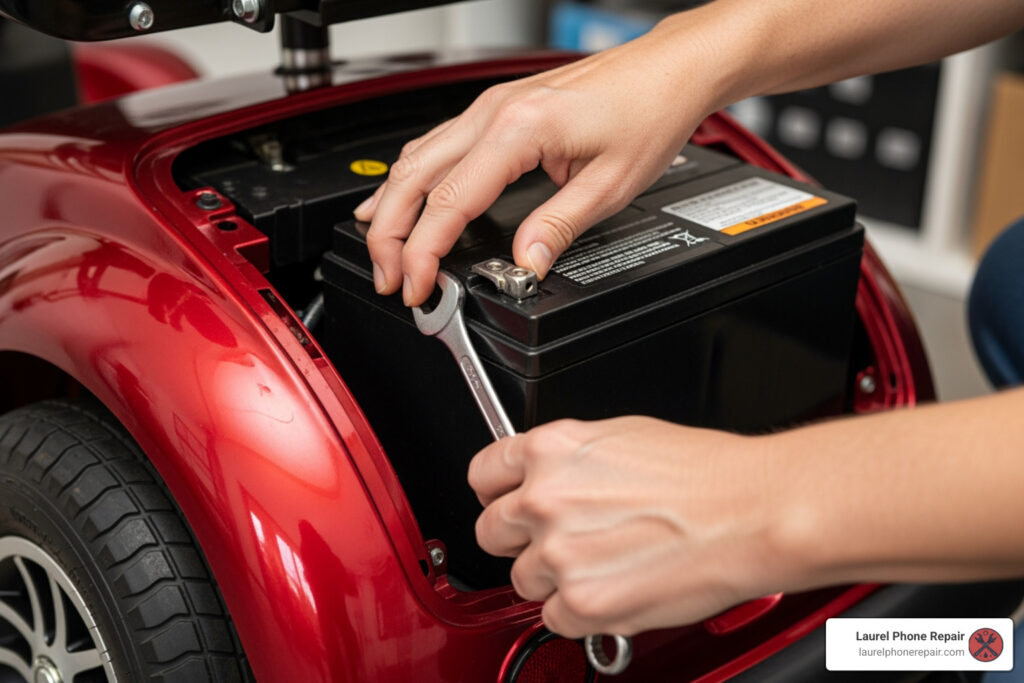
Mobility Scooter Battery Replacement: Top 3 Upgrades
Why Your Mobility Scooter Battery Matters More Than You Think
Mobility scooter battery replacement is essential when your scooter loses range, takes longer to charge, or won’t hold a charge anymore. Here’s what you need to know right away:
Quick Answer: How to Replace Your Mobility Scooter Battery
- Identify your battery type – Most scooters use 12V SLA/AGM batteries (often in pairs for 24V systems)
- Match the specs – Check voltage (12V, 24V), capacity (12Ah-35Ah typical), and physical size
- Choose your chemistry – SLA/AGM batteries cost $50-150 per pair; Lithium batteries cost more ($200-400) but last 4-5x longer
- Replace in pairs – Always change both batteries together, never mix old and new
- Recycle properly – Take old batteries to a recycling center or battery retailer
Average battery lifespan: 1-2 years for SLA/AGM (300-500 cycles), 3-5 years for Lithium (2,000-3,000+ cycles)
Your mobility scooter is your lifeline to independence. Whether you’re heading to the market, visiting neighbors, or attending family gatherings, a failing battery can stop you in your tracks. The good news? Replacing your mobility scooter battery is straightforward, and choosing the right replacement can actually improve your scooter’s performance.
Most scooters use either traditional Sealed Lead-Acid (SLA) batteries or modern Lithium-ion batteries. SLA batteries are affordable and reliable, typically costing $50-150 for a pair, but they’re heavy and last only 300-500 charge cycles. Lithium batteries cost more upfront ($200-400+) but weigh half as much, charge faster, and can last through 2,000-3000+ cycles—that’s 4-5 times longer than traditional batteries.
The replacement process itself is manageable for most users. You’ll need to match your current battery’s voltage (usually 12V), capacity (measured in Amp-hours or Ah), and physical size. Most mobility scooters use two 12V batteries wired together for 24V total power. Small scooters typically use 12Ah-18Ah batteries, mid-size models need 20Ah-35Ah, and heavy-duty scooters may require 50Ah or larger.
I’m Ralph Harris, and with over 20 years of experience in electronics repair, I’ve helped countless customers restore their mobility through proper mobility scooter battery replacement and maintenance. Understanding the right battery choice can transform your scooter’s reliability and your daily independence.
Signs It’s Time for a New Battery
Nobody wants to be stranded with a dead battery. Recognizing the warning signs early can save you a lot of hassle and ensure your mobility scooter remains a reliable companion. Here at Laurel Phone Repair, we’ve seen countless scooters come through our doors in Laurel, Hattiesburg, Jackson, and Jones County, Mississippi, and we can tell you that most battery issues present with clear indicators.
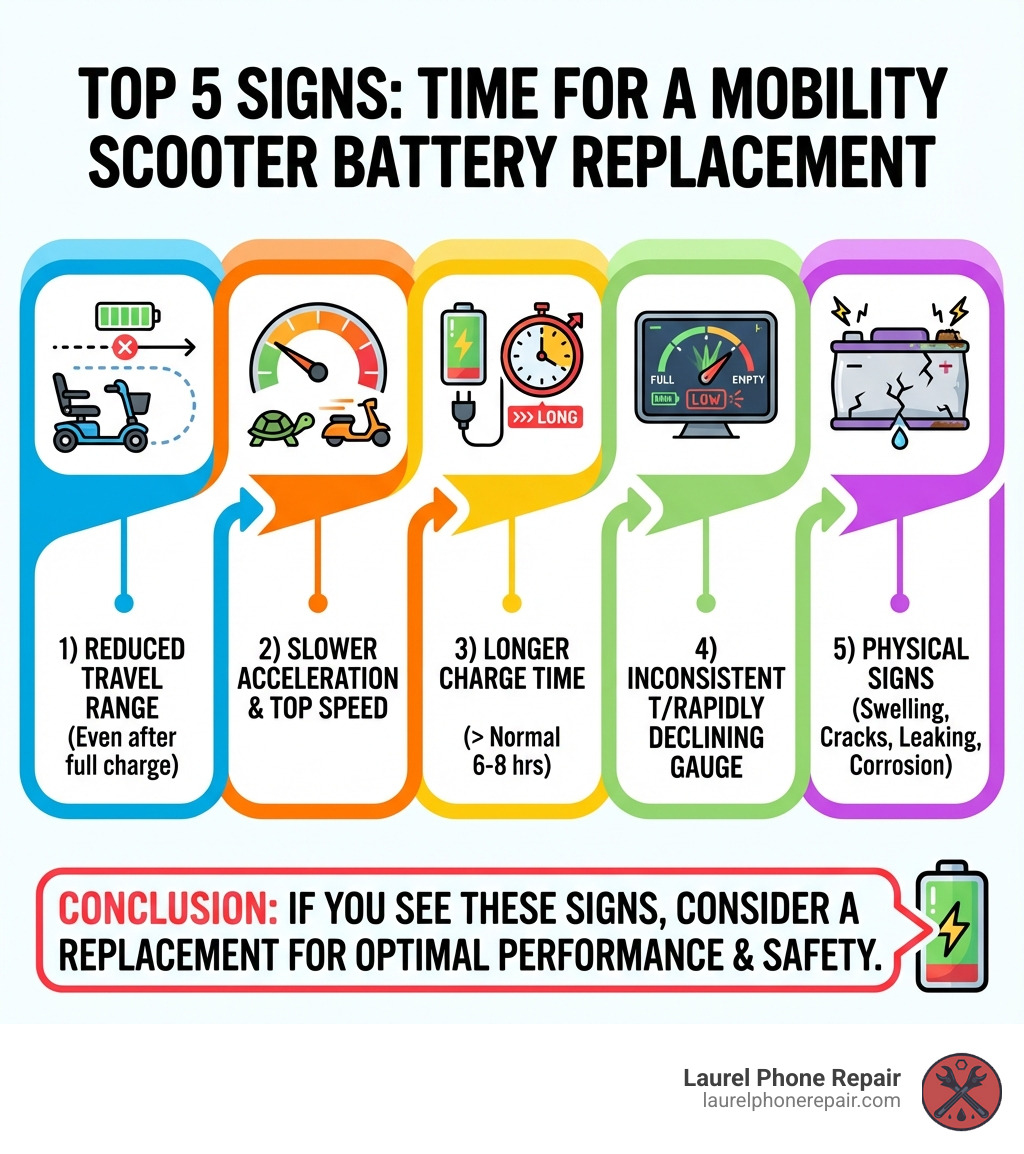
Here are the key signs that your mobility scooter battery needs a mobility scooter battery replacement:
- Reduced Travel Range: This is often the first and most noticeable sign. If your scooter used to take you on long errands but now struggles to make it a few blocks, even after a full charge, your battery’s capacity has likely diminished. The amount of time your scooter runs is decreasing, and that’s a tell-tale sign.
- Slower Acceleration and Speed: Does your scooter feel sluggish? Is it taking longer to reach its top speed, or does it slow down significantly on inclines that it used to handle with ease? A weakening battery struggles to deliver consistent power, making your ride less responsive and slower.
- Takes Too Long to Fully Charge: While charging times vary, if your battery is taking significantly longer than its usual 6-10 hours to reach a full charge, or worse, never seems to reach 100%, it’s losing its ability to accept and hold a charge efficiently. Conversely, if it charges very quickly but then dies just as fast, that’s another red flag.
- Battery Gauge is Unreliable: An inconsistent or rapidly declining battery gauge reading, even after a supposed full charge, indicates that the battery isn’t holding power as it should. It might show full, then drop to half capacity very quickly, or fluctuate wildly.
- Physical Swelling or Leaking: Always inspect your batteries for any physical signs of distress. Swelling, bulging, cracks in the casing, or any visible leakage around the terminals are serious indicators of battery failure and potential safety hazards. If you notice corrosion on the terminals, it could also point to a leak or poor connection.
- Battery is Over 1-2 Years Old: Even with the best care, batteries have a finite lifespan. For traditional SLA/AGM batteries, this is typically 1-2 years or 300-500 charge cycles. If your batteries are within this age range and you’re experiencing any of the above symptoms, it’s definitely time to consider a mobility scooter battery replacement. Newer lithium batteries can last 3-5 years or more, but they too will eventually show wear.
If your scooter seems sluggish, doesn’t start efficiently after a full charge, or shuts down abruptly, it’s time to act. Don’t let a failing battery limit your independence.

Understanding Your Battery Options: SLA, AGM, and Lithium
When it comes to mobility scooter battery replacement, you’ll primarily encounter two main types: traditional lead-acid variants (SLA/AGM/Gel) and modern lithium-ion batteries. Each has its own set of advantages and disadvantages, and understanding them is crucial for making the best choice for your scooter and lifestyle.
Sealed Lead-Acid (SLA) and Absorbent Glass Mat (AGM) Batteries
These are the workhorses of the mobility scooter world, and for good reason. Most mobility scooters, especially older models or those designed for affordability, come equipped with Sealed Lead-Acid (SLA) batteries. Within the SLA category, you’ll most commonly find Absorbent Glass Mat (AGM) batteries, and sometimes Gel Cell batteries.
Advantages:
- Most Common Type: They are widely available and compatible with the majority of mobility scooters.
- Affordable: Generally, SLA and AGM batteries are significantly less expensive upfront than lithium-ion options, typically costing between $50-$150 for a pair.
- Reliable for Standard Use: They provide consistent power output for typical daily use.
- Maintenance-Free: As “sealed” units, they don’t require adding water like older flooded lead-acid batteries. They are delivered charged, sealed, and ready to install.
- Approved for Air Travel: Many AGM batteries comply with IATA/ICAO regulations for transport over land, sea, or air without removal from the chair, making them a good choice for travelers. Interstate Batteries, for example, highlights their compliance with these regulations.
Disadvantages:
- Heavier Weight: SLA/AGM batteries are considerably heavier than their lithium counterparts. This can impact the overall weight of your scooter and potentially reduce its portability.
- Shorter Lifespan: On average, SLA and lead-acid batteries have a lifespan of about 300-500 recharge cycles, which translates to roughly 1-2 years of regular use.
- Requires Regular Maintenance (Charging Habits): While physically maintenance-free, their lifespan is highly dependent on good charging habits. They need to be charged fully after every use and should not be left discharged for extended periods. They also take longer to charge, typically 6-10 hours.
Lithium-Ion (Li-ion) Batteries: The Modern Upgrade
Lithium-ion batteries, particularly Lithium Iron Phosphate (LiFePO4) technology, represent a significant advancement in mobility scooter power. While they might have a higher initial cost, their long-term benefits are compelling.
Advantages:
- Lighter Weight: Lithium batteries are often half the weight of comparable SLA batteries, making your scooter lighter and easier to transport, especially for foldable models.
- Longer Lifespan: This is where lithium truly shines. They boast a lifespan of 2,000-3,000+ recharge cycles, which is 4-5 times longer than SLA/AGM batteries. This often translates to 3-5 years or more of use. Dakota Lithium, for instance, touts 2,000-3,000 cycles for their batteries.
- Faster Charging: Lithium batteries typically charge much faster, often taking only 2-4 hours to reach full capacity.
- Increased Scooter Range and Performance: Thanks to their stable voltage output and higher energy density, lithium batteries can provide twice the run time for your mobility scooter compared to older batteries, leading to greater range and more consistent performance throughout the discharge cycle.
- Maintenance-Free: Similar to sealed lead-acid, lithium batteries require no physical maintenance. They often include a built-in Battery Management System (BMS) that protects against overcharging, over-discharging, and overheating, further extending their life and safety.
Disadvantages:
- Higher Initial Cost: The upfront cost for lithium batteries is significantly higher, typically ranging from $200-$400+ for a pair. However, their extended lifespan can lead to a lower cost of ownership over time.
- FAA travel considerations: While many lithium batteries are designed for travel, the FAA has specific regulations. Any lithium battery for mobility purposes larger than 300 Watt-Hours is generally not in compliance for air travel, and even smaller ones may have restrictions (e.g., a maximum of one spare battery in carry-on baggage). Always check with your airline.
Comparing Battery Types
To help you visualize the differences, here’s a comparison of the key characteristics:
| Feature | Sealed Lead-Acid (SLA/AGM) | Lithium-Ion (LiFePO4) |
|---|---|---|
| Average Cost (Pair) | $50 – $150 | $200 – $400+ |
| Lifespan | 1-2 years (300-500 cycles) | 3-5+ years (2,000-3,000+ cycles) |
| Weight | Heavier | Up to 50% Lighter |
| Charge Time | 6-10 hours | 2-4 hours |
| Performance | Standard range and power | Increased range and consistent power |
| Maintenance | Requires proper charging habits | Virtually maintenance-free |