RC Car Battery Replacement: 5 Easy Upgrades
Why RC Car Battery Replacement Can Transform Your Ride
RC car battery replacement is one of the fastest ways to get more speed, longer run times, and better performance from your vehicle. Here’s a quick look at how to do it:
Quick Steps for RC Car Battery Replacement:
- Identify your current battery type (NiMH or LiPo) and voltage
- Choose a replacement with matching voltage and compatible connector
- Check that the new pack fits your battery tray
- Connect using the correct polarity (red = positive, black = negative)
- Charge with the right charger before use
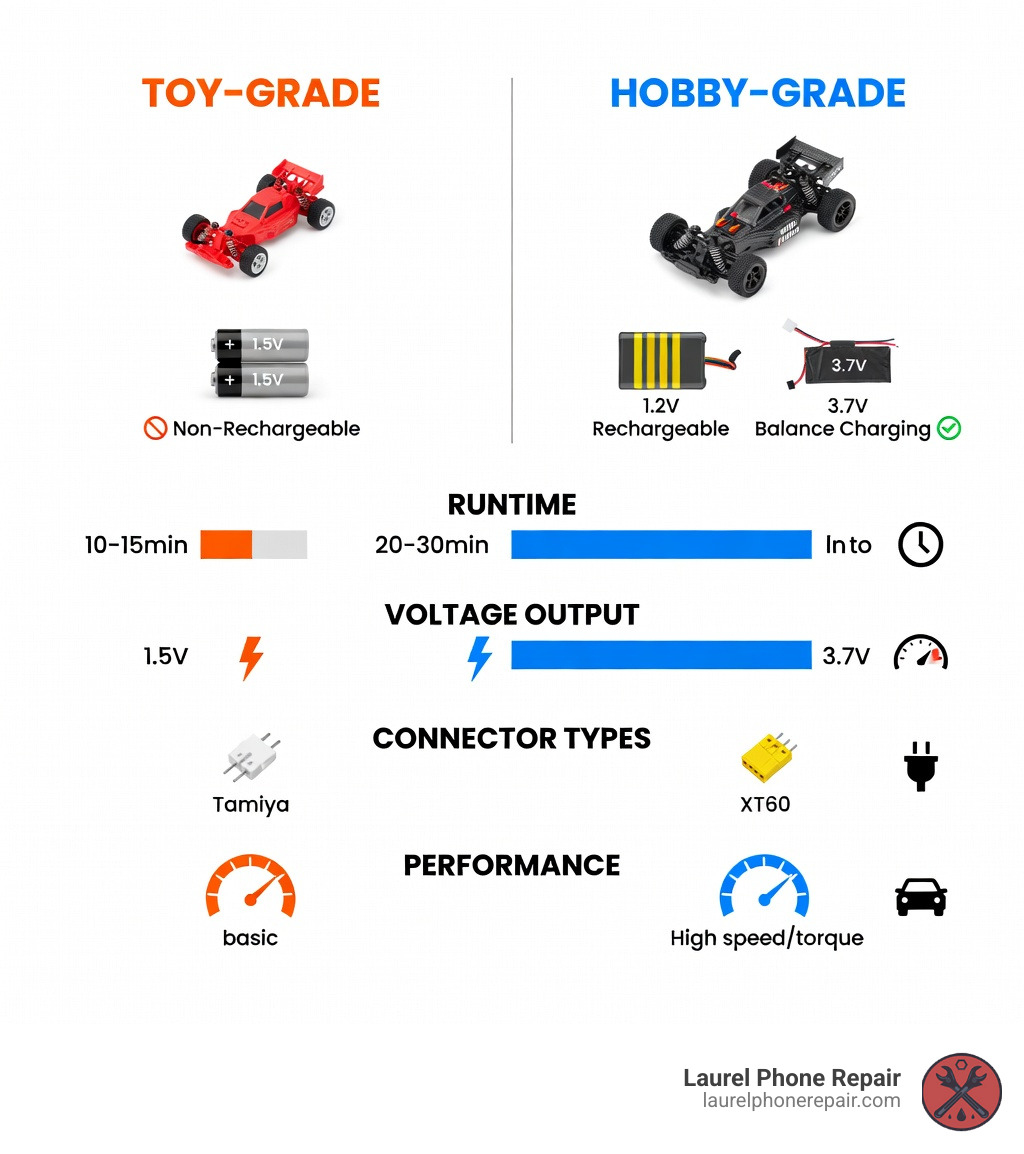
Whether you’ve got a budget toy-grade car running on AA batteries or a hobby-grade machine with a dedicated pack, the right battery swap makes a real difference. RC cars chew through weak batteries fast – and when performance starts to drop, it’s usually the power source to blame.
LiPo (Lithium Polymer) and NiMH (Nickel-Metal Hydride) are the two most common options. Each has trade-offs in safety, weight, and cost that we’ll break down in detail below.
I’m Ralph Harris, an electronics repair specialist with over 20 years of experience and more than 500 device repair certifications – and RC car battery replacement is just one of the many areas where understanding battery chemistry and proper wiring technique makes all the difference. Let’s dig into everything you need to know to upgrade your ride safely.
Quick RC car battery replacement terms:
Understanding Your Power Source: NiMH vs. LiPo
When you dive into RC car battery replacement, you’ll quickly realize that not all batteries are created equal. The two heavy hitters in the hobby are Nickel-Metal Hydride (NiMH) and Lithium Polymer (LiPo). Choosing between them is the first step in any upgrade.
Think of NiMH as the reliable “old school” technology. These packs are rugged, heavy, and very safe. They are great for beginners because they don’t require a lot of special care. On the other hand, LiPo batteries are the high-performance “supercars” of the battery world. They are much lighter and can store significantly more power for the same size, giving your RC car a massive boost in “punch” and speed.
| Feature | NiMH (Nickel-Metal Hydride) | LiPo (Lithium Polymer) |
|---|---|---|
| Safety | Very Safe / Rugged | Requires Care / Fire Risk if Mistreated |
| Weight | Heavy | Light |
| Energy Density | Moderate | High |
| Memory Effect | None | None |
| Voltage Drop | Gradual (slowing down) | Consistent until empty |
| Cost | Budget-friendly | Mid-to-High |
According to Battery Basics, LiPo batteries sustain higher voltage for a longer period during your run. While a NiMH battery will make your car feel slower and slower as the battery dies, a LiPo keeps you at full speed until the very end. If you are looking for a more permanent solution for other devices, you might also be interested in more info about battery repair services we offer for everyday electronics.
Performance and Weight Differences
The difference in “punch” is real. NiMH cells are rated at 1.2V per cell, while LiPo cells are 3.7V nominal. Because LiPo batteries have a much better weight-to-power ratio, your car doesn’t just have more power—it’s also carrying less “dead weight.” This means better jumps, faster cornering, and higher top speeds. If you’re racing in Laurel or Hattiesburg, that weight difference can be the gap between first and second place.
Safety and Durability Considerations
NiMH batteries are incredibly beginner-friendly. You can drop them, bump them, and charge them with a standard charger without much worry. LiPo batteries, however, are sensitive. If they are punctured or overcharged, they can enter “thermal runaway,” which is a fancy way of saying they might catch fire. This is why we always recommend using fire-retardant bags during charging and storage. Always check Battery Basics for the latest safety protocols to keep your home in Jackson or Jones County safe.
Choosing the Right Specs for an RC Car Battery Replacement
Before you buy a new pack, you need to read the label. Getting the wrong specs for an RC car battery replacement can do more than just make your car slow—it can actually fry your electronics. If you’re worried about the cost of making a mistake, you can learn about battery replacement costs for various devices to see why doing it right the first time is so important.
Determining Voltage and Capacity for RC Car Battery Replacement
Voltage (V) equals speed. Capacity (mAh) equals runtime.
- Voltage: Most 1/10 scale cars use a 2S (7.4V) or 3S (11.1V) LiPo configuration. If your car was designed for a 7.2V NiMH, a 2S LiPo is a perfect match. Jumping to a 3S might give you insane speed, but check your ESC (Electronic Speed Controller) compatibility first. Over-volting can lead to permanent motor damage.
- Capacity: Measured in milliamp-hours (mAh). A 5000mAh battery will technically last twice as long as a 2500mAh battery. However, larger capacity usually means a physically larger and heavier battery. Make sure the dimensions fit your car’s battery tray!
Matching Connectors for Your RC Car Battery Replacement
The connector is the “plug” that connects the battery to the car. Common types include:
- Tamiya: The classic white plug. Good for low power, but they can melt under high heat.
- XT60/XT90: Very popular, high-efficiency gold-plated connectors.
- Deans (T-Plug): A compact favorite for many hobbyists.
- Traxxas iD / IC3: Specialized connectors that often include “Smart” technology to help the charger recognize the battery.
Avoid using too many adapters. Every adapter adds resistance, which creates heat and slows you down. It’s always better to solder the correct connector directly onto your ESC.
Understanding Discharge Ratings (C-Rating)
The “C-Rating” tells you how fast the battery can safely discharge its energy. A 30C battery is fine for a slow-moving rock crawler, but a high-speed “basher” or racing truck might need 50C or even 100C to handle the burst current required for big jumps and fast starts.
Step-by-Step Guide to RC Car Battery Replacement and Upgrades
Ready to get your hands dirty? For this RC car battery replacement or upgrade, you’ll need a few tools: a soldering iron, a Dremel tool (if you need to modify the chassis), a multimeter, wire strippers, and some heat shrink tubing. For more complex vehicle battery setups, you can always refer to a Car and Truck Battery Replacement Guide, though RC cars are much smaller and simpler!
Modifying the Chassis and Mounting
If you’ve bought a high-capacity battery that’s a bit too big for your tray, don’t panic. Many hobbyists use a Dremel to trim plastic tabs or expand the battery tray. If you’re working on a cheap toy-grade car, you can even mount a new battery in the spare tire space or on top of the chassis. Just remember: weight distribution matters. Try to keep the battery centered and low to prevent the car from flipping in corners. Use velcro straps or foam padding to make sure the battery doesn’t jiggle around—a loose battery is a damaged battery.
Wiring and Soldering Safety
This is where things get serious.
- Identify Polarity: Red is Positive (+), Black is Negative (-).
- Tinning: Apply a small amount of solder to both the wire and the connector terminal before joining them. This makes a much stronger bond.
- One at a Time: If you are changing a connector on a battery (which we don’t recommend for beginners), NEVER cut both wires at the same time. This will cause a short circuit, sparks, and potentially a fire.
- Insulate: Always slide your heat shrink tubing onto the wire before you solder. Once the joint is cool, slide it over the metal and shrink it with a heat gun or lighter to prevent shorts.
Identifying Terminals and Testing
Before you plug everything in, use a multimeter to check the voltage and ensure your polarity is correct. If you see a “minus” sign on your multimeter, your leads are backward! Once confirmed, do a “bench test.” Prop the car up so the wheels are off the ground, turn on the transmitter, and then plug in the battery. Give it a small amount of throttle to ensure everything is spinning the right way.
Safety First: Charging and Maintenance Best Practices
Charging is when most battery accidents happen. Whether you are in Laurel or Jackson, safety should be your top priority.
- Use a LiPo-Compatible Charger: Never, ever use a NiMH charger on a LiPo battery. It will cause the battery to swell and catch fire.
- Balance Charging: Always use the “Balance” function. This ensures that every cell in the battery (e.g., both cells in a 2S pack) is at the exact same voltage.
- The 1C Rule: Generally, charge your battery at “1C.” If you have a 5000mAh battery, charge it at 5.0 Amps. Charging faster can shorten the battery’s life.
- Never Leave Unattended: Always stay in the same room while charging.
Proper Storage and Longevity
If you aren’t going to use your RC car for more than a few days, you must put your batteries into “Storage Mode.” A LiPo battery should be stored at roughly 3.8V per cell (about 50% charge). Storing a LiPo fully charged or fully depleted will cause it to “puff” or lose capacity. Keep them in a cool, dry place. A quick monthly check on their voltage will help them last for years.
Handling Damaged or Swollen Packs
If your battery looks like a bag of potato chips—swollen or “puffed”—it’s time to say goodbye. Swelling is a sign that the internal chemistry has broken down and gas has built up.
- Stop using it immediately.
- Do not attempt to “pop” the swelling.
- Place it in a fire-safe container.
- To dispose of it, many hobbyists submerge the battery in a bucket of salt water for several days to fully discharge it before taking it to a local recycling center in Mississippi.
Troubleshooting Common Battery Issues
Is your car acting up? Here are some common power-related problems:
- Voltage Drop: If your car cuts out during hard acceleration, your battery might not have a high enough C-rating, or the battery is reaching the end of its life.
- Charger Errors: “Connection Break” usually means a wire is loose in your connector. “Cell Voltage Error” means one cell is much lower than the others—often a sign of a failing pack.
- Overheating: If the battery is hot to the touch after a run, you are pushing it too hard. Consider a higher C-rating or check for mechanical binding in your car’s drivetrain.
For those interested in how larger vehicle batteries compare, checking out a Car and Truck Battery Replacement Guide can provide perspective on how different scales of power systems are managed.
Frequently Asked Questions about RC Car Batteries
Can I put a LiPo battery in a car that came with NiMH?
Yes, usually! However, you must ensure your ESC has a “Low Voltage Cutoff” (LVC). LiPo batteries can be damaged if their voltage drops too low. If your ESC doesn’t have this feature, you can buy a cheap “LiPo Alarm” that plugs into the battery’s balance lead.
Why is my RC car battery getting hot during use?
A little warmth is normal, but “hot” is bad. This usually means the motor is drawing more current than the battery can safely provide. Upgrading to a battery with a higher mAh or C-rating often solves this.
How long does a typical RC car battery last?
With proper care (storage charging and balance charging), a LiPo battery can last 200–300 cycles. A NiMH battery can last even longer but will eventually lose its “punch.”
Conclusion
Mastering RC car battery replacement is the “secret sauce” to taking your hobby to the next level. Whether you’re looking for a simple speed boost in Jones County or trying to win a local race in Hattiesburg, the right power setup makes all the difference. Remember to prioritize safety, match your connectors carefully, and always use a balance charger for LiPo packs.
At Laurel Phone Repair, we love all things tech. While we specialize in phones, tablets, and computers, we understand the thrill of a DIY upgrade. If you’ve got other gadgets that need a power boost—from phones to specialized electronics—our experienced technicians are here to help with transparent options and high-quality parts. Schedule your battery repair today and let’s keep your gear running at peak performance!